


Category: Middle East, World Affairs Topics: Baghdad, Iraq, Karbala, Saddam Hussein Views: 3809
3809
Heading Toward an Historic Mistake



 |
|
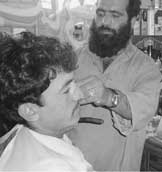
An Afghan having a shave in a barber shop |
Following the fall of the Taliban, Afghans started shaving their beards. Following the fall of Saddam Hussein, Iraqis are growing theirs.
The sudden and unmistakable assertion of majority Shiite religious and political identity is the least expected outcome for America of the Iraq war.
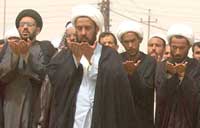
The remarkable pilgrimage by about 1 million faithful, including women, to the holy cities of Najaf and Karbala is the first real symbol of post-Saddam Iraq. It is of far more importance than the photo-op toppling of his statue in Baghdad.
What made it even more potent was its anti-American undercurrent.
But its message was no different than the one emerging from the other segments of the diverse Iraqi nation: "Thank you for freeing us from Saddam but now, please, go home."
Can anyone recall a time in history when the liberators of an oppressed people outlived their welcome in so short a period?
Sure, some of the anti-Americanism is the ideological flag of one or the other of the Iraqi factions competing for power. Some may even be the work of the agents or supporters of Iran.
But there is no mistaking the indigenous unease against the foreign occupation.
Long before the bombs fell, Iraqis knew that their country would not have been targeted had it been a major producer of, say, corn rather than oil.
What they have seen since, and like even less, are the early manifestations of the American agenda.
They see sufficient troops and tanks protecting the oil fields of the south and the north, even the oil ministry in Baghdad - a reasonable precaution in itself - but none for the national museum and rare libraries.
They see the Pentagon airlifting the Iraqi exile Ahmed Chalabi, its puppet, as their next ruler. They see American troops guarding him and training his hastily assembled militia of 600; but none for the most basic policing for urban areas.
They see President George W. Bush rule out the United Nations as a neutral referee to usher in the dawn of the promised democracy.
Various groups, not Shiites alone, have therefore been grabbing what turf they can and asserting their political presence.
Some stepped in to provide food and medicine and to restore law and order. The most poignant stories during the days of chaos and confusion came from mosques, where clerics shamed the faithful into returning looted goods and behaving better with fellow human beings - of all faiths.
The mullah of a minority Sunni mosque in Baghdad invited the Shiites for last Friday's communal prayers, a rare ecumenical act. After the service, both groups called for the occupiers to depart. More >>
 |
The Shiites are clearly leading the anti-American charge, for two reasons: It's a branding exercise for some in the power struggle between several factions, and, regardless of group, all saw democracy as their chance at ending decades of discrimination but feel the fix is in against them.
They are being tainted by Americans with the Islamic and Iranian brush.
Islamic most of them are. Secular elements, such as the one represented by Chalabi, are mostly imported. It turns out that Saddam's persecution of Shiites made them more religious.
But penalizing them for their faith is like barring Bush or Stockwell Day from contesting elections.
Shiites are the minority sect of Islam but they form the majority in Iran and Iraq and have a natural affinity for each other. But their differences go beyond geography.
Their most fundamental theological difference is over political activism. Its most fervent advocate was the late Ayatollah Ruhollah Khomeini, and its opponent is the current leading Iraqi cleric, Grand Ayatollah Ali-Sistani of Najaf.
The latter has been unhappy at how oppressive the Iranian model turned out to be.
Clerics active in politics are themselves divided between hardliners and moderates - as in Iranian supreme religious leader, Ayatollah Syed Khameini vs. President Mohammed Khatami. These differences are reflected in Iraq as well.
Iraqi Shiites are further divided among those who struggled under Saddam's tyranny and those who fled it. Among the exiles, the ones from Iran are more acceptable than those from the West.
Yet America has distanced itself from most religious Shiites.
And Defense Secretary Donald Rumsfeld has lately been complaining of Iranian interference. (If outsiders have a right to influence events in Iraq, shouldn't neighboring Iranians be well ahead of Americans in the line?)
The leading Iraqi Shiite leader most linked to Iran is Ayatollah Mohammed Bakr al-Hakim. He has been living in Tehran for nearly 20 years. As part of the Iraqi National Congress umbrella, he has had contact with the Bush administration. But, lately, he has been shunned.
He responded by boycotting the meetings of potential leaders being orchestrated by the Americans. He also called on pilgrims to Najaf and Karbala to turn the event into a demonstration against America. Many did.
Another leading group is also sitting out the consultative process.
Hakim and other Shiites have signed on to a pluralistic Iraq, with respect for majority religion as well as minority rights for the Sunnis and Kurds. We need to hold their feet to the democratic fire.
Shunting them aside, or letting them conclude that the promised democratic process is a sham, is to push them into active resistance.
Given that five factions - two Shiite, two Kurdish and one pro-American - have militias, a la Afghan warlords, the hope for a peaceful transition fades.
This is no time to be making historic mistakes.
Haroon Siddiqui is The Toronto Star's editorial page editor emeritus.
Related Suggestions


Older Comments:
L4V1TZ said:
Seems like not much has changed since 2003. I wonder what future awaits the Iraqis.
Iraq has been a mess for centuries.
2016-01-30
AZIZ FROM INDIA said:
The Muslims should be united against any forcoming trouble,because the background of Islam has been dirty due to some worthless islamic followers.
This is the time to stand out itself against terrorism and save the haritage of our forfathers, because they has had alot of sacrify to spread it throughout the world. (Not with the pressure of Sword, but with beauty of human kind).
Regards.
Aziz Akhtar
azizakhtar
This is the time to stand out itself against terrorism and save the haritage of our forfathers, because they has had alot of sacrify to spread it throughout the world. (Not with the pressure of Sword, but with beauty of human kind).
Regards.
Aziz Akhtar
azizakhtar
2003-08-07
ABDUR RAZZAQ FROM USA said:
Yahya: As Salaamu Alaik.
I have personally changed my stance on the war, and although we know the US invaded for their own reasons, it appears Allah will bless the Iraqi people with some good for their patience. It reminds me of the treaty of Hudaybiyah when the Muslims were turned back from making Umrah, and the treaty signed looked like a devastating humiliation for Islam, and Umar and others were upset. Allah revealed verses from Surah Al-Fath, indeed assuring victory to the Muslims and, after a small period of time, the Conquest of Makkah occurred.
I also agree that we need more unity. But I cannot be supportive of the Shirk and Bid'ah being practiced by the Shi'a which breech at least 5 commands of Allah and his messenger that I can think of off the top of my head. For Muslims to unite and progress, we need to clean up our Aqeedah, individually, a begin building the Ummah from the pure, sincere, proper worship of our Lord. That is the way Islam was build by the Rasoolullah, and after the Muslims left these principles, time and time again, the Muslims suffered. So may the Shi'a return to the correct practice of Al-Islam, and may we all taste the Love of Allah and His Victory. Ameen
I have personally changed my stance on the war, and although we know the US invaded for their own reasons, it appears Allah will bless the Iraqi people with some good for their patience. It reminds me of the treaty of Hudaybiyah when the Muslims were turned back from making Umrah, and the treaty signed looked like a devastating humiliation for Islam, and Umar and others were upset. Allah revealed verses from Surah Al-Fath, indeed assuring victory to the Muslims and, after a small period of time, the Conquest of Makkah occurred.
I also agree that we need more unity. But I cannot be supportive of the Shirk and Bid'ah being practiced by the Shi'a which breech at least 5 commands of Allah and his messenger that I can think of off the top of my head. For Muslims to unite and progress, we need to clean up our Aqeedah, individually, a begin building the Ummah from the pure, sincere, proper worship of our Lord. That is the way Islam was build by the Rasoolullah, and after the Muslims left these principles, time and time again, the Muslims suffered. So may the Shi'a return to the correct practice of Al-Islam, and may we all taste the Love of Allah and His Victory. Ameen
2003-05-03
YAHYA BERGUM FROM USA said:
Is it wrong when a non-Muslim invasion enables millions to resume a pilgrimage to sacred cities? Praise be to Allah - who alone is deserving of thanks and praise.
2003-05-03
N. AHMAD FROM CANADA said:
I AM VERY DISAPPOINTED IN THIS OVERALL REPORT, DUE TO THE FACT THE MUSLIMS ARE STILL NOT UNITED BY DIFFER THEMSELVES SHITES OR SUNNIES WHEN WE ARE GETTING ATTACKED. THE LAST TIME I CHECKED WE ARE FROM THE SAME TREE DIFFERENT BRANCH.LET'S PUT OUR DIFFERENCES ASIDE AND WORK OUT A SOLUTION TO STOP GETTING ATTACKED BY NON MUSLIMS WHO FIND A EASY SOLUTION TO SEPARATE US.......
2003-05-01
SULAYMAN JALLOW FROM USA said:
I do believe that the majority of the Iraqi people are for the removal of Saddam.I have lived in the US and very impress of their system at home.I therefore hope that they will not only allow Iraq to choose and create their own system and not to impose what they believe is right on others. The Iraqi people must be left alone to create what ever they want as all great nations have done over the years. In short, America should get out of Iraq and leave their oil fields intact.
2003-04-29
OWEN JUBANDANG FROM USA said:
Diivide et Impala (or divide and conquer in English) was the Roman emblem that enabled it to conquer its bitterest enemies. America i s the new Rome. The USA has suceeded in quashing dissenting groups in Saudia Arabia, a relatively homogenous country. What makes the author think that the USA will not suceed in Iraq, a country with three distinct religio-ethnic groups - shia, Sunni, and Kurd. As long as the Muslim world remains divided in itself, I predict no difficulty for the USA to rule over these people.
2003-04-29
YAHYA BERGUM FROM USA said:
White House press secretary Ari Fleischer said Monday that Washington would welcome an ISLAMIC DEMOCRACY but "not an Islamic theocracy like Iran." President Bush said his administration "has no intention of imposing our form of government or our culture."
Here, then, are a few random thoughts. In most DEMOCRATIC nations, appointments to the national court systems are generally made for life. Thereafter, the "justices" are for the most part no longer subject to the political process, in other words, not subject to the whims of politicians and their constituents.
Also, national courts typically have the ability to rule on the "legality" of policies established by other branches of government. Therefore, a nation's submission to Allah might be something assured by a nation's court system. While I don't know all that much about the Shia system, it does seem like the Shiite "clerics" might be fairly well suited for judicial responsibilities - Insha'Allah.
As Salaamu Alaikum.
Here, then, are a few random thoughts. In most DEMOCRATIC nations, appointments to the national court systems are generally made for life. Thereafter, the "justices" are for the most part no longer subject to the political process, in other words, not subject to the whims of politicians and their constituents.
Also, national courts typically have the ability to rule on the "legality" of policies established by other branches of government. Therefore, a nation's submission to Allah might be something assured by a nation's court system. While I don't know all that much about the Shia system, it does seem like the Shiite "clerics" might be fairly well suited for judicial responsibilities - Insha'Allah.
As Salaamu Alaikum.
2003-04-29
YAHYA BERGUM FROM USA said:
Alhamdulillah. I have approximately 40 booklets on Islam around my household. These booklets address various subjects, while sharing certain things in common. For example, they quote from the Quran. In some cases they also quote from Ahadith and Tafsir. Should I be ignoring these booklets because I have copies of the Quran on hand?
Please note that the U.S. Constitution is typically printed in the form of a booklet. It is actually less detailed than some of the booklets on Islam. Why could someone not adapt a booklet that describes Islamic rule, by making sure the text sounds formal and including the word "Constitution" in the title?
Perhaps renaming the work "Islamic Rule For Dummies (Peace Be Upon Them)" might even help to promote its use among non-Muslims - for "team-building" throughout the Middle East and elsewhere. Insha'Allah.
As Salaamu Alaikum.
Please note that the U.S. Constitution is typically printed in the form of a booklet. It is actually less detailed than some of the booklets on Islam. Why could someone not adapt a booklet that describes Islamic rule, by making sure the text sounds formal and including the word "Constitution" in the title?
Perhaps renaming the work "Islamic Rule For Dummies (Peace Be Upon Them)" might even help to promote its use among non-Muslims - for "team-building" throughout the Middle East and elsewhere. Insha'Allah.
As Salaamu Alaikum.
2003-04-28
MUHAMMED FROM CANADA said:
I have never seen such blantant censorship as such that is found on iviews.com.
I post a comment that opposes the views held by the author of the article and it doesn't even make it to the comments page. I sincerely hope it's just that it takes a really long time to get written to the comment database, otherwise I would say this site is more a anti-American propaganga machine than an open forum for the exchange of ideas and beliefs.
I post a comment that opposes the views held by the author of the article and it doesn't even make it to the comments page. I sincerely hope it's just that it takes a really long time to get written to the comment database, otherwise I would say this site is more a anti-American propaganga machine than an open forum for the exchange of ideas and beliefs.
2003-04-28
SZYMON SMAKOLSKI FROM USA said:
What kind of one-sided story is this?
Why is it that everyone brings up the troops that guard oil wells. Remember the Gulf War? Remember the ecological CATASTROPHE? What could possibly be wrong with trying to prevent something like that from happening again? It's not like the troops are there draining the oil into their own tanker trucks and shipping it to America. Before you go citing how oil-greedy America is, go consult OPEC on how they feel the war in Iraq is affecting their control over oil reserves, you uninformed excuse for an online-author.
Why is it that everyone brings up the troops that guard oil wells. Remember the Gulf War? Remember the ecological CATASTROPHE? What could possibly be wrong with trying to prevent something like that from happening again? It's not like the troops are there draining the oil into their own tanker trucks and shipping it to America. Before you go citing how oil-greedy America is, go consult OPEC on how they feel the war in Iraq is affecting their control over oil reserves, you uninformed excuse for an online-author.
2003-04-28
AHMED FROM USA said:
Some here ask why can't Iraq write up a constitution to protect all? For your information, Iraq is a 99% Muslim country and all Muslim countries ALREADY have a constitution written up. A perfect constitution, and that is the Qur'an and the Sunnah of the Prophet (saw). The problem is most Muslims do want to see it implemented but the West with few of their cronies do not want to see this happen. Look at what happened to Algeria when they introduced the free elections and the military backed by France and USA negated the election after the people there chose the Islamic party. Look what the Iraqis are saying now vs. what Rumsfeld is saying. Look at the puppet governments supported by the West that are suppressing Islam that is being seeked by their people.
This battle will go on for a long time till Islam prevails. Allah (swt) promised in His Constitution (Qur'an).
This battle will go on for a long time till Islam prevails. Allah (swt) promised in His Constitution (Qur'an).
2003-04-28
ABDUL FROM USA said:
As-salamu-alakum (Peace be upon you):
Mr. Andrews you wrote why don't Iraq write up an constitution like the United States have? Well the problem with a constitution is that in Islam we already have one. It is called the Quran and the Sunnah of the Prophet Muhammad (SAW).
The problem with a constitution (in the USA case) is that it is an ever changing document. Why does it change? Because in a democracy majority rules. For example alcohol was once forbidden in the USA but as majority lusted for it,alchohol became legal.
The Quran is final. No addtions/subtractions have or will ever be made to it (Inshallah). The laws laid down in the Quran are from Allah and who better to tell mankind how to run a perfect society than God (Glory be to Him).
Mankind weakness is its lusts. We lust for money, power, material things, etc. but Allah is above all wants and needs.
Lets be honest, what the USA wants is a puppet. Some ruler they can control behind the scences. Unfortunately there is too many puppets in the world today. 5% of the world population (USA) consumes more than 60% of the WORLD resources. This is inhumane and unfair.
What the Iraqi people want is an Islamic State. To put any government in place that is not what the Iraqi people want is the same as having Sadam back in power. All the US would do is trade one dictator for another, preferably one they can control.
Mr. Andrews you wrote why don't Iraq write up an constitution like the United States have? Well the problem with a constitution is that in Islam we already have one. It is called the Quran and the Sunnah of the Prophet Muhammad (SAW).
The problem with a constitution (in the USA case) is that it is an ever changing document. Why does it change? Because in a democracy majority rules. For example alcohol was once forbidden in the USA but as majority lusted for it,alchohol became legal.
The Quran is final. No addtions/subtractions have or will ever be made to it (Inshallah). The laws laid down in the Quran are from Allah and who better to tell mankind how to run a perfect society than God (Glory be to Him).
Mankind weakness is its lusts. We lust for money, power, material things, etc. but Allah is above all wants and needs.
Lets be honest, what the USA wants is a puppet. Some ruler they can control behind the scences. Unfortunately there is too many puppets in the world today. 5% of the world population (USA) consumes more than 60% of the WORLD resources. This is inhumane and unfair.
What the Iraqi people want is an Islamic State. To put any government in place that is not what the Iraqi people want is the same as having Sadam back in power. All the US would do is trade one dictator for another, preferably one they can control.
2003-04-27
HYAT FROM CANADA said:
That is precisely what the US wanted, to turn Muslims against each other. That would make them look the better. They (Americans) would always have reasons to control the Middle East by pretending that they are helping the oppressed help, when it is the Americans who are really oppressing them. But do the Arabs see that? Why can't the Muslims whether they are Shiite or Sunni come together like the Quran ordered us to? Follow the Islamic monotheism, live and govern together as one nation. Like they did at the time of Prophet Mohammed SAS. Make history that way, be the ambassadors that we are supposed to be. By setting good examples for the other nations instead of looking like idiots and morons. And get those thieves of our backs out off our lands and riches. I keep dreaming that day will come while I am still alive.
2003-04-27
MUHAMMED FROM W. NORTEO said:
It is possible that Iraqi religious revival and unity is being tolerated (or even covertly encouraged) by the Americans to fill the power vacuum that has developed in Iraq, and to prevent a sectarian bloodbath.
However, it is more likely that the Bush administration miscalculated, and hoped to control Iraq that by using a "divide and conquer" strategy, similar to the one they employed in Afghanistan.
The people of Iraq have faced down many invaders through their long history, and were, for a long time at the center of Muslim civilization.
Bush, because sycophants and neo-conservative Zionist warmongers surround him, did not understand the dynamics of Iraq as explained by the author, instead wearing his ignorance on his sleeve, and dismissing those with knowledge about Iraq as irrelevant multiculturalists. The Neocon cabal, blinded by its notions of racial superiority also failed to recognize that the Iraqis are not merely primitive "goyim" who could be easily controlled but wily people with a rich history and pride.
This war for Israel and oil will end badly for America, and Muslims may yet be grateful for an enemy as ignorant, clumsy and foolish as George W. Bush.
However, it is more likely that the Bush administration miscalculated, and hoped to control Iraq that by using a "divide and conquer" strategy, similar to the one they employed in Afghanistan.
The people of Iraq have faced down many invaders through their long history, and were, for a long time at the center of Muslim civilization.
Bush, because sycophants and neo-conservative Zionist warmongers surround him, did not understand the dynamics of Iraq as explained by the author, instead wearing his ignorance on his sleeve, and dismissing those with knowledge about Iraq as irrelevant multiculturalists. The Neocon cabal, blinded by its notions of racial superiority also failed to recognize that the Iraqis are not merely primitive "goyim" who could be easily controlled but wily people with a rich history and pride.
This war for Israel and oil will end badly for America, and Muslims may yet be grateful for an enemy as ignorant, clumsy and foolish as George W. Bush.
2003-04-27
YAHYA BERGUM FROM USA said:
If Islamists stopped shouting "Death to U.S." Insha'Allah the U.S. military might try drafting a "sample" constitution that conforms to Islamic code - as a part of a "test" for Middle Eastern contingency planning. Get a clue already. Think about looping a small rope through that funny looking ring (hanging from the bull's nose). Who knows? Allah might have even more surprises in store for us in Iraq and elsewhere - Insha'Allah.
Suggestion: the U.S. Supreme Court has authority to invalidate any law passed Congress - if determined to be in conflict with the U.S. Constitution. If Iraq's Constitution conformed with Islamic law then would that in some way satisfy the basic concerns of Islamists? So throw the poor U.S. military forces a bone already.
Suggestion: consider separating a Muslim's duties to the community from a Muslim's duties to themselves. For example, determine what parts of a Muslim's dress code helps to keep the community away from sin and what parts (merely) keep the individual from sin. Why not give "polytheists" the ability to enjoy the benefits of Islamic law?
Suggestion: think about keeping individual stuff out of the constitution - that is what "bida patrols" are for. Make the constitution say that members of organized religions are assured the right to "be ministered to" by authorized parties from their own religion. This actually makes the "individual stuff" (of Islam) assured by the constitution - but for Muslims.
These are merely suggestions. Please consider inviting the infidel to Islam before fighting him. Who knows what might happen? (Allah knows what is best.) Muslims have a duty to invite others to Islam - do we not?
As Salaamu Alaikum.
Suggestion: the U.S. Supreme Court has authority to invalidate any law passed Congress - if determined to be in conflict with the U.S. Constitution. If Iraq's Constitution conformed with Islamic law then would that in some way satisfy the basic concerns of Islamists? So throw the poor U.S. military forces a bone already.
Suggestion: consider separating a Muslim's duties to the community from a Muslim's duties to themselves. For example, determine what parts of a Muslim's dress code helps to keep the community away from sin and what parts (merely) keep the individual from sin. Why not give "polytheists" the ability to enjoy the benefits of Islamic law?
Suggestion: think about keeping individual stuff out of the constitution - that is what "bida patrols" are for. Make the constitution say that members of organized religions are assured the right to "be ministered to" by authorized parties from their own religion. This actually makes the "individual stuff" (of Islam) assured by the constitution - but for Muslims.
These are merely suggestions. Please consider inviting the infidel to Islam before fighting him. Who knows what might happen? (Allah knows what is best.) Muslims have a duty to invite others to Islam - do we not?
As Salaamu Alaikum.
2003-04-27
JANE DIANE ANDREWS FROM USA said:
Why can't Iraq write up a constitution? Here in the United States our citizens are protected from Discrimination of one's Religion, Race, Sex, Etc... We are guaranteed freedoms of speech, Religion, etc...
Because our elected officials must swear to uphold the Constitution we are protected from any leader doing anything illegal ranging from imposing tyranny to just something as small as to lie under oath to a grand jury.
If all parties involved would start writing up drafts of a constitution and refine it to become an agreed upon document beneficial for all and would protect rights of the people, then no matter who finally got elected to lead the country, there would be no chance that he could do something to hurt those that he has sworn to protect.
Of course there is the issue of electing judges to uphold the law, but if these judges are held to the strict guidelines of this Constitution then there will never be a person tortured in a prison in Iraq ever again. And if any official or citizen, on there own, decided to hurt anyone else there would be legal recourse for the victim and there family to get justice.
What a bright future Iraq has. Maybe someday I will get to go there and have an enjoyable vacation with my family. Allah be praised.
Because our elected officials must swear to uphold the Constitution we are protected from any leader doing anything illegal ranging from imposing tyranny to just something as small as to lie under oath to a grand jury.
If all parties involved would start writing up drafts of a constitution and refine it to become an agreed upon document beneficial for all and would protect rights of the people, then no matter who finally got elected to lead the country, there would be no chance that he could do something to hurt those that he has sworn to protect.
Of course there is the issue of electing judges to uphold the law, but if these judges are held to the strict guidelines of this Constitution then there will never be a person tortured in a prison in Iraq ever again. And if any official or citizen, on there own, decided to hurt anyone else there would be legal recourse for the victim and there family to get justice.
What a bright future Iraq has. Maybe someday I will get to go there and have an enjoyable vacation with my family. Allah be praised.
2003-04-27
CONCERNED FROM US said:
i may be wrong, but i doubt it. a democracy with an islamic flavor means that the majority is whoever wants to do what Allah and His messenger says to do, not the majority in a numerical sense (west). so please when explaining this to others make this clear. we are not non-muslims, we are muslims. if any form of democracy is to come to iraq it should be, that which is established by the qur'an and sunnah.
2003-04-27
KOVIT FROM CANADA said:
Here comes Islam!
If the real reason for the US/UK to invade Iraq was the Democracy, then that is what they are going to get. But it looks as if Bush and Blair want to replace the old dictator by another dictator that listens to its master, becareful! these people are not fighting like the Republical guards of Saddam (that was too exaggerated to use for propaganda). Soon the power hungry US/UK will have to pay the price.
In this case I'd like US/UK to invade Egypt to implement "democracy". Most of these Muslim Countries if they were given a choice rather than recieved hand picked leaders by the US would have true democracy and choose to have an islamic state rather than these joke of a leaders placed by US.
If the real reason for the US/UK to invade Iraq was the Democracy, then that is what they are going to get. But it looks as if Bush and Blair want to replace the old dictator by another dictator that listens to its master, becareful! these people are not fighting like the Republical guards of Saddam (that was too exaggerated to use for propaganda). Soon the power hungry US/UK will have to pay the price.
In this case I'd like US/UK to invade Egypt to implement "democracy". Most of these Muslim Countries if they were given a choice rather than recieved hand picked leaders by the US would have true democracy and choose to have an islamic state rather than these joke of a leaders placed by US.
2003-04-26
BOB FROM USA said:
Is it not nice to be able to voice ones opinion without fear of ones family being tortured and murdered........It is Freedom......Freedom is the right to voice ones own opinion without the fear of being targeted as an enemy of the state...
2003-04-26
AKBAR KHAN FROM CANADA said:
As-Salaam-U-Alaiykum,
I read this article in the Toronto Star, and must say that Haroon Saddiqui is the only main supporter of the Islamic view in the newspaper. For that reason alone, and that he does such an excellent job in describing the events taking place to explain who is running the show, and who is being shunned, I really enjoy reading his column in the paper...
Of course the Bush's "axis of evil", namely Iran would not be influencing the outcome of Iran, but whether the Bush Administration likes it or not, as Mujahideen from all over teh world converge in Iraq, it is making the job of the Coalition forces much harder in maintaining their occupation. Sure the Iraqi's are happy to be free and it is good, but as they are saying on the streets, it doesn't stop there...they would like to maintain their Islamic ways of life and function amongst the International body of nations independently, without a foreign military presence creating Iraq's future plans...
the Iraqi people have spoken, so let's work to stop Chalabi from being favoured by the US Govt....how does that become a democracy if he is not elected by the Iraqi's but favoured by the US Govt...would that not be another "regime" being installed like the numerous other times the British and American agents have done throughout history, what reason would a person have to think taht things have changed now??? YES let's stop making historic mistakes, great article by Haroon Saddiqui, a brother with, Islamic knowledge, hafiz of Qur'an al-Karim, and a person with the ability to see world events for what they really are and in a comparative, contrasting light is wonderful. Good article.
Wa-Salaam-U-Alaiykum
I read this article in the Toronto Star, and must say that Haroon Saddiqui is the only main supporter of the Islamic view in the newspaper. For that reason alone, and that he does such an excellent job in describing the events taking place to explain who is running the show, and who is being shunned, I really enjoy reading his column in the paper...
Of course the Bush's "axis of evil", namely Iran would not be influencing the outcome of Iran, but whether the Bush Administration likes it or not, as Mujahideen from all over teh world converge in Iraq, it is making the job of the Coalition forces much harder in maintaining their occupation. Sure the Iraqi's are happy to be free and it is good, but as they are saying on the streets, it doesn't stop there...they would like to maintain their Islamic ways of life and function amongst the International body of nations independently, without a foreign military presence creating Iraq's future plans...
the Iraqi people have spoken, so let's work to stop Chalabi from being favoured by the US Govt....how does that become a democracy if he is not elected by the Iraqi's but favoured by the US Govt...would that not be another "regime" being installed like the numerous other times the British and American agents have done throughout history, what reason would a person have to think taht things have changed now??? YES let's stop making historic mistakes, great article by Haroon Saddiqui, a brother with, Islamic knowledge, hafiz of Qur'an al-Karim, and a person with the ability to see world events for what they really are and in a comparative, contrasting light is wonderful. Good article.
Wa-Salaam-U-Alaiykum
2003-04-26
ABDULCDIR M. SHEIKH FROM UNITED STATES said:
I counld have said better than this.
It seems that the Bush admistration does not want
accept what the Iraqi people choose, but they want install a puppett government.
It seems that the Bush admistration does not want
accept what the Iraqi people choose, but they want install a puppett government.
2003-04-26
MOHAMMAD TAJUDDIN FROM CANADA said:
A probing article written with judicious balance and vision. It is backed by much-needed information, and underlines developments in Iraq that most columnists in these historic times seem to miss or ignore. It serves a timely warning to U.S.A. and, beyond it, to all those elements who have vested interests in the country.
2003-04-26
YAHYA BERGUM FROM USA said:
I would suggest trying to be a bit more upbeat, about what seems to be mainly good news. Also, a constant theme of "letting no good deed go unpunished" seems to get old rather quickly.
May peace and blessing upon the article's author. Insha'Allah there will additional reward for enduring criticism for doing that which Allah considers to be good - Insha'Allah.
As Salaamu Alaikum.
May peace and blessing upon the article's author. Insha'Allah there will additional reward for enduring criticism for doing that which Allah considers to be good - Insha'Allah.
As Salaamu Alaikum.
2003-04-26
