
IslamiCity
Listen PodCasts, Live Quran, Watch Videos @VideoHub

This article introduces Islamic illumination, looking at its function and common features, and illustrating its historic development with sumptuous examples from Qur'ans around the world.
Since Islam prohibits the representation of the human or animal form in religious contexts, Islamic art finds its ultimate spiritual expression in beautiful calligraphy and illumination of the sacred script. It should be stressed that neither calligraphy nor illumination can be divorced from the other, the two being unified by page design. While beautifying the Qur'an manuscript can be considered as an act of religious devotion, the decorations on its pages have the additional function of facilitating reading. Hence, Qur'an illumination highlights the structural division of the text and the points at which the believer should prostrate during the recitation of the Qur'an. In manuscripts from other cultures the initial letters are often illustrated; however, since there are no capital letters in Arabic script, Qur'an illumination emphasises key words and headings. These are generally illuminated in gold or other colours, or written in a different script from the rest of the text, and sometimes even with a combination of all three.
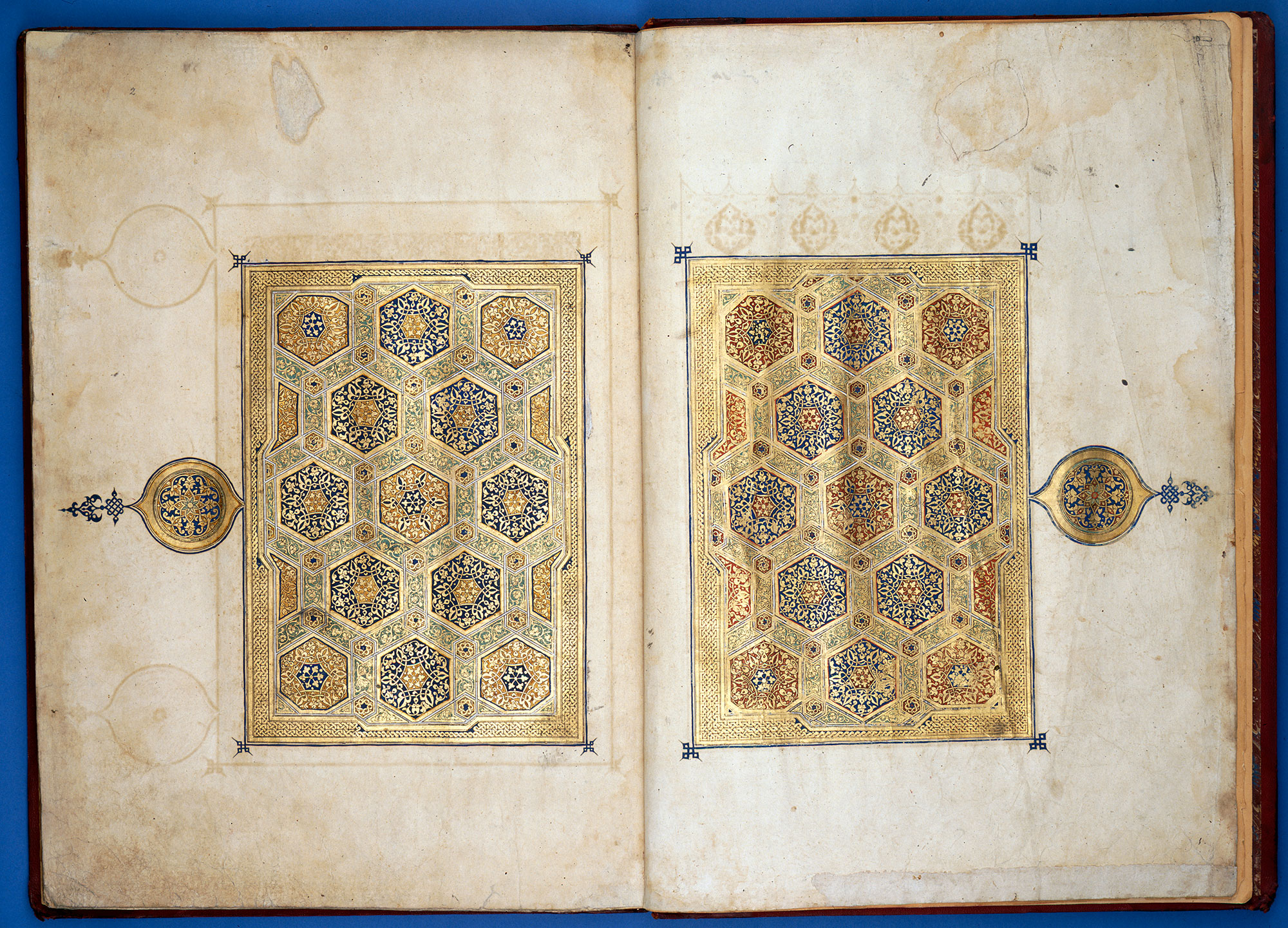
The carpet pages of the Sultan Uljaytu Qur'an, remarkable for their Mongol style of illumination and exquisite coloring (photo: British Library).
The pages immediately following the frontispiece were also especially embellished. The first chapter of the Qur'an, Surat al-fatihah ('opening chapter'), was often embellished. For Muslims this chapter is particularly significant because it is recited during the five daily prayers. In multi-volume Qur'ans, the initial decorated pages carry the opening of the relevant section. Other elaborately illuminated pages are generally found in the centre opening of the volume and the final openings containing the shortest chapters which, according to tradition, were revealed to Muhammad in Mecca. At the end of the volume a full-page illumination is also often found, balancing the frontispiece both functionally and decoratively. A number of design features characterise these illuminations such as arabesques (interwoven flowing patterns of floral motifs) and geometric patterns.
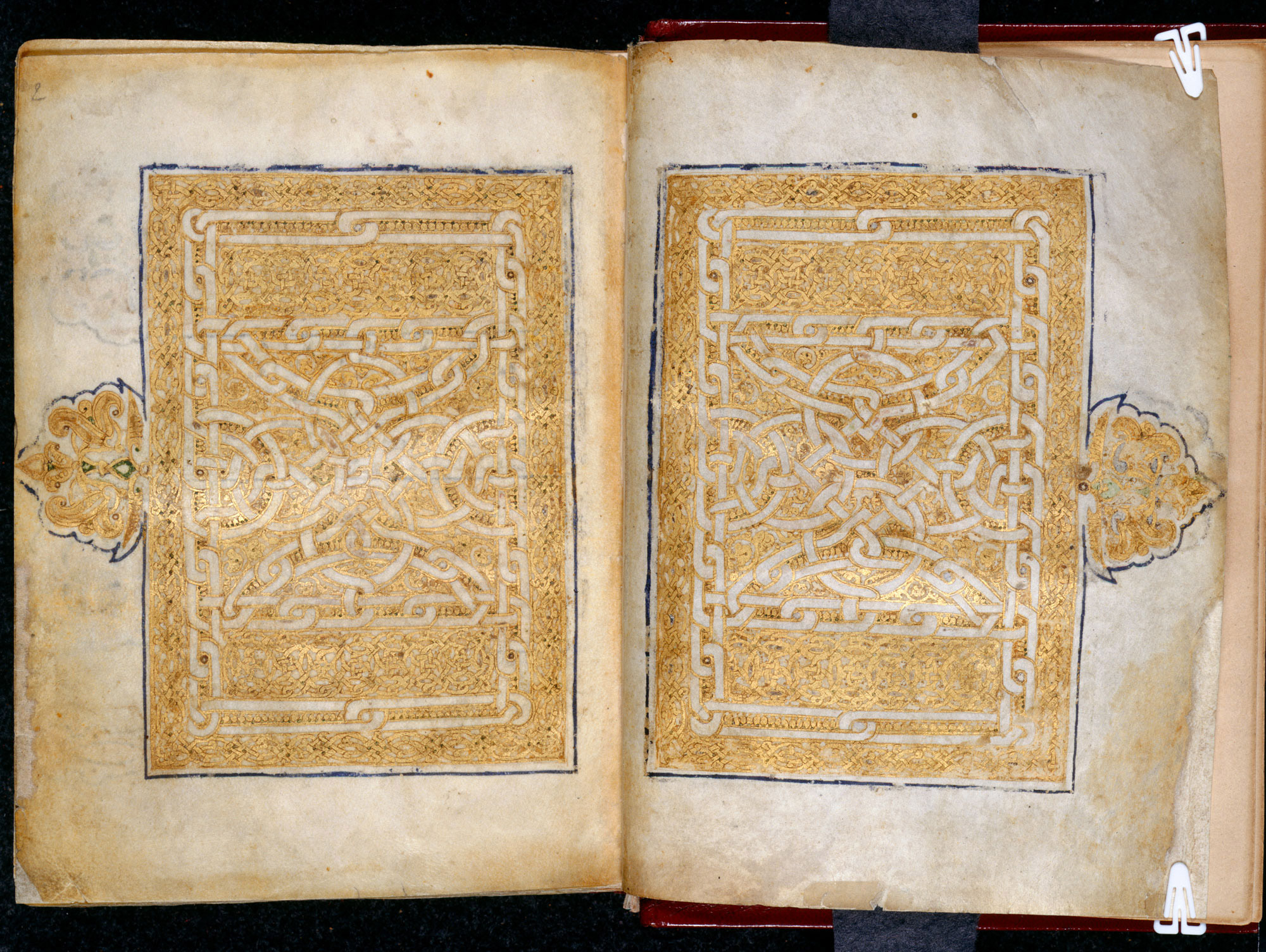
Ornate frontispiece of a 10th-century Qur'an, probably from Egypt, with arabesque decoration in gold and overlapping chain-patterns in white (photo: British Library).
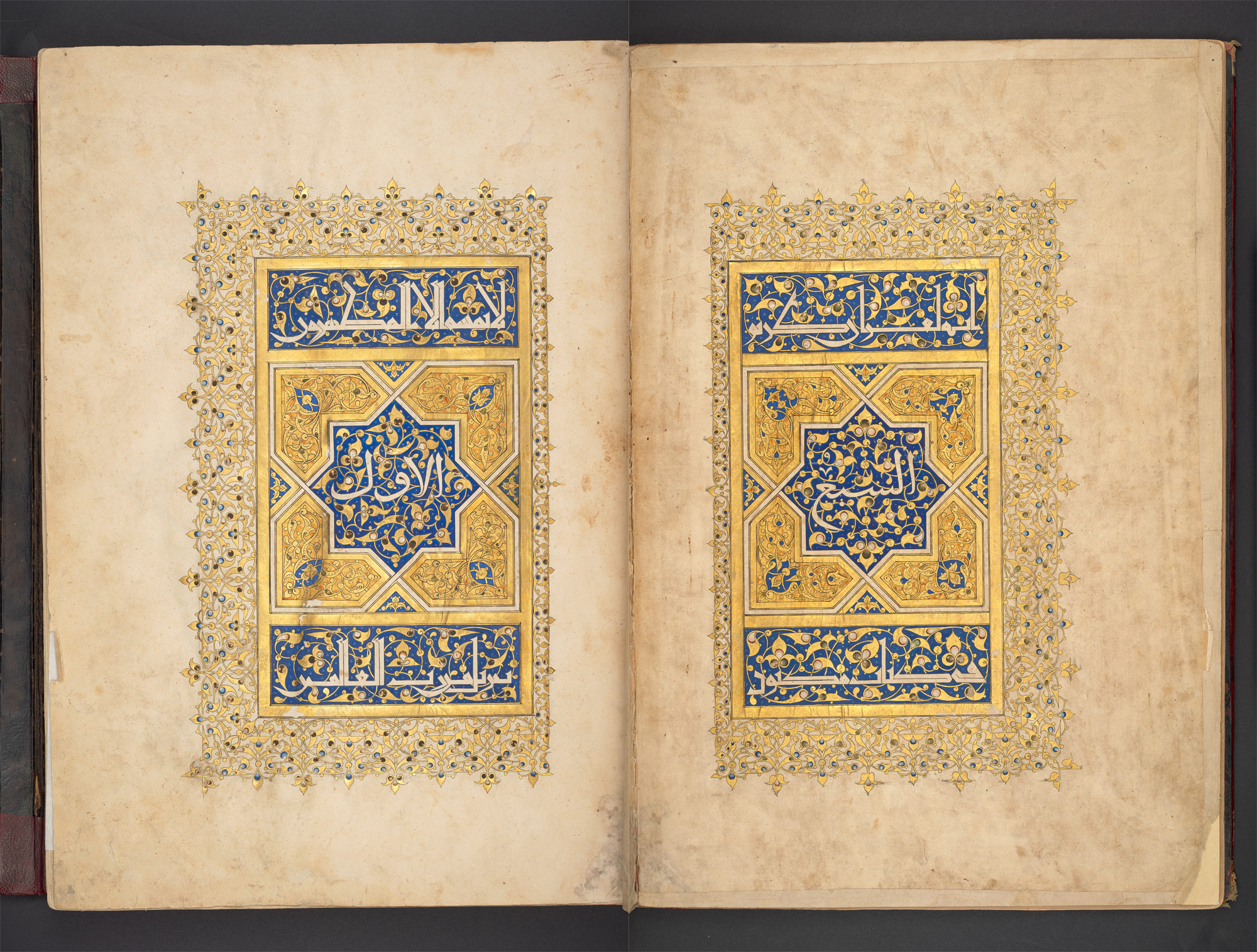
The carpet pages from volume one of Sultan Baybars' seven-volume Qur'an (photo: British Library).
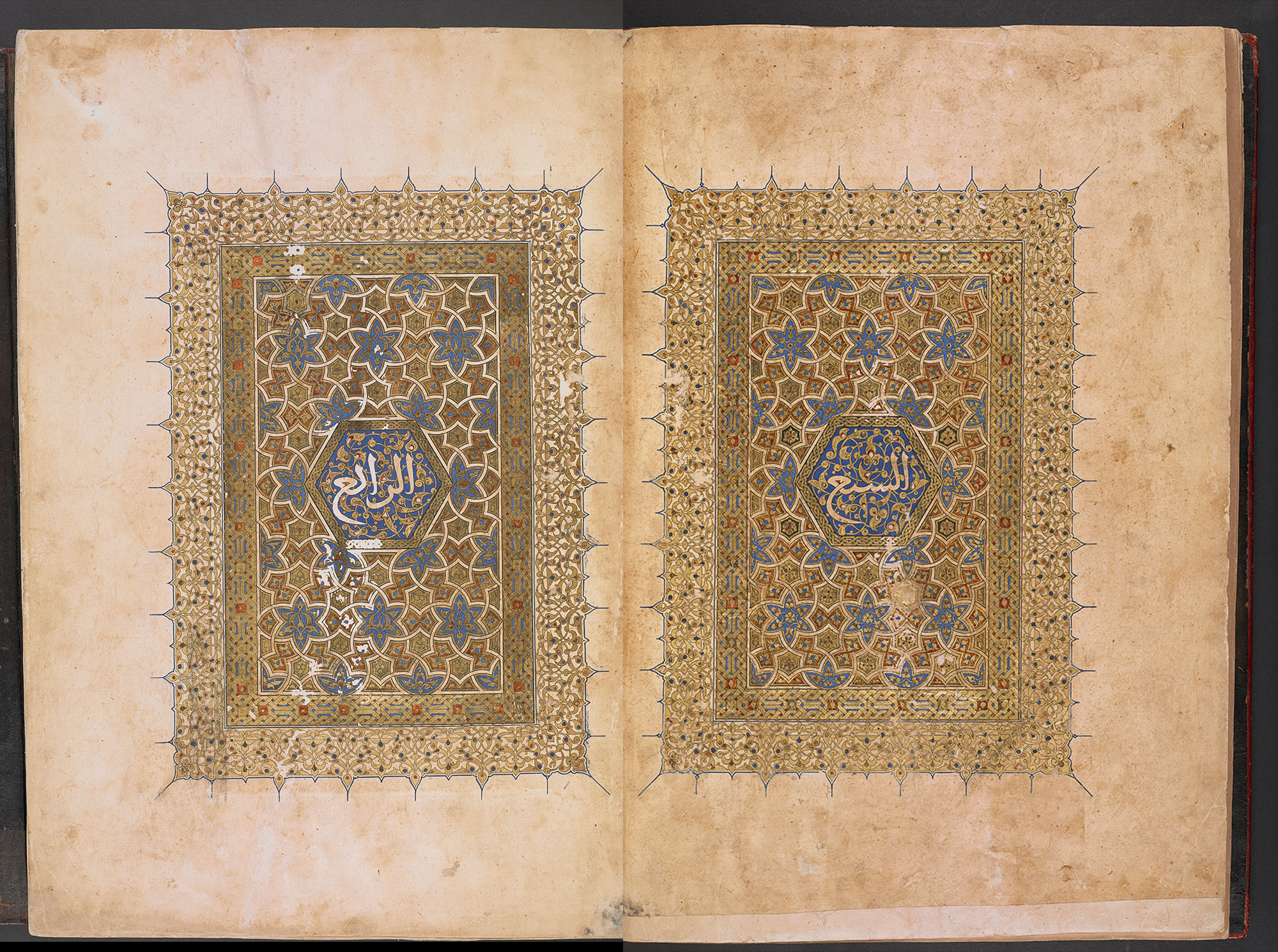
The carpet pages from volume four of Sultan Baybars' seven-volume Qur'an (photo: British Library).
Whereas in earlier Qur'ans the design of these pages is mainly without text of any kind, the Baybars Qur'an introduces into its carpet pages quotations from the Qur'an and, because of its multi-volume presentation, the specific number of the particular volume. The whole Qur'an is written in gold thuluth script and is outlined in black ink, with vowels marked in red and other spelling signs in blue. The choice of thuluth as the script is unconventional, as it was generally considered ornamental, being used primarily for chapter headings and not for the body of the text. The layout of the calligraphy is also of special interest as each page of the Baybars Qur'an carries an even number of lines. This is virtually without precedent; most Qur'ans have an odd number of lines per page. Of interest, too, is the fact that the text layout is continuous and chapter headings are merely indicated by a change of colour, with red ink overlaying the gold, but with no additional spacing between the lines. It would seem that the calligrapher did not wish to interrupt the visual flow of the page.
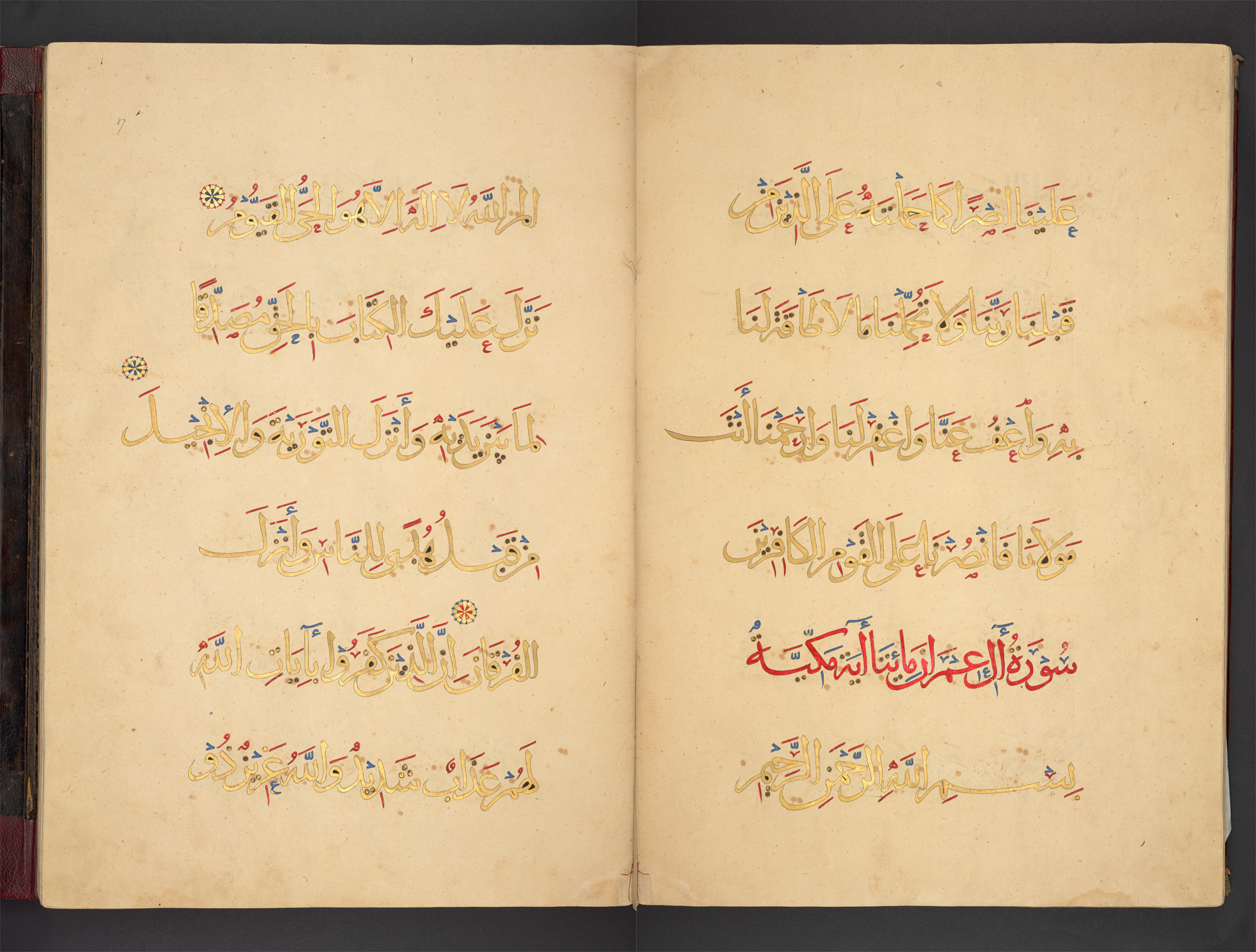
Sultan Baybars' Qur'an written in gold thuluth script (photo: British Library).
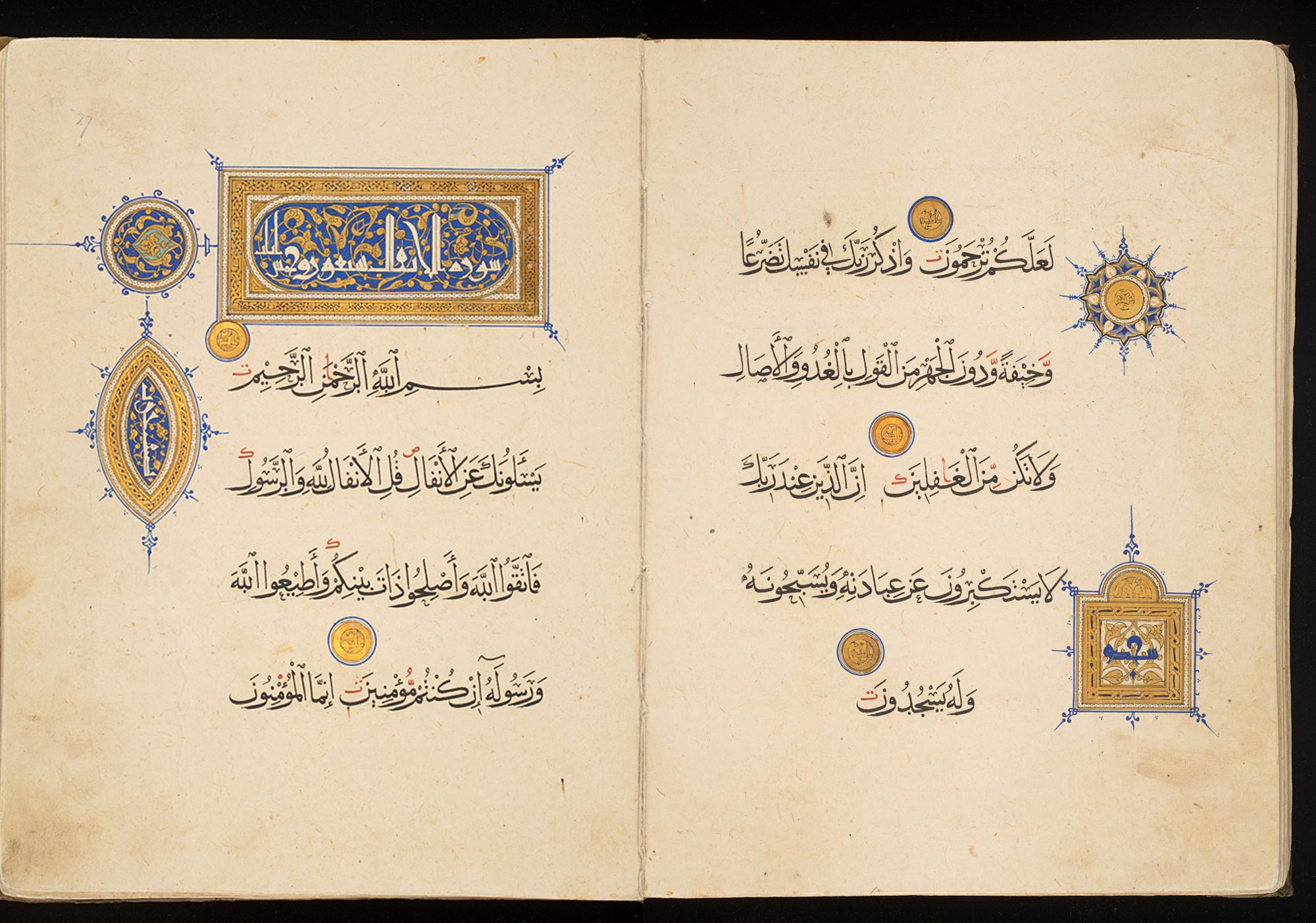
Ornate text pages written in rayhani script from the 14th-century Mamluk Qur'an of Sultan Faraj ibn Barquq, Cairo (photo: British Library).
This feature has a liturgical purpose, instructing the believer when to prostrate during the recitation of the Qur'an. The chapter heading within the rectangular panel is in white kufic. This monumental angular script contrasts with the refined cursive black rayhani script of the body of the text, while the unframed layout gives an impression of infinite space.
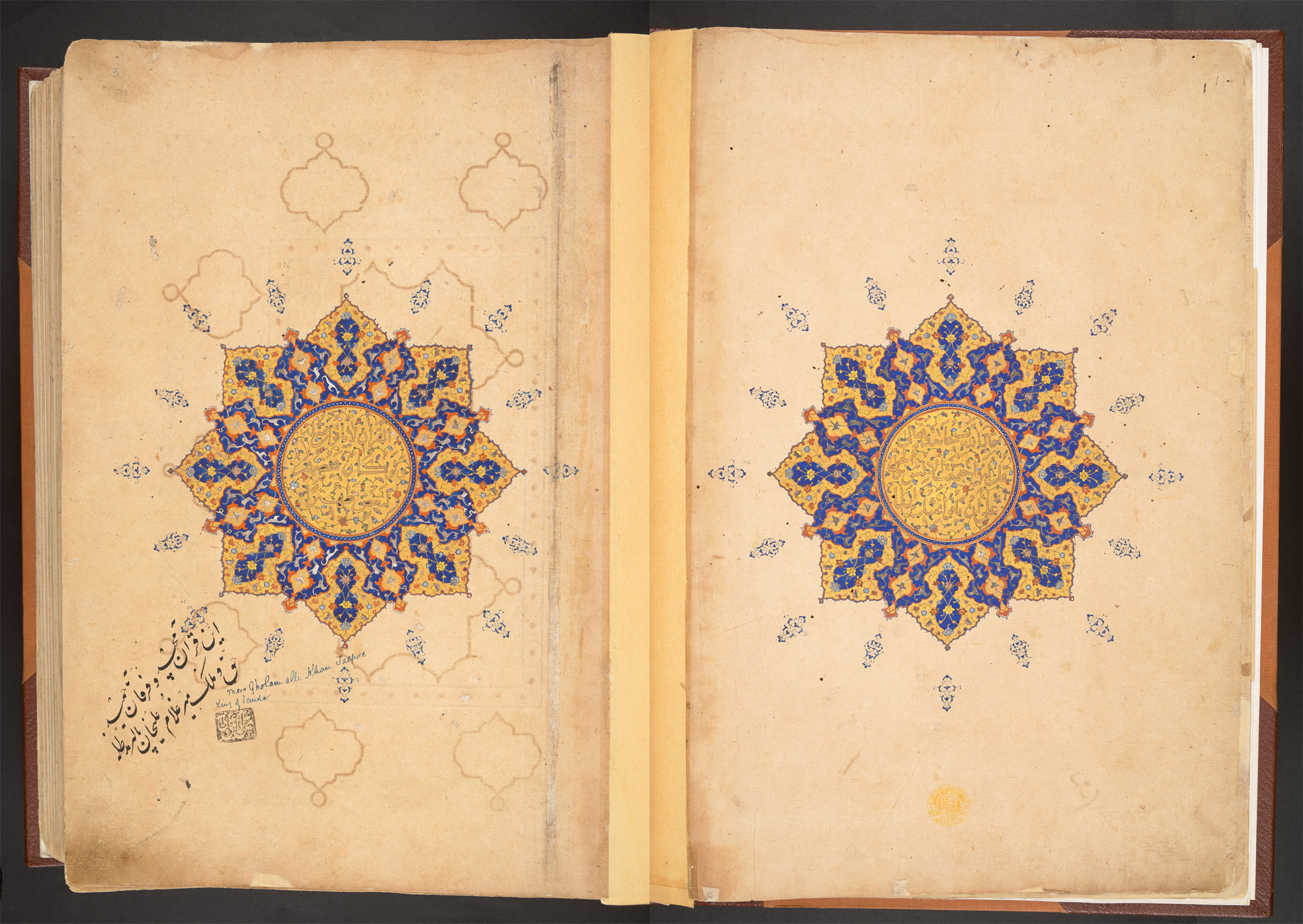
Shamsah ('sun') medallions from a 16th-century Qur'an, Afghanistan or possibly India (photo: British Library).
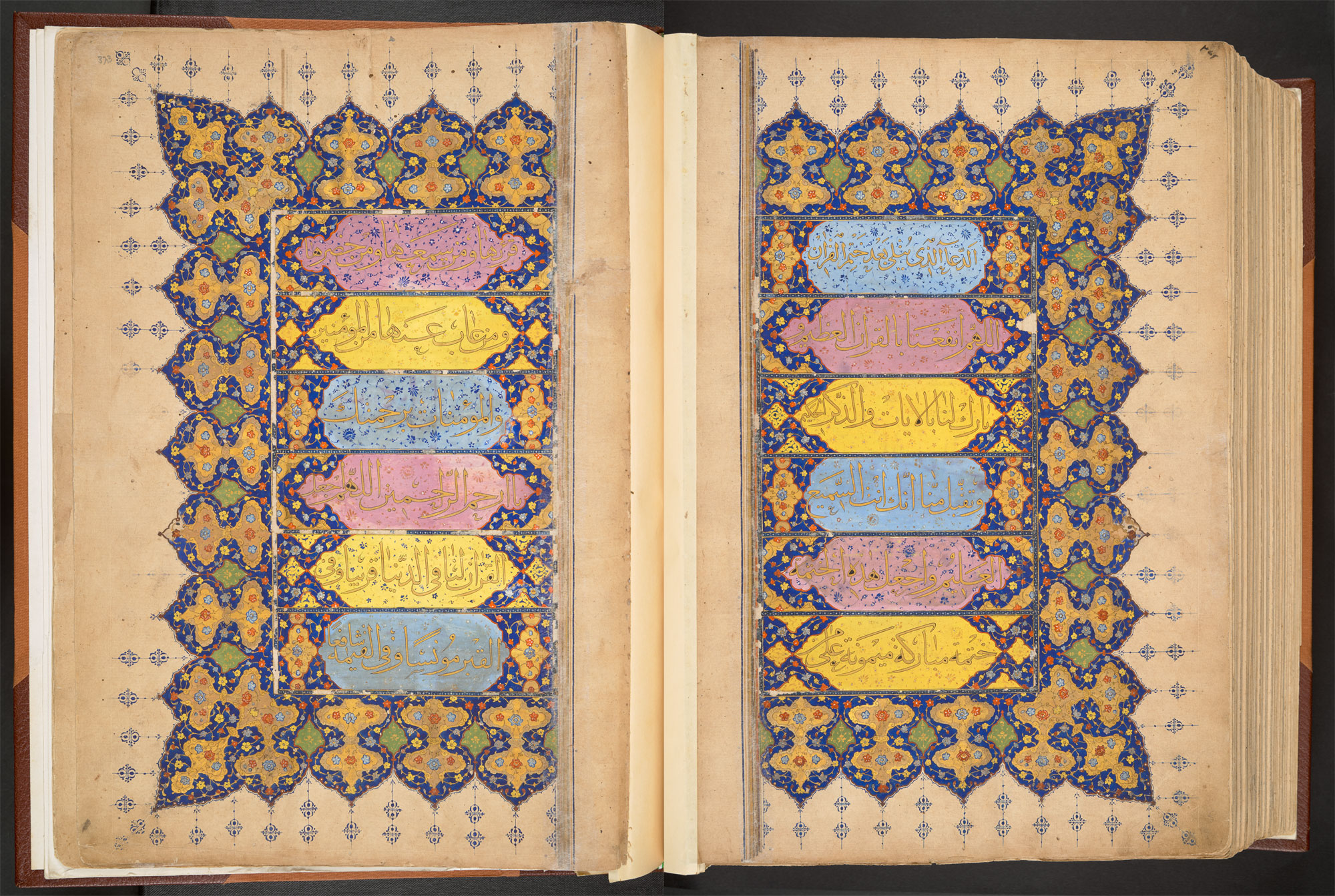
The prayer pages from a 16th-century Qur'an, Afghanistan or possibly India (photo: British Library).
Once the shamsah medallion replaced the carpet page as a frontispiece, the carpet page became incorporated elsewhere. The concluding prayer, which Muslims recite on completing a reading of the whole Qur'an, can be found at the end of the volume. Here the prayer pages have the same format as a carpet page, with each line of text on the right-hand page in gold set against an alternating background of blue, pink and yellow cartouches. For theological and doctrinal reasons, since only God is perfect, the symmetry of design in the decorative pages of Qur'ans is not exact. Usually the symmetry is broken subtly; in this case, however, the asymmetry is obvious in the coloured cartouches.
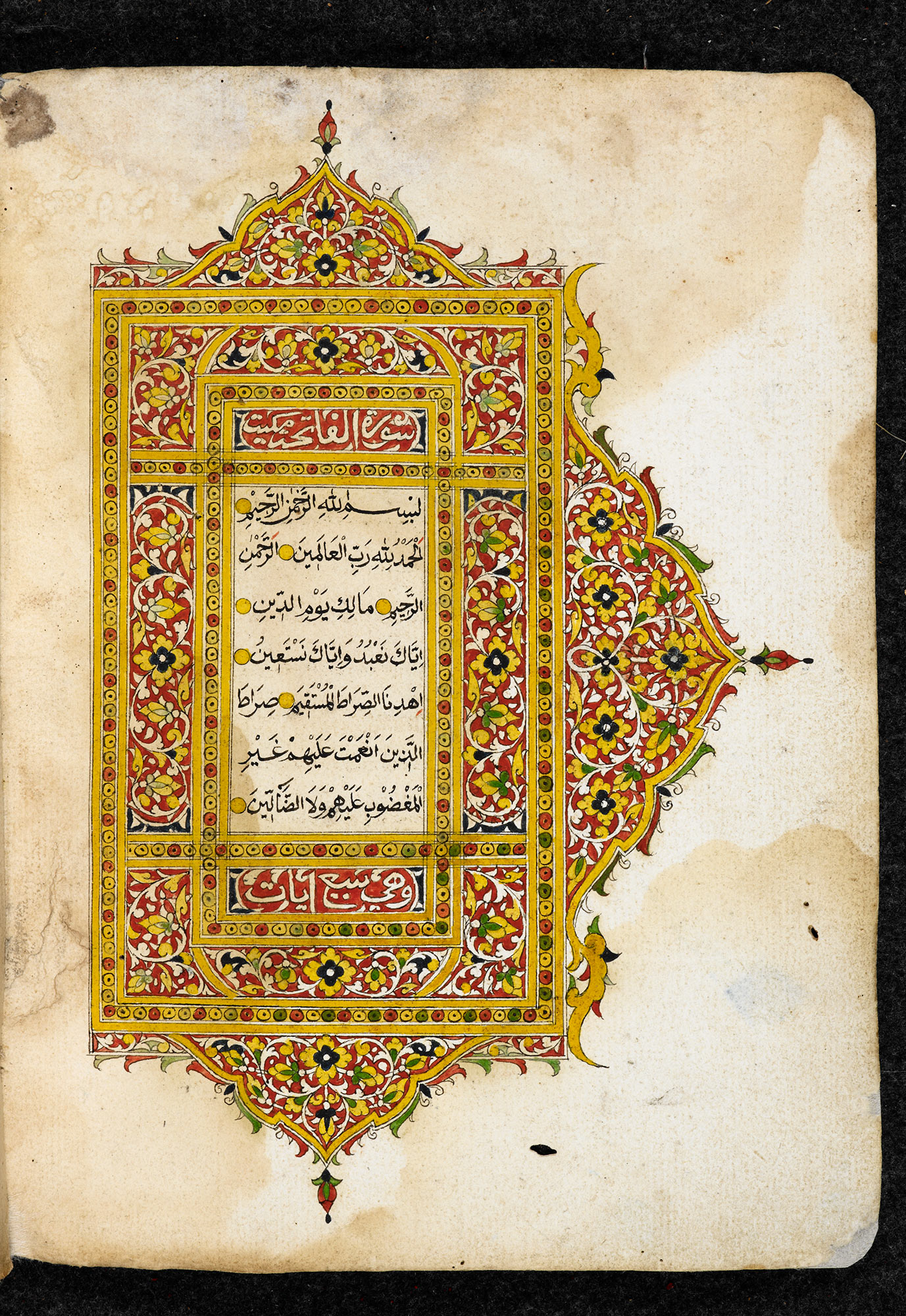
This exquisite illuminated Qur'an manuscript probably comes from the northeast coast of the Malay peninsula, either from Kelantan in present-day Malaysia, or from Patani in southern Thailand. The opening shows the Surat al-Fatihah (photo: British Library).
In this first opening of the volume - containing chapter one and the beginning of chapter two - the text is encased in central panels. Typical of Qur'ans from this region, these rectangular frames are elaborately ornamented on three sides only, here with wave-like arches protruding into the margins. Local flora and vegetation appear to have been the inspiration for the stylised background of petals and leaves within the overall design. As for the text itself, the Arabic script has not been influenced by local calligraphy. The script is traditional naskhi in black, with yellow roundels to mark the end of each verse.
Qur'an manuscripts have been devoutly and assiduously copied throughout the centuries, exhibiting diverse styles in calligraphy and illumination, which often reflect their place of origin and date of production. Calligraphy and illumination evolved to such a degree of subtlety in Qur'an manuscripts, imbuing its sacred script with spiritual resonance.
Dr. Colin F. Baker is Head of the British Library's Middle Eastern and Central Asian Collections. He has worked extensively on Arabic and Judaeo-Arabic manuscript collections. He was one of the curators of the British Library's 2007 exhibition Sacred and, to coincide with the exhibition, he wrote the book Qur'an Manuscripts: Calligraphy, Illumination, Design (British Library, 2007).
( Source: Republished under the Creative Commons License from the British Library ).
 Jesus Cannot Be Son of God Because God Has No “Wife”


