
IslamiCity
Listen PodCasts, Live Quran, Watch Videos @VideoHub

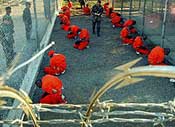 |
Unmindful of universal criticism, the U.S. government is holding 660 adults and three teenagers as "enemy combatants" at a prison at Guantanamo Bay.
The U.S. Supreme Court recently agreed to hear the petition filed by a group of retired federal judges, former U.S. diplomats, ex-military officials and international law experts, urging it to review their indefinite detention.
The detainees, held at a super-maximum-security prison at Camp Delta, are not given a prisoner-of-war status, so that the Geneva Conventions could apply to them.
No criminal charges have been filed against them, and they are denied access to a lawyer or a U.S. court.
Most of these detainees were captured during the war on Afghanistan. Their relatives and human rights groups say many of them were simply in the wrong place at the wrong time or were picked up on bad intelligence.
The indefinite detention has had a terrible effect on prisoners' morale, and there have been more than 30 attempts at suicide. The human rights advocates, including the International Committee of the Red Cross and Amnesty International, have voiced concern.
Amanda Williamson, spokeswoman for the Red Cross, the only non-state organization permitted to visit the prison, said in a recent interview, "After more than 18 months of captivity, the internees have no idea about their fate, no means of recourse through any legal mechanism. They have been placed in a legal vacuum, a legal black hole."
A number of heads of leading law organizations around the world have urged the administration to give these prisoners a fair and lawful trial.
The chairmen and presidents of law societies from Britain, France, Sweden, Australia and Canada have publicly expressed misgivings at the U.S. plan to put the detainees before military tribunals without jury.
And attorneys for the prisoners from Kuwait, Britain and Australia had sought hearings on behalf of their clients.
But the U.S. Circuit Court of Appeals for the District of Columbia denied their request, saying Guantanamo Bay lies beyond the reach of federal courts.
John J. Gibbons, a former chief judge of the Third U.S. Circuit of Appeals called the decision "ludicrous," since the Navy base is under perpetual lease from Cuba, and the U.S. exerts its full sovereign rights over it.
Other lower courts have given similar judgments. Thus, although they have consistently upheld the notion that U.S. courts have no jurisdiction over non-Americans detained abroad, the issue is of such importance that it must be resolved in the top court.
This is all the more important since the administration has obstinately refused to be governed by reasonable rules in detention of foreigners in its "war on terrorism."
Former Vice President Al Gore, in a speech in November, severely criticized these detentions saying the "handling of prisoners at Guantanamo has been particularly harmful to America's image. Even England and Australia have criticized our departure from international law and the Geneva Conventions."
"Foreign citizens held at Guantanamo should be given hearings to determine their status provided under Article V of the Geneva Convention, a hearing that the United States has given those captured in every war until this one, including Vietnam and the Gulf War," he said.
"If we don't provide this, how can we expect American soldiers captured overseas be treated with equal respect? The president should seek congressional authorization for military commissions he says he intends to use instead of civilian courts to try some of those who are charged with violating the laws of war."
"Review of their decision must be available in a civil court, at least the Supreme Court, as it was in Word War II."
Thus, as the world leader, it is incumbent on the United States that it does not violate the conventions to which it owes allegiance, but rather continues with good and honorable precedents for others to follow.
Siraj Mufti, Ph.D., is a researcher and free-lance journalist.
 The Six Arab Scientists Who Were Mysteriously Murdered


