
IslamiCity
Listen PodCasts, Live Quran, Watch Videos @VideoHub

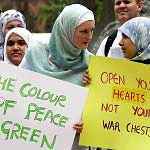 |
Ever since President Bush unilaterally declared the war on Iraq, and as its pretenses are falsified, so is anti-Americanism getting widespread in the Arab and Muslim world.
According to a recent global attitudes survey carried out by the Pew Research Center, "The bottom has indeed fallen out of Arab and Muslim support for the United States."
For example, in Turkey, a secular Muslim, non-Arab democracy and a stalwart member of NATO, favorable opinion towards the U.S. dropped from 52 percent three years ago to 15 percent in the spring of 2003. The situation is not much different in other Muslim and Arab countries.
Given this, the U.S. Congress mandated a bipartisan 13-member Advisory Group on Public Diplomacy for the Arab and Muslim World. Its report released on Oct. 1, calls for a new White House office to manage strategic direction and government coordination of public diplomacy in promoting national interest by informing, engaging and influencing various people.
The report concludes, "America can achieve dramatic results with a consistent, strategic, well-managed, and properly funded approach to public diplomacy, one that credibly reflects U.S. values, promotes the positive thrust of U.S. policies, and takes seriously the needs and aspirations of Arabs and Muslims for peace, prosperity, and social justice."
However, Michael Holtzman, a public affairs advisor in the Clinton administration, doubts that "recommendations like spending millions more on public relations" will be of much help, and "the entire operation needs rethinking."
This because, the State Department, which oversees such efforts, seems to view public diplomacy not as a dialog but as a one-sided exercise, resulting in speaking at the world with simplistic and often offensive propaganda.
For example, a $15 million advertising campaign, called "Shared values" was intended for broadcast in Muslim countries. Several Arab countries refused to run these ads, and they were subsequently dropped when the test audiences said that they did not touch on the main issues that divide America and the Muslim world.
Although Holtzman suggests that this enterprise should rather be public, the issues, much more than diplomacy, are of the U.S. policies towards the Arabs and Muslims, that need to be addressed earnestly.
Even the public diplomacy advisory panel admits, "Foreign policy counts." That "surveys show clearly that specific American policies profoundly affect attitudes toward the United States. That stands to reason. For example, large majorities in the Arab and Muslim world view U.S. policy through the prism of the Arab-Israeli conflict. Arabs and Muslims overwhelmingly opposed the post-9-11 U.S. military campaign in Afghanistan, as well as the use of force against Iraq, and the U.S. war on terrorism in general."
Writing in Foreign Affairs, September/October, under the heading "Taking Arabs Seriously" Marc Lynch observes that a new elite has emerged in the Arab world that "increasingly sets the course for the street and palace alike." And that the Bush administration "needs to recognize that the elite Arab public can speak for itself, deeply resents being ignored or condescended to, and is more than capable of directly observing American words and deeds for inconsistencies."
Therefore, it is vital to realize that, whereas the American core values are admired and respected worldwide, it is the reality of our unbalanced and counterproductive foreign policies that negatively impacts global public opinion.
It is these policies that must be addressed not on our immediate hegemonic interests, but on what will be good and lasting for America in befriending rather than antagonizing the 1.5 billion world Muslims. Moreover, these policies need to be based on uniform standards of international law, political equity, social justice, and respect for human rights.
Siraj Islam Mufti, Ph.D. is a researcher and a free-lance journalist.
 Islamic Worldview in Comparative Perspective


