
IslamiCity
Listen PodCasts, Live Quran, Watch Videos @VideoHub

A recurring call echoed in the West since September 11 was that of reform in the Muslim societies. To this end, the United States is asking them to reform their religious education. It is assumed by several scholars, journalists and politicians that fanaticism that motivated the highjackers, is rooted in religious precepts - that they teach narrow views to be imposed on the rest of humanity through violence. This call is made without any objective analysis: it does not take into account the causes that underlie Muslim frustrations with the current situation, and is an exaggeration that considers only a fringe element of Muslim society. Despite this, it requires examining the 'why' of this reality: why the West is at odds with the non-Western, especially Islamic concepts. Clearly, this problem arises because the West insists that its cultural norms should become universally accepted as standards. And it is this universalistic monologue that the U.S. is forcefully engaged in now, instead of relying on a cross-cultural dialogue that would aim at finding a middle ground for common human existence. In fact, ever since the emergence of Islamic movements, the Western decision-makers and their cohorts in the Muslim societies have suspiciously viewed the advocacy of religion in the public domain as regressive, and a return to medieval way of life. Their contention is that the Western society has progressed intellectually, politically, socially and economically by pushing religion aside into private life; and therefore, other societies must follow a similar course for modernity and progress. This secular assumption has been vigorously advanced as a strategy for modernization through the model of Westernization. Its advocates range from Leonard Binder to Samuel Huntington. Although Binder realized that Islam is central to modernization in the Middle East in his seminal work, Islamic Liberalism, but unfortunately, that marked the end of his career among modernization theorists. Conversely, Huntington advanced from advocating modernization to forecasting the doomful "Clash of Civilizations." It must be realized that the call for reformation within Muslim societies is nothing new: For example, consider the middle nineteenth century reputed reformers Jamaluddin Afghani and Muhammad Abdu. These reformers realized that profound societal and cultural changes in the Muslim societies were needed; but they always based them within the Islamic vision - although their endeavors were frequently undercut by the ruling elite who used the facade of Western modernity to disguise their despotic intentions. Isn't it ironical that Western reformation within Muslim societies is voiced by the very powers that resist Islamic reform? And isn't it even more ironical, that the advocates of freedom and democracy in the West, in gross violation of these principles, have aligned themselves with such autocrats to achieve their specific selfish ends? There goes the truth and honesty! A meaningful reform of Muslim societies cannot be undertaken by ignoring the Islamic foundations of Muslim cultures. Nor, can it be unwillingly forced upon the Muslim masses. Islam is ingrained in the very psyche of Muslims and any reform effort must be firmly based on it; nothing that is in conflict with this basic understanding will ever succeed - as clearly evidenced from various post-colonial experimentation in Muslim lands. Furthermore, all reform efforts must proceed through free and open debate in the public square and a consensus achieved before it could be enacted. This is also what Islam demands in all dealings from home to the state affairs. A cultural reform has been underway since colonization of Muslim lands, and includes, in addition to the above, a long list of reformers; for example, Khairuddin al Tunusi, Abdulrahman al Kawakibi, Rashid Rida, Muhammad Iqbal, Said al-Nursi, Malik Bennabi, Ali Shariati and Ismail al Faruqi, to name a few others. Their appeal is to the values and ethos embodied in the Islamic sources in order to restore the moral autonomy of the individual, and to develop an open and egalitarian political culture. Indeed, all major reform movements that brought about profound cultural changes have been religious. Even the modern secularist West owes it to the Religious Reformation, as reminded by Weber in his Protestant Ethic. Likewise, the Muslim East should carry out its own reformation that is rooted in its Islamic ethos. Islam requires both individual and societal reformation. It emphasizes individual responsibility, and as a result, has encouraged various individual expressions within its very broad boundaries. It inspired individual creativity in eminent works such as that of al-Farabi, Averroes, Avicenna and Ibn Khaldun that contributed to the Western scholarship. And along with it, this individualism has historically maintained, rather celebrated - pluralism, much more than the modern West. And this pluralism, lasting until the fall of the Ottoman Empire, reached far beyond the religious and political into the social, cultural and even legal spheres. Indeed, the current totalitarian orientation is the result of decline in rational thought, and the rise of authoritarian regimes encouraged and assisted by the West. The universalistic monologue of the U.S. is predicated on its strategic and hegemonistic designs and is coercive in its nature whereby its proponents feel justified dictating to others their particulate dictums based on these considerations. In order that a meaningful dialogue could take place, it requires instead a change in understanding and attitude - from one that relies on power and self-righteousness to one that depends on rational interaction, and respects the autonomy of various cultural communities. Only thus through an open and free dialogue could universally shared standards be objectively established. Therefore, in a world distinguished by its cultural pluralism, the emphasis must shift from an inter-subjectively derived universal norm of a certain cultural community (the West, in the current situation), to cross-cultural inter-subjectivity, wherein communities with their different normative references must freely acknowledge a universal norm. While explicit agreement of people within a similar cultural set-up is essential, it is all the more so, for a cross-cultural dialogue that aims at peace and justice for the world. Siraj I. Mufti, Ph.D. retired as a research professor from the University of Arizona and a chaplain from the U.S. Department of Justice. He currently writes as a free-lancer.

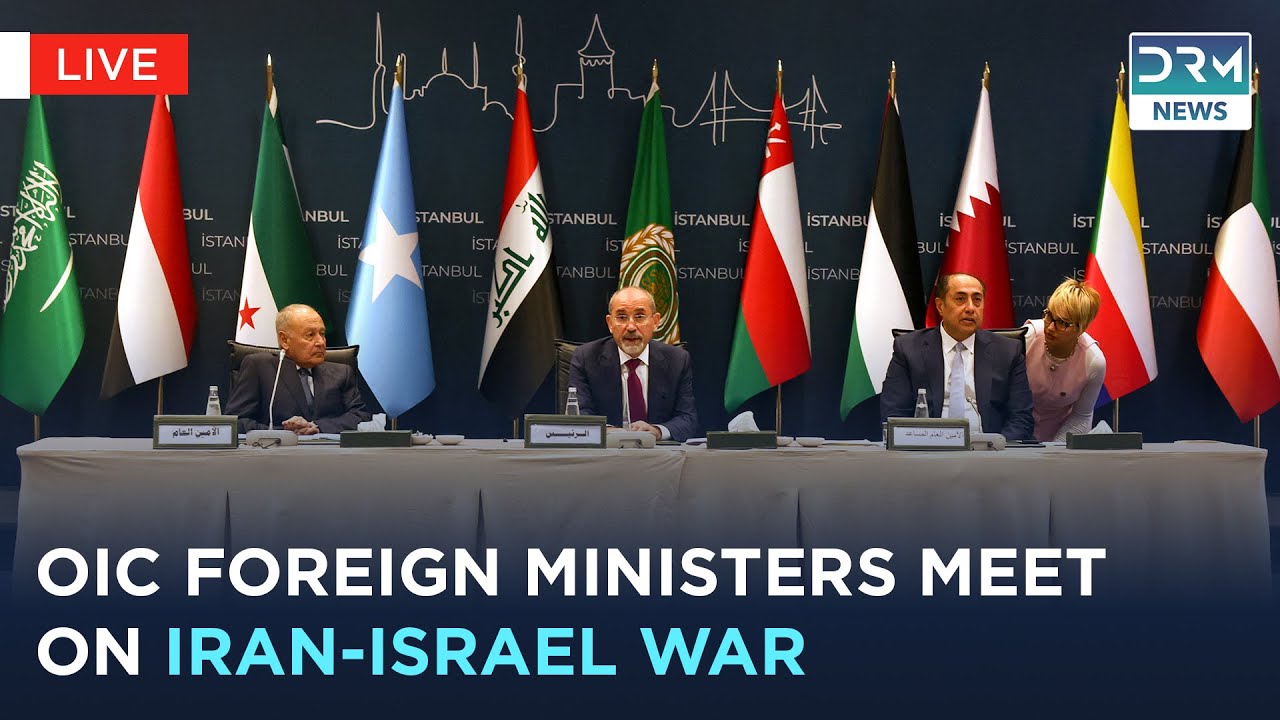 OIC: Muslim World Responds to Gaza & Iran Strikes


