
IslamiCity
Listen PodCasts, Live Quran, Watch Videos @VideoHub

The Holy Qur'an and the Sunnah of Prophet Muhammad ﷺ signify a conceptual foundation of Islamic art, architecture and the whole universe of the built environment. They furnish the Muslim built environment professionals, policy makers and users alike with an inspired outlook on life and those issues that are pertinent to the realm of the built environment.
They also provide some broad rules of morality and guidelines of proper conduct which may or may not be directly related to art, architecture and built environment. Those principles and teachings account for the core of the Islamic monotheistic (tawhid or God's Oneness) worldview and ethical system.
Muslims are thus invited to establish such built environment theories, systems and styles which will be consistent with their religious preferences and the exigencies of their diverse epochs, geographical regions, cultures, socioeconomic conditions and other practical needs and requirements.
Indeed, the whole Islamic built environment is a symbiosis between permanence or perpetuity, which is represented by the constant inclinations of the primordial human nature and the heavenly revelation and guidance, and impermanence or transience, which is necessitated and controlled by the vicissitudes of life.
The sophisticated world of the Islamic built environment declined and struggled to retain its conspicuous identity principally when its two defining poles were bartered. This happened when the sacred in the Islamic built environment was compromised and regarded as a transient and man-generated legacy; when either the building system or the style of an age or a geographical zone became excessively venerated and regarded as a sole inspiration and guidance; or when a complete detachment from the direction of the Islamic message and its civilization occurred and an inspiration and guidance were sought from foreign sources instead, which entailed incompatible worldviews and ethical systems. It follows that the success in reviving the authentic meaning and vigour of the Islamic built environment depends entirely on properly conceptualizing its basic notions and theoretical frameworks, which then should be followed by finding and actualizing appropriate strategies and methods for it.
This book aims to contribute towards the prospect of reviving the Islamic built environment as a theory and practical reality. It discusses a number of salient built environment aspects and features exclusively based on the Qur'anic worldview as the fountainhead of all wisdom and guidance. The topics deliberated are those revolving around the concepts of architecture, art, sustainable development, peaceful coexistence with the natural environment, decoration (aesthetics), housing and mosques.
A cluster of relevant Qur'anic surahs (chapters), and sets of relevant Qur'anic verses (ayat), have been identified and interpreted for the purpose. The attained results are expected to enrich the domains of the Islamic built environment theories and its codes of professional conduct significantly. They could also enhance, as well as Islamise, the Islamic built environment educational programmes and curricula, impacting in turn on the quality and appropriateness of the occupational output of the Muslim built environment professionals.
The book is divided into six chapters, each chapter dealing with either a single theme or more based on a selected Qur'anic surah, or a set of Qur'anic verses. Those chapters are:
Linguistically, Sunnah means a path or way. It is a primary source of Islamic Law, second to the Qur'an, taken from the sayings, actions and approvals of Prophet Muhammad ﷺ. It functions as the practical exegesis of the Qur'an, the real application, as well as the ideal, of Islam. In short, Sunnah is the Qur'an interpreted and Islam embodied. Prophet Muhammad ﷺ was the first one who personified the message of the Qur'an. He did so under the aegis of revelation, setting thus an example and life paradigm to be followed by all Muslims, at individual and social planes.
When A'ishah, the Prophet's wife, was asked about the character of the Prophet ﷺ, she simply replied that his character was the Qur'an. Whoever desires to know the practical way of Islam, its particulars and pillars, should seek it as elaborated and embodied in the Prophet's Sunnah.
Sunnah is a pattern distinguished by its comprehensiveness and completeness in relation to the whole human life in all its dimensions, just as the case of the Qur'an which it interprets and exemplifies. Furthermore, Sunnah details what is summary in the Qur'an, particularizes what is general, and qualifies what is absolute in it. Without the Sunnah, much of the Qur'an would be ambiguous.
As a result, among Muslims' perennial duties is that they should learn about this detailed Prophetic pattern and be proficient in it and apply it with adequate understanding and proper decorum. Indeed, the foremost crisis currently facing Muslims is the crisis in thought and knowledge of these two primary sources of Islam and Islamic civilization.
Thus, the Qur'an states clearly that the believers must look up to Prophet Muhammad ﷺ so as to admire and endeavour to follow his most beautiful pattern of conduct: "Certainly you have in the Messenger of Allah an excellent exemplar for him who hopes in Allah and the latter day and remembers Allah much" (al-Ahzab, 21).
On the sublime conduct of the Prophet ﷺ that inspires, awakens and transforms every truth seeker, God says: "And most surely you conform (yourself) to sublime morality" (al-Qalam, 4).
The Prophet ﷺ said that it was but God who educated him and perfected his good manners. He also said that he was sent as the last messenger of God to the people as a completion of the highest moral standards (makarim al-akhlaq) for them to follow.
It follows that the Prophet ﷺ ought to be the role model to Muslims in virtually everything, from pure worship rituals to the matters concerning the incubation and growth of a civilization. The themes of architecture, art and urban planning and development are no exceptions. Thus, the Qur'an and Sunnah serve as the first sources of Islamic architecture (Islamic built environment), forming its conceptual point of reference and foundation.
Finally, how can the Prophet ﷺ serve as our eternal and most sublime role model when he lived more than fourteen centuries ago?
In a nutshell, the answer lies in the proper and total understanding of the Qur'an and the Prophet's Sunnah, and how they are implemented in different and fluctuating life conditions dictated and governed by time and space factors. Certainly, one's ignorance or indifference towards the Qur'an and Sunnah and how their leading roles in the lives of Muslims are to be restored - even if coupled with a large dose of poise and zeal - is not an answer. Such an attitude may bring more harm than good.
Furthermore, the answer lies in striking a delicate balance between the permanent and temporary, and between the absolute and relative, aspects of existence, granting each pole its due ideological along with jurisprudential consideration, merit and task.
Certainly, being keen and enthusiastic, but not rational and pragmatic enough, and being devout and sincere, but not wise, competent and resourceful, is also not an answer. Such an outlook too - just like the previous one - may cause more harm than benefit to those who subscribe to it.
Among other things, it could generate and then, through a variety of means, perpetuate a deadening formalism, not only in religion but also in matters pertaining to cultural and civilizational initiatives and goals, apathy, regression, prejudice and narrow-mindedness.
Hence, Muslims are invited to establish their architectural theories, systems and styles that are consistent with their religious preferences and the requirements of their diverse eras, geographic regions, cultures and other practical needs and conditions.
Islamic architecture is a symbiosis between permanence, which is represented by the constant innate inclinations of essential human nature and the heavenly guiding principles and regulations, and impermanence which is necessitated and controlled by time and space factors. It is impermanence that changes, while permanence is abiding and remains unchanged.
This is the thrust of Islamic architecture's powerful identity. Hence, Islamic architecture was able to rise above the precincts of the geographic and cultural contexts in which it was planted.
Furthermore, Islamic architecture was able to transcend the restrictions of the historical moments during which it was fashioned, outliving generations of its engineers, craftsmen and users. The ideals it personifies dominate its people and their thinking patterns. It is never the case that the people subjugate to their wishes and then control the world of Islamic architecture. Whenever this happens, it spells out a dire degeneration of Islamic architecture which can lead to its eventual death.
Islamic architecture likewise enlightens and inspires. Some of its facets can be inspired by a fine and purified vision, philosophy and thought approved by the Islamic consciousness, which then are fully Islamized and made subservient to the same Islamic consciousness.
However, no segment of Islamic architecture can be inspired by ideas and attitudes that are contradictory to the source whence Islamic architecture originates, that is, the revelation in the forms of the Qur'an and Sunnah of Prophet Muhammad ﷺ. Such an act would be blasphemous and injustice towards the Islamic architecture users.
Islamic architecture declined and struggled to retain its conspicuous identity only when its two defining poles were bartered. This happened when the sacred in Islamic architecture was compromised and regarded as a transient and man-generated legacy, when the building system or the style of an age or a geographic region became excessively venerated and regarded as a sole inspiration and guidance, or when a complete detachment from the religion of Islam and its civilization occurred and an inspiration and guidance were sought from foreign sources. It follows that the success in reviving the real meaning of Islamic architecture depends on properly conceptualizing its basic notions and ideological framework, which then should be followed by finding and actualizing its appropriate strategies as well as methods.
The first role of the Qur'an and Sunnah as the sources and foundation of Islamic architecture is to afford a perfect guidance as to how Muslims perceive the creating, using and possessing of architecture. This is an integral part of the total Islamic worldview and belief system. The two holy sources also educate on the importance of architecture and its purpose in life. The goals of architecture are closely linked to man's life purpose and goals, and are treated as such. The two, in fact, complement each other.
Thus, a Muslim architect should perceive himself firstly as a servant of God, then an architect. He should see his profession as a means towards realizing his noble terrestrial mission as a vicegerent and servant of his Creator. In general, the purpose and goals of every Muslim's professional life - it goes without saying - cannot deviate from the purpose and goals of his total existence. Architecture is a form of service to the people, environment and God.
It stands to reason that a conceptual dimension of architecture, which determines and shapes its physical and artistic dimensions, is perhaps most critical in evolving an architectural style. This is so because humans are not the only creatures that build. Many a creature that we classify low down the hierarchy of the animal kingdom, such as bees and ants, build elaborate structures. However, it has been suggested that awareness, thinking and imagination single out humans as superior to other animals in architectural output.
While other creatures act on the environment instinctively with no reasoning or training - as preordained by God, the Creator of the universe - humans do the same willingly and at their own discretion. Since their actions are preceded by thinking and beliefs, human beings clearly demonstrate through acts of building - and every other engagement of theirs - their philosophy and outlook on life. The relationship between the people's outlook on life and the disposition of their actions, including building, is causal, the former being the cause of the latter.
No sooner does a paradigm shift occur in one's worldview, than a corresponding change accordingly ensues in the very essence and character of one's performances, thus revealing and immortalizing one's actual relationship with his own self, peers, other creatures and his Creator.
Equally misguided is he who asserts that the architecture of Muslims has nothing to do with the beliefs and value system of Islam, and that the two should be kept clear of each other.
The Qur'an and Sunnah with their vision of and approach to architecture function as the everlasting sources of inspiration and catalysts for matchless ingenuity, in addition to other conventional sources and catalysts needed by architects. And the two notions: inspiration and ingenuity, are fundamental to every successful architectural story. It is yet argued that the wellbeing of civilizations depends on how creatively and resourcefully they respond to recurring challenges confronting them.
As a few examples, the Qur'an and Sunnah do not speak about how to plan and design house entrances and windows, but speak about the issues and activities pertinent to the subject matter; nor do they address how to organize inner spaces inside a house, but deal with scores of issues related to that particular topic; nor do they speak about the ways mosques are to be planned and designed, but speak about mosque activities and matters relevant to mosques and their multiple functions as community centers, which should be duly considered when planning, designing and building mosques; nor do they speak about how to make buildings sustainable and environment friendly, but speak about the meaning and importance of the environment and our many duties and rights over it, so much so that one gets a feeling that Islam is truly a religion of environmental protection and that Prophet Muhammad ﷺ was the first de facto environmentalist; nor do they speak about how to make buildings perfectly safe, secure and clean, but speak about establishing safety, security and cleanliness as foremost principles of Islam and the most important standards of living.
Without doubt, the broad and general Islamic values and principles, which lie at the core of architecture, can enlighten, enrich and inspire Muslim designers and architects. They can widen not only their architectural, but also spiritual and intellectual, horizons. Muslim designers and architects have thus nothing to lose, but on the contrary, can only gain multiple benefits.
The above were some examples where the contents of the Qur'an and Sunnah can function as the sources of motivation and catalysts for creativity. However, this is to be seen as a starting point only for a Muslim architect to express himself architecturally and produce such architectural concepts and forms as he deems most suitable insofar as his spiritual inclinations and life interests are concerned. He uses the same divine guidance as a point of reference for acceptance and authorization whenever an architectural accomplishment is made. This hierarchical organization and order in Islamic architecture render it ever alive and applicable. It also signifies God's acknowledgment of the talent and potential inherent in man, God's vicegerent on earth, which, after all, are God-given.
Islam is a complete way of life. Its values and teachings are universal and timeless. Islamic architecture is universal and permanent too, in that the philosophy that it embodies is an Islamic one. However, such is the nature of Islamic architecture that it is receptive to advances in science and technology and the dictates of people's living conditions.
It is an imperative that Muslim architects always remember this verity while trying to revive and sustain the notion of Islamic architecture. They are bidden firstly to identify the general guidelines and principles of the Qur'an and Sunnah pertaining to the enterprise of building. Next, they should be fully aware of the implications of the fluctuations of their time and the diverse regions in which they live. They cannot be trapped in a historical episode, overly romanticizing it and attempting to emulate the architectural solutions the Muslims of that particular period successfully evolved. If something was the norm during a period and in a particular ecological and socio-economic setting, such by no means might be the same in every subsequent period and in different ecological and socio-economic milieus.
Technological advancements rapidly change, demands of different eras vary, even under the same ecological conditions. Climate exigencies ought to be painstakingly heeded, too. Lastly, human psychology also changes in line with the changes in the vicissitudes of life, which poses several exigencies of its own. No architectural design, which served as a solution for an age and a place, can be simply "parachuted" to another age and place without properly modulating it consistent with different environmental and socio-cultural requirements. Such strategy would betray the dynamic spirit of the common sense and the perpetual message of the Qur'an and Sunnah. Blind and ignorant imitations as well as following, even in sheer religious matters, are categorically rebuked by Islam.
While taking hold of the general values and teachings of the Qur'an and Sunnah in order to create an Islamic architecture, on the one hand, and while studying the needs of different times and situations so that the former can be accurately understood and applied, on the other, Muslim designers and architects, in reality, perform a degree of ijtihad, i.e., forming an independent opinion or judgment within the framework of an available text from the Qur'an and/or Sunnah. In doing so, if one excels, one receives two rewards from God, but if one for whatever reason fails to deliver, even after he had tried his best, one is bound to receive one reward from God. This was explained by the Prophet ﷺ in one of his traditions.
Based on the tradition, a serious, enlightened, accountable and willing person cannot be a loser as far as the execution of matters ordained by God is concerned. Verily, this divine assurance should serve as a starting point for Muslim architects and designers to look carefully and critically at the state of architecture and how buildings in the Muslim world are designed and built. They should start contemplating the prospects of finding much better solutions which will be inspired by and infused with the spirit of the Qur'an and Sunnah, and will be responsive to the demands of everyday life.
Hence, in Islam, wrongdoings such as wasting, overindulgence, haughtiness, greed, corruption, discrimination, environmental destruction and immoral competition are regarded as grave sins. They can put at risk the spiritual wellbeing of a person and the whole community. So serious are those vices that they have potential to deny their perpetrators God's grace in this world and the Hereafter, plunging them into the agony of God's wrath and Hellfire.
Therefore, Muslim architects should be an exemplary group that are responsible towards themselves, their profession, society, culture and religion. It does not matter whether they are governed by a code of ethics and professional conduct in places where they work, or otherwise. Their code of moral values and professional demeanour is enshrined in the Qur'an and the Prophet's Sunnah.
Islamic general ethics, which accounts for a system of values that guide our choices and actions and determine the purpose and course of our lives, should constitute the core of different codes of ethics and professional conduct that different architectural companies and establishments may establish for themselves. They need to ensure that Muslim architects are dedicated to the highest standards of professionalism, integrity and competence.
It follows that the Islamic architectural education must seriously address the matter. Islamic education, generally, does not produce greedy, materialistic and egocentric professionals that readily dispense with moral principles in their professional and private lives. Islamic education, on the contrary, produces capable, ethical and accountable professionals. They are as skilful and competent as their peers who graduated from the conventional secular educational systems. Islamic education produces not only good professionals, but also good men and women. As such, they are bound to be good citizens as well.
Overall, the impact of architecture and architects on their surroundings is immense. Thus, for example, if medical education begins with taking an oath where the students' responsibility for caring for people's wellbeing and health, and where the serious implications of their actions for the patient, the patient's family and the whole community, are greatly accentuated, "should not architectural education establish the same understanding of the architect's responsibilities to society, building users and clients?
Do not architects have similar ethical and professional demands placed on themselves for the health, safety, and welfare of the public, especially given the impact that design choices impose on individuals, communities and the global citizenry?
Environmental stability, the wise use of land, the design of public spaces, energy conservation, community improvement, resource allocation, adaptive reuse, building function, aesthetic delight, air quality, safety and security, and so many more of the issues that we address in the course of our professional lives must be approached with an inherent understanding that being an architect carries immense responsibility. Our education must be founded on such an understanding" - asks and explains Douglas L. Steidl.
According to the message of the Qur'an and Sunnah - which is to be mirrored in the Islamic architectural education - knowledge without righteousness is useless, dangerous and deceiving. Likewise, righteousness without knowledge is deficient.
Both must be integrated as a foundation of people's lives. Such a philosophical framework will underline people's approach to life, actions and relationships. The inappropriateness of a one-sided approach to life, and education which is the foundation and lifeblood of the former, as well as the appropriateness of an integrated approach to life, is the message of the following Qur'anic verses: "There are men who say: 'Our Lord! Give us (Your bounties) in this world', but they will have no portion in the Hereafter. And there are men who say: 'Our Lord! Give us good in this world and good in the Hereafter, and defend us from the torment of the Fire!'" (al-Baqarah, 200-201) The Prophet ﷺ surely had in mind a knowledge devoid of morality and virtue and its perils when he implored God to guard him against a knowledge that brings no benefit.
Undoubtedly, this is a comprehensive and emphatic dimension of Sunnah and the Qur'an, in their capacity as the first sources and foundation of Islamic architecture. Therein one can find virtually every aspect of the true character of Islamic architecture dealt with either explicitly or implicitly.
Notwithstanding its simplicity, Madinah presented to the Prophet ﷺ and Muslims the first physical locus of the first and most meticulous actualization of the Islamic message. The experiences of the Prophet ﷺ and those around him were rich with lessons on a wide spectrum of issues relating to architecture.
Prophet Muhammad ﷺ was a universal personality with a universal mission. He was an excellent example in all matters: "You have indeed in the Messenger of Allah an excellent exemplar for him who hopes in Allah and the Final Day, and who remember Allah much" (al-Ahzab, 21).
The Islamic theory of architecture - and general planning and urbanization - is as old as the Muslim community. Its fundamental principles have been comprehensively laid out in the Qur'an as well as in the sayings and practices of Prophet Muhammad ﷺ.
Certainly, the best example of the earliest form of Islamic architecture and development was the establishment of the Muslim society in Madinah in the wake of the migration (Hijrah) from Makkah. The matter henceforth was evolving steadily. It corresponded with the rapid spread of Islam throughout the world and the incredible growth of the civilization and cultures inspired by the Islamic worldview and value system.
In summary - as a conclusion - since architecture is indispensable to life and man's fulfilment of his vicegerency mission on earth, it occupies a remarkable place in Islam. It is an obligation. Islamic architecture is not an end. It is a means by which another end, embodied in a set of cosmic goals, is to be achieved.
Thus, when using and judging an architectural expression, our interactive experiences should take into consideration not only that which can be seen and felt by the five senses, but also an architecture's intelligent and spiritual sides discernible only by a sixth sense. Architecture is not only to be looked upon, but more importantly, to be experienced and emotionally attached to.
The roles of the Qur'an and Sunnah in shaping the identity of Islamic architecture can be summarized in the following concepts: education, guidance, inspiration, thrust, point of reference and contentment. It follows that any prescription for reviving Islamic architecture ought to address firstly the subject of the Qur'an and Sunnah as the conceptual base. It will then be followed by mastering the building technology and engineering of the day, and answering the pressing requirements of the general circumstances of a given age and a geographic zone.
The Qur'an and Sunnah do not regard architecture as a religious ceremony or a complete and solitary secular business. They look upon architecture as a combination of both, in that Islam is a code of life. No human activity is ever devoid of spiritual connotations while, at the same time, there is no religious ritual in Islam that is directly linked to, and totally dependent on, any architectural activity.
Finally, Prophet Muhammad ﷺ has said and accomplished many things that can be related to architecture, somehow or other. He did so in different contexts and under different circumstances. Sometimes, he did so as an educator and leader, while at other times as an ordinary citizen and user.
Yet there were times when he acted as an active protagonist and participant in the field. The Prophet ﷺ sometimes advised a person and not the whole community. At other times, however, he established a principle that was binding on everyone then and in the future.
Generally, in matters concerning religion and his duties as a prophet, the Prophet ﷺ acted under the divine guidance of revelation, in which case he was unquestionably infallible and his actions and judgments perfectly flawless. At times and in some sheer and inconsequential worldly matters, he acted on his own discretion in isolation from the revealed word, which implies that some of his actions and judgments have not always been categorical and absolute. Without doubt, the built environment compass spanned all existential realms, perfectly exemplifying their features and properties.
Hence, if one studies the Prophet's -- i.e., Islam's -- attitude towards architecture, one needs to be very careful, taking into account and scrutinizing the issues mentioned above. Plain spiritual is not same as plain secular. An action of the Prophet ﷺ in his capacity as the Messenger from God is not like an action in his capacity as an ordinary human and citizen minding his own business and the business of his household. A counsel for a person in a situation is not necessarily always a counsel for everyone in all situations. The transient is not equal to the permanent, nor is the absolute equal to the relative.
Positively, anything bereft of a comprehensive, open-minded and systematic approach to studying the Qur'an and the Prophet's life - both his words and actions - would spell a recipe for failure that is bound to trigger confusion and myriads of misconceptions.
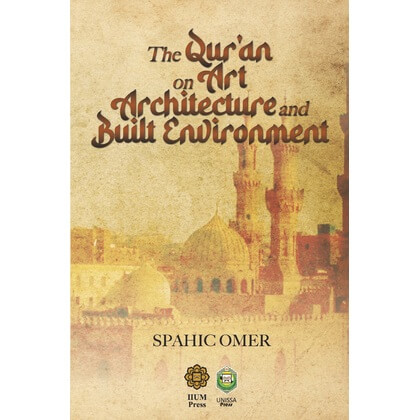 The above article is an excerpt from my award-winning book The Qur'an on Art, Architecture and the Built Environment (2023), which received the Best Publication Award at university level. In this work, I examine how the Qur'an and Sunnah form the conceptual basis of Islamic art and architecture, offering enduring guidance for theory, practice, and education in the built environment.
 Ibadur-Rahman (The Servants of the Most Merciful)


