
IslamiCity
Listen PodCasts, Live Quran, Watch Videos @VideoHub

God is the creator and controller of all that exists. He is omnipotent and omniscient beyond and above humans and transcends all the human understating. Islam is the only faith among the world religions that stands out with realistic understanding of God. This article provides in summary the major articles of the prevalent world religions and of the Islam in the following.
According to the Washington-based Pew Research Center in its article titled How the Global Religious Landscape changed from 2010 to 2020 Muslims grew fastest, Christians lagged behind global population increase. The world's population expanded from 2010 to 2020, and so did most religious groups, according to a Pew Research Center analysis of more than 2,700 censuses and surveys.
Christians remained the world's biggest religious group, but Christians of all denominations, counted as one group did not keep pace with global population growth from 2010 to 2020. The number of Christians rose by 122 million, reaching 2.3 billion. Yet as a share of the world's population, Christians fell 1.8 percentage points, to 28.8 %.
Muslims were the fastest-growing religious group over the decade. The number of Muslims increased by 347 million, more than all other religions combined. The share of world's population that is Muslim rose by 1.8 points to 4.1%. The Pew Research Center estimated the world Muslim population at 2.0 billion in 2020.
Buddhists were the only religious that had fewer people in 2020 than a decade earlier. The number of Buddhists worldwide dropped by 19 million, and declined to 324 million.
People with no religious affiliation, who are sometimes called "nones"- were the only category aside from Muslims that grew as a percentage of the world's population. The number of religiously unaffiliated people rose by 270 million, reaching 1.9 billion. Hindus grew at about the same rate as the world's overall population. The number of Hindus rose by 126 million reaching 1.2 billion.
Jews also held steady as a share of the world's population. The number of Jews worldwide grew by nearly 1 million, reaching 14.8 million.
All other religions combined (including Bahais, Daoists, Jains, Sikhs, adherents of folk religions and numerous other groups) expanded in tandem with the rest of the world, but their share of the global population held steady at 2.2%.
Collectively, 75.8% of the world's people identified with a religion as of 2020. The remaining 24.2% did not identify with any religion, making people with no religious affiliation the third- largest group in this study, after Christians and Muslims.
The growth of religious "nones" is striking because they are at a "demographic disadvantage" since their population is relatively old, on average, with relatively low fertility rates. However, unaffiliated people continued to grow as a share of the global population because many affiliated people around the world - primarily Christians - are "switching" out of religion.
Sub-Saharan Africa is now home to the largest number of Christians, surpassing Europe. As of 2020, 30.7% of the world's Christians live in sub-Saharan Africa, compared with 22.3% in Europe. This change was fueled by differences in the two regions' rates of natural increase (with much higher fertility rates in Africa than in Europe), as well as by widespread Christian disaffiliation in Western Europe.
Global change in the size of religious populations is the result of two primary mechanisms. Religious switching 2. Natural increase i.e. the difference between births and deaths.
Religious 'switching.' The religious unaffiliated category has had the largest net gain due to switching during the period under report. Christians experienced the biggest net loss from switching, 3.1 left for every 1.0 joined . Buddhists also had more people leave than joined - 1.8 left, 1.0 joined. Hindus have had more people leave than join. However, religious switching into or out of the Hindus and Buddhis groups is relatively uncommon.
Islam is generally considered the most converted religion in the world. Every year, thousands of people from all walks of life choose to follow Islam. Therefore, Islam is one of the fastest and most active growing religions. It is believed that around 3 million people convert to Muslims every year. Studies estimate about 30,000 convert to Islam annually in the U. S., including many celebrities.
Buddhism and Hinduism have common origins in the culture of Nepal and ancient India, which around 4the century C.E spread and became dominant religion in Southeast Asian countries A great majority of 94% of the world Hindus live in India. Nepal has 2%, and Bangladesh about 1% of the world's Hindus. As a whole, Hindus are younger with a median age of 26 than the overall global population, median age of 28.
Even though Hinduism is referred to as a polytheistic religion, a Pew Research Center 2019-2020 survey found only7% believe in multiple god. Nearly 95% Hindus in India celebrate Diwali, the festival of lights indicating overcoming of good over evil.
Nature of God's existence in Hinduism. For Hindus, Brahman is the ultimate reality. Brahman is divine and it exists mainly in three forms called Trimurti. The three forms are Brahma, Vishnu, and Shiva. Brahma is the lord of creation, Vishnu is the Lord of Preservation and Shiva is the Lord of Destruction. According to the Pew Research report of June 29, 2023, 44% of Hindus are closer to Shiva. In Hindu temples, Shiva is represented both through his male form as well as a symbol, known as lingam. Shiva's role in destruction does not necessarily have a negative role. Destruction is is considered central to creation, paving the way for beneficial change, according to the report.
Reincarnation or rebirth after death. Hinduism advocates reincarnation; that when a person dies, his soul lives on and transmigrates into a new body, and continues its journey through various life forms in this world. This process is influenced by karma, the principle actions have consequences and shape the soul's future incarnations. Good deeds lead to more favorable rebirth, while negative actions can result in a less desirable one. The ultimate goal in Hinduism is to break free from the reincarnation cycle and attain moksha or liberation from the endless cycle of birth and death.
Animals are sacred in Hinduism. Among the unique features of Hinduism is that they consider animals sacred, and Hindus worship various animals because they believe animals are closely related with their Gods. Elephants represent the head of Lord Genesha, horses are associated with Lord Ram, cows are considered holy and given the status of mother, bulls are revered because they symbolize strength and vitality and are closely associated with Lord Shiva, monkeys are associated with Lord Hanuman, snakes are associated with both Lord Shiva and Lord Vishnu, rats and mice are associated with Lord Ganesha, and lions and tigers with Goddess Durga.
Cows are sacred and Killing of cows is banned in India. Cows are kept in some Hindu temples. No Hindu will eat any beef product.
The caste system in Hinduism is among the world's oldest surviving social systems, with a history of more than 3,000 years A June 19, 2019 BBC article explained its complexities. The system divides Hindu society into rigid hierarchical groups based on their karma (work) and dharma (the Hindi word for religion, but here it means duty).
The caste system of the Hindu society is accepted as the basis of order and regularity of society. Many believe that the groups originated from Brahma, The Hindu God of creation. Then the Kshatriyas, or the warriors and rulers, supposedly from his arms. The third class is Vaishyas, or the traders, who were created from his thighs. At the bottom of the heap were the Shudras, who came from Brahma's feet and did all the menial jobs.
The main castes were further divided into about 3,000 castes and 25,000 sub-castes, each based on their specific occupation. Outside of this Hindu caste system are the achhoots called the Dalits or the untouchables.
The Caste system has dictated almost every aspect of Hindu religious and social life. Rural communities were long arranged on the basis of castes, the upper and lower castes almost always lived in segregated colonies, not sharing the water wells. Brahmins would not accept food or drink from the Shudras, and one could marry only within one's caste.
The India's caste system survives to this day. It is often criticized as being unjust and regressive. However, despite these obstacles, historians have recorded quite a few Dalit and other low-caste Hindus have moved up, such as BR Ambedkar who authored the Indian constitution, and KP Narayanan who rose to become India's first Dalit president. As such, Historians also note that until the 18 th century these formal distinctions were of limited importance and Indians could move from one caste to another rather easily.
The British who were India's colonial rulers made the caste system as India's defining social feature when they used censuses to simplify the system, primarily to create a single society with a common law that could be easily governed.
After achieving independence, India's constitution banned discrimination on the basis of caste, and in an attempt to correct historical injustices and provide a level playing field to the traditionally disadvantaged, the authorities concerned announced in 1950 quotas in government jobs and educational institutions for scheduled castes and tribes, the lowest in the caste hierarchy.
In 1989, quotas were extended to include a grouping called the OBCs (Other Backward Classes) which fall between the traditional upper castes and the lowest.
In recent decades, with the spread of secular education and growing urbanisation, the influence of caste has somewhat declined, especially in cities where different castes live side-by-side and inter-caste marriages are becoming more common.
Some say the caste system would have disappeared by now if the fires were not regularly fanned by politicians. At elections, many caste groups still vote as a block and are wooed by politicians looking for electoral gains. As a result, what was originally meant to be a temporary affirmative action plan to improve the lot of the unprivileged groups has now become a vote-grabbing exercise for many politicians.
Buddhism's worldwide existence. There are about 488 million Buddhists worldwide, representing 7% of the world's total population. There are three major branches of Buddhism Mahayana, Theravada and Vajrayana (sometimes described as Tibetan). Mahayana Buddhism is believed to be largest, because it is prevalent in several countries including China, Japan, South Korea, and Vietnam. Theravada Buddhism, the second largest is concentrated in Thailand, Burma (Myanmar), Sri Lanka Laos and Cambodia. Vajrayana Buddhism is the smallest of the three is in Tibet, Nepal, Bhutan, and Mongolia.
Buddhism began in Asia and nearly 99% live in Asia-Pacific region. In North America there are 3.9 million Buddhists, and in Europe 1.3 million are Buddhists. China has 50% of the world Buddhists at 244 million, Thailand 13%. Japan 9%, Burma (Myanmar) 8%, Sri Lanka 3%, Vietnam, 3%, Cambodia 3%, South Korea 2%, India 2%, and Malaysia, 1%.
Globally, Buddhists are older with a median age of 34 than the overall population with amedian age of 28.
Buddhism is generally considered a non-theistic religion, meaning it does not center on the belief in a creator god or a supreme being who brought the universe into existence. Various Buddhist traditions acknowledge the existence of deities, often called devas, but they are not considered as supreme beings.
Buddhists believe in reincarnation as the Hindus do. Reincarnation is the cycle of rebirth and that they are subject to karma.
The core of Buddhist practice is focused on personal liberation called Nirvana, the ultimate peace and freedom from suffering through practices like meditation, mindfulness, and ethical conduct. Buddhists emphasize that individuals are responsible for their own liberation through their actions and choices they make for their salvation.
Islam is monotheistic. The following description is taken from bitesize bbc.uk, on beliefs and practices and nature of God in Islam.
Monotheistic means there is belief in one God. Central to the belief is Tawhid, that is the belief in one God, who Created and controls the universe. Islam is the last of of Abrahamic faiths revealed to Prophet Muhammad, 570-632. Belief in one God is an essential aspect of Islam-there is no partner or any associate with God. In Islam there is no image of God. Muslims believe in the transcendence of God, in other words, God cannot be compared to anything or anyone as He is holy. Allah is compassionate creator and sustainer of the universe.
Tawhid is fundamentally a rejection of polytheism, the belief in multiple Gods. Tawhid means that no other being shares in God's attributes, power, or the right to worship. Tawhid is not just a theoretical concept but also a practical one that guides Muslims in their daily lives. It requires complete and unwavering devotion to Allah, rejection of any form of idolatry or polytheistic practices. Shahada is the declaration of faith as the core expression of faith stating "There is no God but Allah, and Muhammad is the messenger of Allah." A prophet who received message from the creator is a messenger. Muslims believe that the Prophet Muhammad is the final prophet. "We believe in Allah and that which is revealed unto us and that which was revealed unto Abraham, and Ishmael, and Isaac, and Jacob, and the tribes, and that which the prophets received from their Lord." (Al Baqarah 2, 136).
Whenever a Muslim mentions the name of Muhammad, they say "Peace be upon him." For Muslims, the prophets provide an important link between Allah and humankind. Key fact. The basic truth brought by all Muslim prophets is that there is one God and the wicked will be punished while the good will be rewarded.
Identity and diversity of different traditions in Islam. The main difference between Sunni and Shi'ah Muslims stems from a debate about the leadership. The question is: Should there be a family line or rulers, or did Muhammad intend for there to be elections to find the best candidate to lead? Those who believe in the election of a new leader became known as Sunni Muslims, Sunni Muslims. The word 'Sunni' is related to to the Arabic word 'Sunnah' and means 'followers of the Prophet's Sunnah or tradition'.
Sunnis make up the majority of Muslims worldwide. They believe in Muhammad's role as the prophet of Allah ended with him. In other words, no one else revealed Allah's laws and will after Muhammad.
Shi'ah Muslims. The word 'Shi'ah' comes from a phrase meaning 'followers of Ali'. Ali was the Prophet Muhammad's son-in-law and cousin. For Shi'ah Muslims, the Hadith of Ali (the record of the traditions or sayings of Ali)is consulted as well as those of Muhammad. Shi'ah Muslims believe that a new Imam should be chosen by his predecessor through divine inspiration. In other words, it is Allah's choice , and Allah did not leave Muslims without guidance and leadership.
Sufi Muslims. The mebers of this section of Islam want to feel as close to Allah as they possibly can, They are not happy with simply following the five pillars of Islam.
Sufi Muslims trace back to the 8 th century CE. This tradition emphasizes a relation with Allah. There is focus on purity of the heart, rather than living out rituals.
Key fact. Sunni, Shi'ah and Sufi Muslims differ with regards to their holy scriptures and some ritual practices.
The purpose and practice of the five pillars of Islam. Muslims follow the five pillars to show their submission to the will of Allah. The Five Pillars are visible signs of the Muslim way of life and the unity of Muslims with other members of Islam worldwide.
Key fact. Muslims believe that we will have to answer to Allah for the way we have chosen to live. Muslims believe that on a day decided by Allah, and known only to Allah, life on Earth will come to an end and Allah will destroy everything. On this day, all the people who have ever lived will be raised from the dead and will face judgment by Allah. Muslims believe that they will remain in their graves until this day, which is called by different names: the Day of resurrection (yawm al-Qiyamah), the Day of Judgment (yawm al-din), the Last Hour (as-sa'a), Allah will judge a person's actions as well as their faith - believers will be forgiven for their sins and go to Heaven, those who do believe will go to Hell.
"Judgment will be passed among them equitably, and they will not be wronged. And every soul will be fully compensated for what it had done. He is well aware of what they do." (Al-Zumar 39: 69-70).
Qur'an completes and corrects the early scriptures of Torah and the Bible. Muslims often refer to God as Allah, which is a generic name for God, related to Aramaic and Hebrew names for God. It affirms that He is one unique being with no partners or equals. The name Allah cannot be pluralized or limited to a specific gender. God is the one who Created all that exists in the universe (or universes as is now known), and controls and sustains them all.
As a final scripture Quran completes and corrects all connotations in the earlier scriptures. Such as description of God as a human being in Genesis; Jacob wrestles with God and lets him go only after getting the promise that will raise prophets in the progeny of Jacob.
Much more serious is the Christian belief of Jesus as God or son of God. Islam Belief organization has a lengthy discussion on how Bible has been changed, yet there exist clear and explicit verses in the Bible that show Jesus is not God. The Qur'an severally negates this wrong Christian notion; for example ponder over the following verses: "And to warn those who say, 'God has begotten a son.' They have no knowledge of this, nor did their forefathers. Grave is the word that comes out of their mouths. They say nothing but a lie." (Al Kahf 18: 4-5).
How could humans who God created become God, the mortals become eternal, despite all their shortcomings and weaknesses?
God Created humans as His representatives and granted numerous favors. God created man as His representative, Khalifa on earth as stated in the following verses: "Behold thy Lord said to the angels 'I will create a Khalifa on earth."(Al Baqarah 2: 30). God bestowed enumerable blessings on humans: "If ye would count up the favors of Allah, never would ye be able to number them: for Allah is oft-Forgiving, Most Merciful." (Al Nahal 16:18).
God placed the heavens and earth at the disposal of humans. "And He has subjected to you, as from Him, all that is in the heavens and on earth: Behold in that are Signs indeed for those who reflect." (Al Jathia 45: 13).
God created means of sustenance for humans and for all creatures: "And We have provided therein means of subsistence - for you and for those for whose sustenance you are not responsible." (Al Hijr 54:20).
Entry into Islam starts with Shahada. Shahada or 'Witnessing', is as if the person has already seen God, convinced of Him and is now 'Witnessing' or testifying that He is the One who should be worshipped and obeyed. Other articles of the faith surround this major concept.
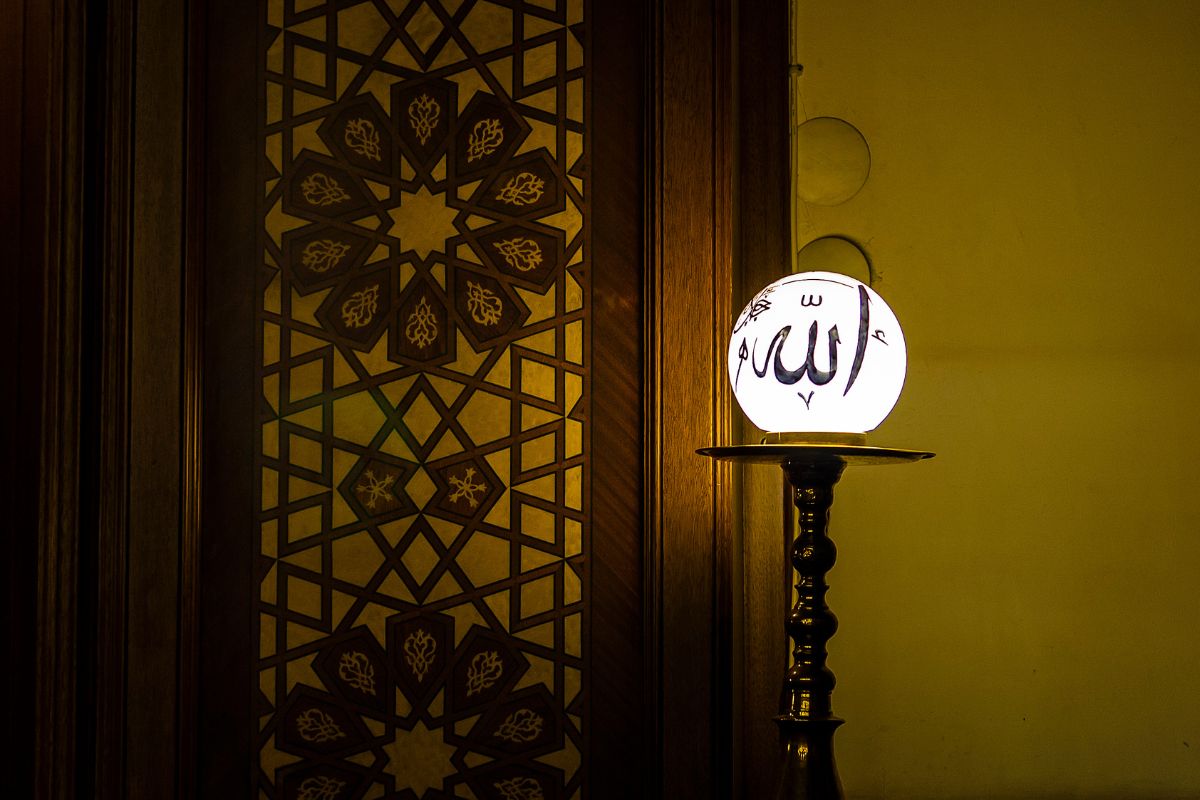 Where Do Hearts Find Rest… If Not in Allah?


