
IslamiCity
Listen PodCasts, Live Quran, Watch Videos @VideoHub

No annual event on the face of the globe, religious or non-religious, compares to hajj in terms of the sheer number of participants, duration of the event and the breadth of agenda. In spite of this fact, it has always remained equally fascinating and mysterious to not only non-Muslims, who are not allowed to enter the area, but also to millions of Muslims, who had not performed Hajj.
What then is Hajj? In essence, hajj is man's evolution toward Allah; his return to Him. It is a symbolic demonstration of the philosophy of creation of Adam  , the first man. To further illustrate this, it may be stated that the performance of Hajj is a simultaneous show or exhibit of many things. It is a show of creation. It is a show about history. It is a show of unity. It is a show of Islamic ideology. It is a show of Ummah, the community of Muslims. That is why it is said in the Quran: "And proclaim unto mankind the Hajj. ... That they may witness things that are of benefit to them." (Quran 22:27-8)
Just as in any other good show or movie or theatre-play, the following conditions prevail in Hajj. Allah is the Stage Manager. The theme portrayed is the actions of these main characters - Adam, Haw'a (Eve), Ibrahim, Hajera, Isma'il , and Shaytan. The main scenes are - Masjid al-Haram, 'Arafat, Mas'a (space between the mountains - Safa and Marwa), Mash'ar (area between 'Arafat and Mina) and Mina. Important symbols are - Kaba, Safa, Marwa, day, night, sunshine, sunset, idols and rituals of sacrifice. The dress and make-up are - 'Ihram, halq, and taqseer (part of ceremonies of hajj involving cutting of hair and nails, afterward). Lastly, the player in the show is - YOU - the Hajji. You are the main feature of the performance. The role of Adam, Ibrahim, Isma'il and Hajera in a confrontation between Allah and Satan is all played by you. As a result, you are the hero of the show!
Hajj is a duty unto Allah for mankind, for him or her who can find a way or means to get there (Quran 3:97). It is not a tax on your wealth, but a duty. Thus, to qualify, you must be sane and wise to understand what you are getting into, and able-bodied to go through this task, and lastly, have the means or resources to perform Hajj.
Others are not pillars, although some may require kaffara or penalty, if not done. The person who puts on the 'Ihram or cloth for either 'Umrah (lesser pilgrimage) or hajj (greater pilgrimage) is called a Muhrim.
1. Ifrad involves first performing Hajj and then Umrah.
2. Tamattu is when one first performs Umrah and then Hajj, both in the same year with some break in between the two.
3. Qiran is when one puts on the 'Ihram with the intention of combining both Hajj and 'Umrah without any break in between the two.
2. Make provision for hajj from one's lawful wealth.
3. Learn the pillars of Hajj and its ceremonies.
4. Be kind and forbearing with others, lest the reward be nullified.
5. Observe the obligations of prayers and its statutes.
6. Be open-handed, maintain the poor and spend as much as he/she is able to.
7. At the station of 'Arafat, remember the Day of Judgment (Yawmil Qiamat).
8. Should not miss visitation of the Prophet's  grave in Madinah.
9. After return from Hajj, one should turn toward Akhirat (Hereafter).
10. One should remember his parents and other close relatives who have passed away with pious prayers and make-up for them if they could not fulfill their obligations for hajj.
The show of hajj begins with Miqat. At this point, the participant must change his/her clothes. Clothes show individuality, status, preference, and distinction. They create superficial barriers that separate man from man. The concept of "I" (and not "We") emerges which gives birth to discrimination. At Miqat you assume your original shape as a "man", just one of "children of Adam" who will die one day. The cloth of 'Ihram is, therefore, the antithesis to that "individualism", it is the kafan (or burial shroud). You wear the kafan, the two pieces of cloth, just like everyone else. You join the mass, the multitude and become nothing or just a drop of water in the ocean that has no special identity of its own. An atmosphere of genuine unity prevails everywhere. It is a human show of Islamic unity, it is a show of universal brotherhood. The bodies were left in Miqat and the souls are motivated here. This is the beginning of your journey, your voyage to nothingness. There is no sex, no perfume, no shoes, no sewn clothes and head covers for men, no face mask, no cutting of hair or nails, i.e., absolutely no signs of aristocracy or distinction. In the state of Muhrim, you don't even look in a mirror to see your own image. You don't hunt any animal, you don't uproot any plant. So you kill the tendencies of aggression by being peaceful to nature. You cease to remain or behave like somebody. Hajj is a movement to returning to Allah, just as Allah says in the Quran: Wa ilal-lahil maseer (24:42), meaning, "Unto Allah is the journeying." All your selfish egos must be buried at Miqat. You witness your own dead body and visit your own grave. By sacrificing your individuality, you focus on reality, the basic purpose for which you were created - that being a slave unto Allah. Just as when you would be buried in two pieces of cloth, leaving behind all your wealth and worldly belongings, here in Miqat you practice a dress rehearsal for that inevitable event.
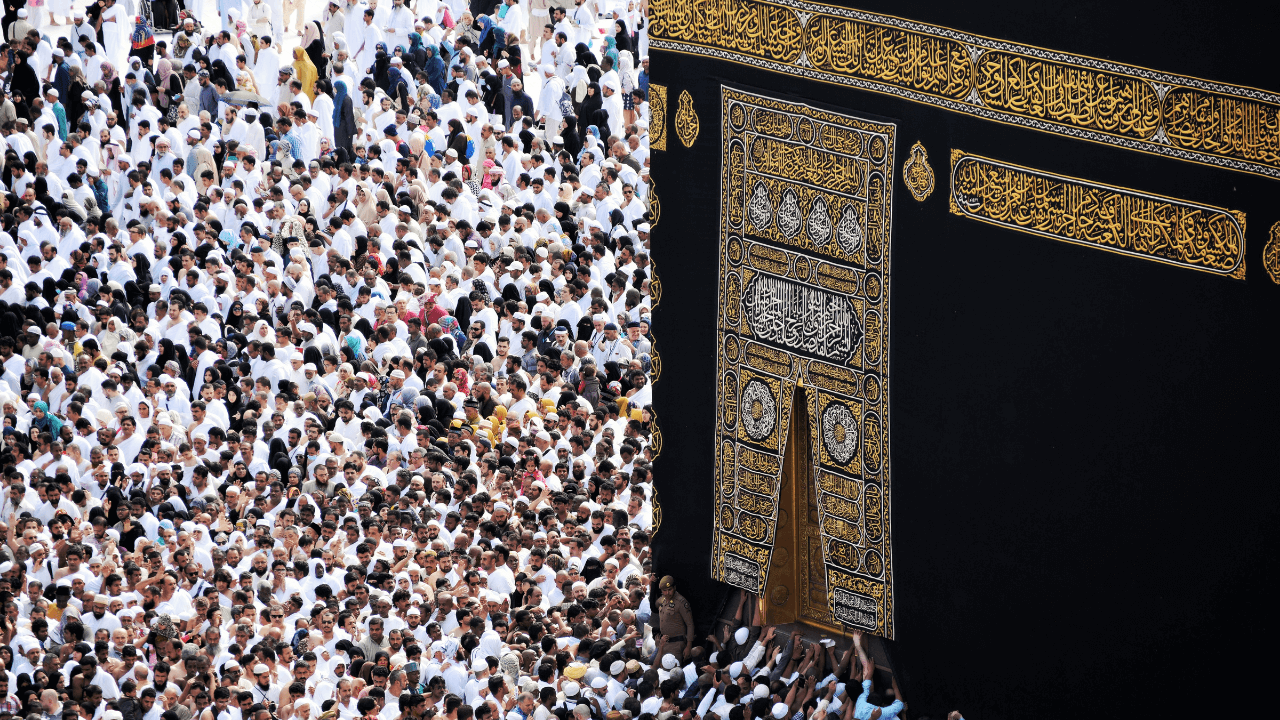
prayed for its security and blessings. Just as planets of our solar system orbit around the sun, you orbit around the world's sun - the Ka'ba, and become part of a universal system. You demonstrate your love for Allah by making Tawaf around His house. Tawaf should be started from the cornerstone - the Black stone, Hajr al-Aswad - with Ka'ba on the left. This is where you make a contract to join all the tribes of the earth, and become like a drop of water entering the ocean. The moment of truth has come and you must select your path, distinct from those who had rejected their Creator. Three of the seven Tawafs must be at a faster pace than normal walking. You should try to touch the stone with hand, and put your forehead on it and then kiss it. By touching the stone, you have shown your allegiance to your Creator, who had sent this very stone from the heaven, so that He could know your love for Him. By touching the stone, you have cut off all forms of allegiance to anything other than Allah, you have become free again from the servitude of men and this world. During Tawaf, you become part of the cosmos. You forget about yourself. You are in love with the symbol of unity and servitude to Allah. You see nothing but His symbols, the Ka'ba and the Black Stone, Hajr al-Aswad. By denying yourself you have become a lover of Him just like Hajera who migrated to this land, barren and rugged, without vegetation, without any forms of subsistence, but with complete reliance in Her Lord, Allah Subhana Wa ta'Ala (SWT). And Allah did not neglect either her or her infant son. He brought out the Jamjam well and let people settle there, making it the most important place in the Arabian peninsula. Remember that some rituals of Hajj are, in reality, a memory of Hajera. Hijrah or migration is what Hajera did. Any migration like hers is a move toward civilization.
During Tawaf, everyone encircles the Ka'ba collectively. The movement is of one unit and there is no individual identification of men or women, black or white, red or yellow. The movement has transformed one person into the totality of a "people." All of the "I's" have transformed into "We," establishing the universality of ummah with the goal of approaching Allah. Likewise, all your self-centeredness must go and transform into self-denial or ummah-centered activities. Allah's way is the way of the people. In other words, to approach Allah, you must first approach people. That is why individual activities in Islam are less meritorious than collective actions. You step out of the Tawaf cycle at the same place you started after completion of the seven orbits. This is just like being resurrected from the same spot where you would be buried.
Maqam is a very blessed place for praying (Quran 2:125). It is the nearest point to Allah. As a matter of fact, there is no place in this entire earth where you get more reward than this place for praying. The stone has the footprint of Ibrahim , the rebel against the established despot of his time, Nimrod. He stood over this stone to lay the cornerstone - Hajr al-Aswad and to re-construct the Ka'ba and to pray (Quran 2:125). Do you now understand where you are standing? By standing on the same stone, you vow to become like Ibrahim Hanifah wa Khalil-Allah, the upright friend of Allah, who was uncompromising in his conviction of Tawhid. In Maqam, symbolically, you shake hands with Ibrahim by pledging the same dedication to Allah - i.e., to be like Ibrahim and Isma'il , his son.
This is called Sa'iy. Literally, it means search, a movement with an aim. It is depicted by running and hurrying. Here you act like Hajera, the mother of infant Isma'il. She had no food, no water, no shelter, neither for herself nor for her child, but only uncompromising, relentless faith that the God of Ibrahim will not leave her and her only son without sustenance. Remember, when Ibrahim left her and their only son, Isma'il near the valley of Makkah, Hajera asked him: "O Ibrahim, where are you leaving us, while there is no habitation of men nor any provision for food and drink? Who is going to look after us?" Ibrahim  replied, "Ilal-lah (to Allah's protection only)." She said, "Raditu billah (I am fully satisfied with Allah?" She also asked, "Have you done this to fulfill Allah's command?" When Ibrahim confirmed that by saying, "Yes," she simply said, "Well in that case, we have no fear, for Allah will not let us die without providing any provision [i.e., He will definitely provide for us in the middle of this desolate, barren desert]." [Bukhari] Do you see the strength of her trust in Allah? Away from the view of his wife and son, Ibrahim prayed, "Our Lord: Lo! I have settled some of my posterity in an uncultivable valley near unto Thy Holy House (Ka'ba), Our Lord! that they may establish proper worship. So, incline some hearts of men that they may yearn toward them, and You provide them with fruits in order that they may be thankful." (Quran 14: 37). Soon, however, Hajera's water and food were all gone, there was no milk or water or any food either for herself or for her child. She started looking out for water, running to the top of the mountain, Safa. No, there is no water anywhere. Then she comes down and looks at her infant to check if he is fine. She then goes to the top of the other mountain, Marwa, and takes a deep long look to fetch water. She was searching water, why? Because it is needed for physical salvation, for life to continue. So, should man work for livelihood, trusting in Allah. She searches again and again. After running seven times between these two mountains, she comes down from Marwa to see the condition of her infant son. She hears the sound of gushing water coming from near her son and is surprised to see an angel (Jibril) dig a well near the heel of her infant son. The gushing water from the well was making all that sound. She quickly puts a barrier around it so that water could be stored and that it did not overflow. And this well came to be known as the Jamjam. Muhammad said, "May Allah bless the mother of Isma'il . If she had not put that barrier around the Jamjam, instead of a well, the gushing water would have continued to flow like a spring [and flooded the entire valley]." It was a gift from Allah to the mother and son, and all those who came later. It is a mineral water rich with nutritional and medicinal power to cure man of many diseases. The Safa and the Marwa, thus, became among the signs, indications of Allah (Quran 2:158).
Visit and stay at Mina on the eighth day (after arriving there in the morning) till the next Fajr (dawn prayer).
Proceed to 'Arafat (five miles further north) and seek Allah's forgiveness there till Maghrib (prayer after sunset).
'Arafat literally means knowledge and science. 'Arafat represents the beginning of man's creation, that of our forefather Adam. It was shaytan who misled our forefather by whispering to him saying: "O Adam! Shall I show you the tree of immortality and power that wastes not away?" (Quran 20:120) He caused the downfall of Adam and Haw'a (Eve). For years, they were separated from each other having descended at different places. It was in 'Arafat that they met again. It was in a small rocky hill of Jabal al-Rahma in the center of 'Arafat that their sins were forgiven by Allah. So, here in 'Arafat, you act like Adam or Haw'a and seek forgiveness for you and your loved ones.
Spend the night before Eid in Muzdalifah. Pray Fajr early. Collect pebbles there (70 per person).
Muzdalifah is part of Mash'ar-ul-Haram. Our Prophet Muhammad prayed for long duration here. You must be in Mash'ar by the nightfall (while you were at Arafat during the day). Darkness engulfs you in Mash'ar. Arafat is knowledge, it requires daylight for clear vision. Mash'ar literally means consciousness and understanding. Such blossom at night through deep reflection or meditation. So, Mash'ar is the stage of insight while Arafat was the stage of experience. Intuition needs no light. It can see in the darkness. It is the stage between knowledge and love, or Arafat and Mina. Here you reflect upon yourself and strengthen your spirit. Are you not in the right way? Are you ready to fight against Satan or his insinuations? In Makkah, during tawaf you joined the crowd and became part of them. Here you are alone, despite being within a crowd. Here you are for yourself only. Therefore, confess your sins to Allah. And this night is a good cover for your tears. Take preparation for tomorrow by getting ready tonight. There is a great battle in which you have to participate tomorrow. So, collect your weaponry - the pebbles - before the day breaks. The pebbles will be used against your enemy. You have to act like Ibrahim here just as he fought against the insinuations of Satan on his way to sacrifice his beloved son, Isma'il .
. Mina literally means love. Ibrahim felt too much love for his only son, Isma'il . And Allah wanted to test how great or how real his love was for Him. Ibrahim saw a vision of sacrificing his most beloved son. That was the command from Allah to test Ibrahim of his love and devotion. Can Ibrahim pass this test? He ponders on this unusual, rather cruel, test. He has grown old and he has no other offspring. In his very old age, Allah has listened to his prayer and has blessed him with this son through his second wife, Hajera. As a thanksgiving for answering his prayer, he has named his son, Isma'il (meaning: God listened [to my prayer]). was asked to settle Isma'il and his mother in the valley of Makkah when the child was still an infant. And now that the lad has become old enough to walk and reason, Allah wants him to sacrifice that son to prove that his true love is only for Allah. Just ponder on this for a moment (Quran 37:102). Don't you get a chill in your back? Satan tries to create doubt in his mind: 'O Ibrahim, are you sure you want to sacrifice your son, your true love, your joy, the meaning of your existence, the fruit of your life; who would there be after you to worship your Lord; don't you have heart, any soft feelings toward your son?' Ibrahim is momentarily confused. Should he or shouldn't he carry out Allah's command, "you must sacrifice your son?" Is he dreaming or is it the reality? No, there is no confusion what he saw in his vision is crystal clear; God truly wants him to sacrifice his beloved Isma'il. He wins over Satan, the sneaking whisperer. But then Satan returns and tries to digress him from his task. Ibrahim wins over again. But Satan does not give up that easily, he tries to create confusion for the third time. Ibrahim wins over Satan's temptations yet for the third time. He is mentally all prepared to carry out the task. His choice is obvious - absolute obedience and devotion to Allah; Isma'il must be sacrificed. He wanted to share the message with his lad. Thus, he talks to his young lad, Isma'il , of his dream and asks his opinion. And what does this "gentle" son (whom the Quran calls Ghulamin Halim) reply? He calmly says: "O my father! Do that which you are commanded. Allah willing, you shall find me of the steadfast." (Quran 37:102) He answers like the rock of Gibraltar! What did you expect? Did you expect the son of Ibrahim , the upright, to be any less faithful than his father? So, here in Mina, you act like Ibrahim , the soldier of Tawhid (monotheism), ready to defeat, subdue or shoot down your real enemy, the Satan within you representing your personal egos, desires, cravings, and preferences. These "other" things, the "idols", were distracting you from the true worship of God. But here in Mina, you are now ready to fight against these taghoots (demi-gods) to show your true devotion and obedience to Allah. You fight Satan just as Ibrahim had fought against him. To mimic that event, you throw stones at Satan at the three Jamarats.
Qurbani or sacrifice an animal, saying only Bismillah.
When both the father and the son - Ibrahim and Isma'il - had surrendered to Allah and Ibrahim had flung Isma'il down upon his face and was about to put the knife on his son's neck, Allah called Ibrahim : "O Ibrahim! You have already fulfilled the vision." (Quran 37:104-5) Ibrahim doesn't have to sacrifice his son. Instead, he should sacrifice this ram, which has been sent to him, as a ransom for Isma'il . Unlike the false-gods of polytheism, Allah, the One True God, is not bloodthirsty. He just wanted to check where Ibrahim stood in his devotion and love, whether he was capable of overcoming his personal feeling of love for his son to please Allah. A lesson was taught by Allah - from now on there would be no human sacrifice in the altar of God. The sacrifice of a halal animal whose meat you can eat and distribute among the poor is a sufficient substitute.
asked to sacrifice? It was nothing short of the most beloved thing/entity among his possession. But when he was ready, his Isma'il was returned unto him, unscathed and unharmed. And he was made a model for humanity: "And We left for him [Ibrahim ] among the later folk (the salutation): Peace be unto Ibrahim. Thus do we reward the good." (Quran 37:108-9) If you love something more than you love Allah, then that thing has become your idol and you must be ready to sacrifice that. Are you ready to slaughter your worldly desires, worldly love, your Isma'il in Mina in order that you be free from all attachments save those of Allah? If you are, then slaughter a goat, sheep, ram, cow or camel as a ransom towards your Isma'il. As Dr. Shariati rightly puts it, "To offer a sheep instead of Isma'il is a "sacrifice", but to sacrifice a sheep just for the sake of sacrifice is "butchery"!" (Ref: Hajj by Dr. Ali Shariati) For surely Allah says, "Their flesh and their blood do not reach Allah, but the devotion from you reaches Him." (Quran 22:37) Men should shave their head or trim their hair, at least, one-quarter of the head. Women should not shave their head but only trim slightly at the end of the lock of a hair.
After the Qurbani (sacrifice) of the animal, you have almost completed the basic requirements of Hajj, so you can make an end of your unkemptness (Quran 22:29). You have defeated Satan but you may not have succeeded in completely killing it. You may have defeated him outside but he comes back inside of you. So, you should stay for the next three days in Mina and continue with your battling of the Satan at Jamarat.
After shaving or trimming the hair, you should go to Makkah and make the Tawaf of visitation and run seven times between the Safa and the Marwa. Then your hajj is complete and you can come out of Ihram.
. When you first approached Ka'ba you had not, by then, purified yourself. You were still impure and unconscious. In Arafat, you gained consciousness. In Mina you purified yourself. So, this is appropriate that you do the tawaf and sa'iy in the purified state before you return home. During the rituals of Hajj, you played the roles of Ibrahim and Hajera. Do not replace your role-playing to something else when you return. Like Hajera, always trust in Allah. Like Ibrahim fight the fire of Nimrod, i.e., oppression. Like Ibrahim be prepared to sacrifice your Isma'il, i.e., love or desires, for the sake of your faith. That is the essence of Hajj. You return to Allah the way He wanted you to be: a slave totally dedicated to his/her Master. In closing, let me quote from Ali bin Uthman al-Jullabi al Hujwiri's (R) Kashf al-Mahjub. A certain man came to Junayd [al-Baghdadi] (R). Junayd asked him whence he came. He replied: "I have been to hajj." Junayd (R) said: "From the time when you first journeyed from your home have you also journeyed away from all sins?" He said, "No." "Then," said Junayd (R), "you have made no journey. At every stage where you halted for the night did you traverse a station on the way to Allah?" He said: "No." "Then," said Junayd (R), "you have not trodden the road stage by stage. When you put on the Ihram (pilgrim's garb) at the proper place did you discard the attributes of humanity as you cast off your ordinary clothes?" "No." "Then you have not put on the Ihram. When you stood on 'Arafat did you stand one instant in contemplation of Allah?" "No." "Then you have not stood on 'Arafat. When you went to Muzdalifa and achieved your desire did you renounce all sensual desires?" "No." "Then you have not gone to Muzdalifa. When you circumambulated the Ka'ba did you behold the immaterial beauty of Allah in the abode of purification?" "No." "Then you have not circumambulated the Ka'ba. When you ran between Safa and Marwa did you attain to the rank of safa (purity) and muruwwat (virtue)?" "No." "Then you have not run. When you came to Mina did all your wishes cease?" "No." "Then you have not yet visited Mina. When you reached the slaughter place and offered sacrifice did you sacrifice the objects of sensual desire?" "No." "Then you have not sacrificed. When you threw the stones did you throw away whatever sensual thoughts were accompanying you?" "No." "Then you have not yet thrown the stones, and you have not yet performed the pilgrimage. Return and perform the pilgrimage in the manner which I have described in order that you may arrive at the station of Ibrahim ."
May Allah grant us the vigor to follow the dictates of hajj so that this duty is acceptable unto Him.
Habib Siddiqui lives in suburban Philadelphia, PA, and is the author of the book "Islamic Wisdom". This essay is based on the book "Hajj" by Dr. Ali Shariati.
 The Spirituality of Hajj: Conclusion


