
IslamiCity
Listen PodCasts, Live Quran, Watch Videos @VideoHub

 |
Hamas views itself as an Islamic resistance group against the Israeli occupation. It rejects to recognize the State of Israel, and makes its annihilation as one of its main goals. They see any means of hurting Israel as a "legitimate" way of this struggle, including suicide bombings and random rocket attacks into Israeli territories.
To be sure, armed struggle has been the only way for achieving freedom and independence by many nations on earth, including Israel. Thus, the Palestinians do also have every right to resist an occupation and establish their independent country if they wish to do so.
In my opinion, however, armed struggle is a not an absolute. It is contingent on many factors, the most important one of which is whether the armed struggle stands a realistic chance of succeeding. If the answer to t his question is a realistic "yes," so be it. If however, the answer is a thoughtful "no" than the struggle is nothing more than a protracted suicide. In case of a "no" scenario, I believe that the best strategy of struggle is that of non-violent struggle.
I would doubt the sanity of those who believe that Hamas stands a realistic chance of succeeding militarily against Israel, a covert nuclear power backed unconditionally by a superpower, the U.S. What chance do Hamas' home-made "rockets" have against the state-of-the-art Israeli war machine, while even the military sophistication of the other regional powers does not come close to that of Israel?
Here I will venture to say that there has been no better time and location for waging a successful non-violent struggle than one that Palestinians can undertake in the occupied territories against Israel today. This is because of an unparalleled two-lane public relations expressway that is present vis--vis the Israeli-Palestinian conflict.
First, the said conflict is in the spotlight of the whole world, thanks to the unprecedented level of the sophistication of communication media today. Israel -which is known to go to great lengths to have successful public relations- cannot ignore the world public opinion of its actions.
Second, the Jewish Diaspora has significant presence in many countries, especially in the West. They are far from being monolithic in their views about the Israel-Palestinian conflict. In fact, an increasing number of Jews are coming forward to openly criticize some of the Israeli policies in the region. Emerging advocacy groups -such as the J Street- are presenting viewpoints that are in stark contrast to the ones espoused by the more traditional pro-Israel lobbying groups such as AIPEC. All of this will bring meaningful pressure-directly or indirectly-to bear on the Israeli decision making apparatus.
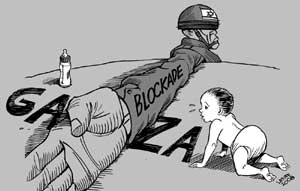
Not even that great champion of non-violence, Gandhi, had the same favorable circumstances for his struggle as the Palestinians have. But, alas, Hamas has so far squandered this golden opportunity. Far from using this set of auspicious circumstances to its advantage, Hamas turned the world public opinion against itself by resorting to suicide bombings in civilian areas and sending primitive home-made rockets randomly into Israel. Apart from the loss of the world public sympathy, the Palestinians got the worst and most brutal punishments from Israel: the targeted killings, the tight Gaza blockade, and the brutal Gaza war.
A humble attempt of the peace activists of the Gaza flotilla to break the Israeli blockade of Gaza succeeded what Hamas modus operandi could not have succeeded in a thousand years! Namely, rallying an unprecedented worldwide support for Gazans, and a willy-nilly Israeli easing of the blockade. The question is whether Hamas will learn a lesson from this incidence, or whether it will keep insisting on dysfunctional and backfiring strategies that are making the lives of millions of Palestinians unbearable.
Hamas ostensibly claims to derive its ideology and ways of conduct from Islam. I, a Muslim myself, am aware of some Islamic "scholars," such as the likes of Yusuf al-Qaradawi, who make an exception for the suicide bombing when it comes to the Palestinian issue. In my view, there is no precedence in the life of Prophet Muhammad that can justify suicide bombing and killing of noncombatants. I think the above-mentioned scholars are wildly off the mark to the point of allowing gross breaches of Islamic injunctions and the example of the prophet. Let me explain my point:
I would remind Hamas that Prophet Muhammad and his followers suffered wicked oppression at the hands of the pagan Meccans for almost thirteen years, including a brutal blockade of the Muslim quarters for three years. Although, Islam does give the right for people to defend themselves within certain code of conduct, the early Muslims did not engage in any armed struggle during their presence in Mecca. Why? The early Muslims could also have engaged in armed struggle that is very similar to that of Hamas today, which involves suicide missions and views as legitimate the killing of the civilians of the other side.
But why did not the prophet undertake them? How difficult is it to send a man with a sword or a dagger hiding under his jubbah to a crowded Meccan fair and have him start killing as many innocent civilians as possible until he is taken over? The reason is simple. The suicide killings and bombings are novel phenomena of the 20th century, as the renowned historian of the Middle East, Bernard Lewis makes clear in his latest book Islam: the Religion and the People. The prophet of Islam could not have resorted to them because suicide killing is not allowed in Islam, as killing of civilians and suicide itself are expressly forbidden. Furthermore, Islam does not want you to wage a struggle if it is not going to relieve you of the causes of your struggle in the first place. In addition, the Islamic means of a struggle must be as much sacrosanct as the aspired end itself. It is precisely for these reasons that the prophet and his followers preferred to migrate (the Hijra) to Medina, demonstrating an alternative solution to a deadlock.
The latter is rooted in the now long-deserted Islamic pragmatism and rationality. The same rationality would find Hamas's stubborn refusal to recognize Israel as a state as primitive and sclerotic.
Is Hamas blind to see how unarmed struggle -as demonstrated by the peace activists of the Gaza flotilla recently- can bring about positive results almost overnight, while their own strategy is decimating the Palestinian people? Or do the Hamas officials have some secret vested interests (to preserve the status-quo) that would prevent them to take that route?
Is it not high time for the Palestinian people to give a serious consideration to the option of waging a full-fledged nonviolent political struggle against Israel?
*****
Dr. Serkan Zorba is assistant professor of physics at Whittier College, CA, USA. He is originally from Turkey.


 Gaza, Lebanon, and the Architecture of a State’s Violence — How a Polit...