
IslamiCity
Listen PodCasts, Live Quran, Watch Videos @VideoHub

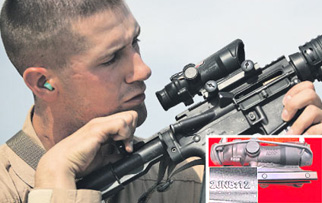 A US marine checks his M-4 service rifle with Trijicon gunsight (inset) bearing the code JN8:12 Photograph: www.defenseimagery.mil |
Jesus loves you. Well, maybe not everybody. Especially if you happen to be a Taliban caught in the crosshairs of a rifle made by the American company, Trijicon.
A bit of a stushie has being brewing of late over Trijicon and, for those readers unfamiliar with the rumpus, let me briefly elaborate.
In a nutshell, Trijicon has a multi-year contract worth $660m to provide state-of-the-art gunsights for the US military and, as was revealed this week, the British Ministry of Defence. So far so good, or bad, depending on how you feel about arms manufacturers. Then again Trijicon doesn't make guns, just bits for guns. Advanced Combat Optical Gunsights or Acog's. I quote from Trijicon's sales promotion material: "When you're engaged in a firefight or defending an established position, you want a battle-tested partner at your side. Trijicon, the world leader in self-luminous Brilliant Aiming Solutions, can supply that partner."
That "battle-tested partner" is not the only thing at your side, however. As every US soldier in Afghanistan will be relieved to hear, with Trijicon they also have God on their side. How do we know this? Well, with every Trijicon gunsight comes a free - yes, free - biblical inscription. For years, it seems, Trijicon has been inscribing its gunsights references to biblical passages. Markings such as "2COR4:6" and "JN8:12" in the same font as the stock number. The first is a reference to part of the second letter of Paul to the Corinthians. The second is chapter eight, verse 12 in the book of John: "When Jesus spoke again to the people, he said, 'I am the light of the world. Whoever follows me will never walk in darkness, but will have the light of life'."
Yes, indeed, the light of life, not to mention the accuracy and enough knockdown power to blow a hole in a man several hundred yards away. But perhaps I'm being cynical. After all, according to Tom Munson, director of sales and marketing for Michigan-based Trijicon, the inscriptions "have always been there". Apparently they were devised by Trijicon's former CEO Glyn Bindon, a devout Christian who appears to have overlooked the words "Thou shalt not kill" before he died in a plane crash in 2003.
How dare I or anyone else presume this might have been a recent addition to Trijicon's products, aimed at ramming home Christian fundamentalism from the barrel of a gun towards an Islamic enemy? That fact that the inscriptions have been there for "two decades" makes all the difference. To be fair, Mr Munson does have a point. He could have argued that Trijicon's values have been around for a very long time, centuries even. Indeed, wasn't it that earlier God-fearing generation of Christian holy warriors, the Crusaders, who used to inscribe their swords before using them to cut up Muslims?
As far as Trijicon is concerned, the company goes to great lengths to point out it has always endeavoured to have its products used whenever "solutions are required to protect individual freedom".
Now, let's address some serious questions. For a start, what sort of message does the existence of these "Jesus guns", as they have been dubbed, send to the Taliban as well as ordinary Muslims in places such as Afghanistan and Iraq?
Stop for an instant to think of the terrific propaganda coup this has handed the Taliban and Islamic extremists. In the vigorous rumour mill that exists about the war in Afghanistan's towns, villages and tea houses, the Jesus guns story will already be doing the rounds. No slouches when it comes to exploiting such tales for their own ends, the Taliban propaganda machine won't miss the opportunity to point out the parallels with the Crusaders and insist that each US and British soldier targets Muslims with the power of their "God's word". The fact that Afghan and Iraqi soldiers have been trained using these gunsights will only add to the potency of the Taliban's long-argued case that the battle for Afghanistan is a "religious war". A war between Christianity and Islam.
How can the Pentagon and MoD talk of winning hearts and minds in Afghanistan while allowing such a crass oversight to play directly to the Taliban's efforts to do the same? Under US military rules, the proselytising of any religion in Iraq or Afghanistan is prohibited. They were drawn up specifically to prevent criticism that the US was embarked on a religious "crusade" in its war against the Taliban, al Qaeda and Iraqi insurgents.
It's not surprising, then, that the Penatagon is keen to play down the Trijicon Jesus guns affair. But some on the other side of the pond are determined that it will not simply be swept under the carpet. "It violates the constitution, it violates a number of federal laws," says Michael Weinstein, of the Military Religious Freedom Foundation, a group that seeks to preserve the separation of church and state in the military.
Quoted on ABC NEWS, the US network that broke the story, Weinstein, a lawyer, says many within the military have complained about Trijicon's markings. This will come as a surprise to many people, who might be forgiven for thinking the US military is hopelessly inhabited by bible-bashing nutters.
Worryingly, though, Weinstein admits that some in the ranks who approve of the markings have referred to the weapons and their Trijicon gunsights as the "spiritually transformed firearms of Jesus Christ".
Meanwhile, on this side of the Atlantic, the MoD, in the best tradition of British understatement, says it had no idea of the significance of the inscriptions when it placed an order for 400 gunsights as part of a 1.5m "urgent operational requirement".
Frankly, it is unbelievable that both the Pentagon and MoD missed the existence of such a potentially provocative issue as these biblical markings on soldiers' weapons. At the very least, it casts doubt on the level of understanding both departments of state have about those parts of the Islamic world where they are embroiled in war.
As for Trijicon, so far there are few signs that the millions of dollars it makes from its contracts will be adversely affected. The company stands by its belief that "America's goodness is based on biblical standards ... and will strive to follow those morals".
In God We Trust might well be the US national motto, but as far as the Taliban is concerned, it is the devil in the detail of the "Jesus guns" that no doubt will add renewed vigour to its own holy war.
Source: HeraldScotland Guest Comment
 Afghanistan: 'America's Longest War Is Finally Over'


