
IslamiCity
Listen PodCasts, Live Quran, Watch Videos @VideoHub

Since there is only one God, Allah, there must be only one Truth. There cannot be two or more Truths, just as cannot be two or more Gods. Moreover, just as people came from the same origin, are subjected to the same laws of existence and march towards the same destination, it is only sensible that they should possess only one vision and mission when in this world and that they are subjected to the same spiritual and ethical tenets, guiding principles and rules. It is because of this verity that every prophet from Adam to Muhammad (peace be upon them all) was appointed to fulfill the same purpose. They had to convey the same message to their respective nations and communities, that is, the message of tawhid, the Oneness of Allah who alone deserves to be glorified and worshipped. "Not a messenger did We send before you without this inspiration sent by Us to him: that there is no god but I; therefore worship and serve me." (al-Anbiya', 21:25)
The only religion before Allah is Islam (Alu 'Imran, 3:19). The rest is error and delusion, being either the distorted versions of Islam revealed at some points of history to some of Allah's messengers, or the belief systems and ideologies which men, now and then, have invented in full absence of the direct influences of revelation and prophets. In either of these two cases, people are false to their own nature and the reasoning strength of theirs, as they are false to Allah's will and plan. "If anyone desires a religion other than Islam (submission to Allah) never will it be accepted of him; and in the Hereafter he will be in the ranks of those who have lost." (Alu 'Imran, 3:85)
Thus, Islam is the first and last revelation from Allah. All the prophets before Prophet Muhammad (peace be upon them all) while preaching the same message operated in single historical episodes until the emergence of their successors, succeeding each other and reviving each other's traditions and legacies, and complementing them, until Muhammad (pbuh) was sent as the seal of prophets whose message was meant to be valid for all times till the end of this terrestrial life. Likewise, all the prophets before Muhammad were sent only to their respective nations and communities, operating in certain geographical regions, until Muhammad was sent to the whole of mankind, thus completing the heavenly cycle which commenced with the creation of the first man and prophet on earth, Adam.
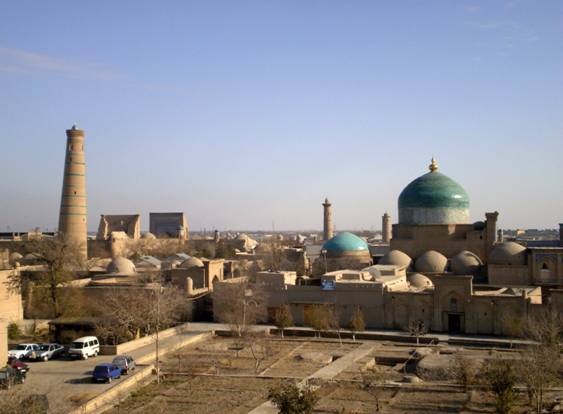 |
| The skyline of the city of Khiva, Uzbekistan. |
Prophet Muhammad's message is a universal and permanent one not affected by the implications of the time and space factors. Besides, not only is it meant for all people till the end of time, but also for Jinns. This necessitated that the Qur'an be meticulously guarded against being lost, misunderstood, interpolated or distorted, which unfortunately was not the fate of previous revealed scriptures. The one in charge of preserving the Qur'an is Allah Himself, as He explicitly vowed in the Qur'an. Since the Sunnah, Prophet Muhammad's words and actions, constitutes the second source of Islam, whose primary task is to interpret, elucidate and complement the Qur'an, it is also a form of revelation. It, too, had to be preserved against misinterpretations, interpolations, distortions and loss, which unfortunately was not the fate of the life stories of previous prophets.
As the seal of prophets, Prophet Muhammad's task was not only to look at the present as well as the future, and to chart the courses for people's moral and spiritual fulfillment. It was also to look back at the past where the tawhidic schemes of other prophets have been corrupted and tampered with, setting the things right and occasionally naming the culprits. That way, the struggles, achievements and legacies of prophets, their followers and whoever wished and contributed any good to the spiritual and civilizational enrichment of mankind have been duly recognized and endorsed. At the same time, the falsehood and deceptive plots of the opponents of prophets and Truth were emphatically exposed and rebutted.
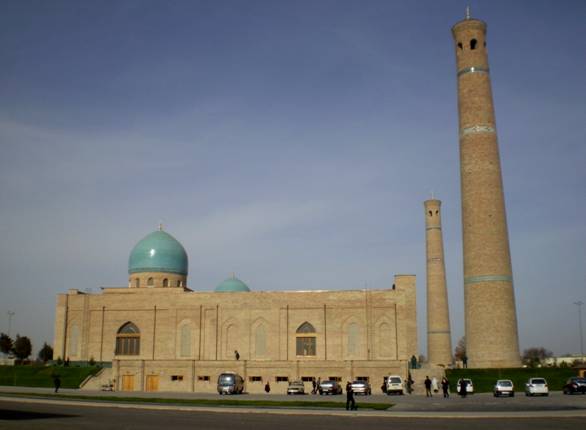 |
| Hazrati Imam Jome Mosque in Tashkent, Uzbekistan. |
Prophet Muhammad (pbuh) thus stands for a microcosm of the prophethood phenomenon and all its protagonists. It is because of this that at the core of the Islamic faith is believing in all prophets and the holy books revealed to them. Rejecting a prophet or a revealed book renders a person a nonbeliever. It is because of this, furthermore, that fundamental to the Islamic message are the notions of Muslim brotherhood, the unity of mankind, mutual understanding and respect, dialogue, tolerance, benevolence, moderation, comprehensive excellence and erudition.
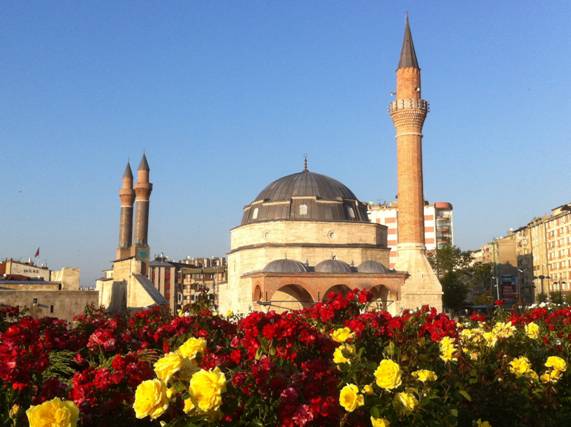 |
| The city of Sivas, Turkey. |
The implications of Islam as the final and universal revelation for Islamic architecture
The implications of the notion that Islam is the final and universal revelation for Islamic architecture are at once conceptual and practical. Due to the fact that the religion of Islam is universal, the architecture of its peoples, which functions as a framework for their Islamic lifestyles, is universal too. Indeed, universal is every segment of Islamic eclectic civilization of which Islamic architecture is an integral part.
Once revealed to Prophet Muhammad (pbuh), the principal and most immediate concern of Islam was not building pursuits as such. Islam and Muslims felt that the most pressing issue was to correct people's perception of God, life and death, the world, nature, culture, civilization and man: his role and position on earth, for if these are perverted, people's perception of and approach to building would be perverted and corrupted as well. Similarly, if these themes are properly grasped and honored, people's perception of and approach to building would be appropriate and inspired as well. For this reason, for example, does the Qur'an speak not only about faith but also about building and development when referring to some of the ancient civilizations, such as that of the 'Ad, Thamud, Pharaohs and the children of Israel. The Qur'an thus wishes to explicate some of the detriments that human society is bound to put up with on the physical plane of civilization as soon as the divinely prescribed worldview and morals are forsaken and other alternatives become pursued instead.
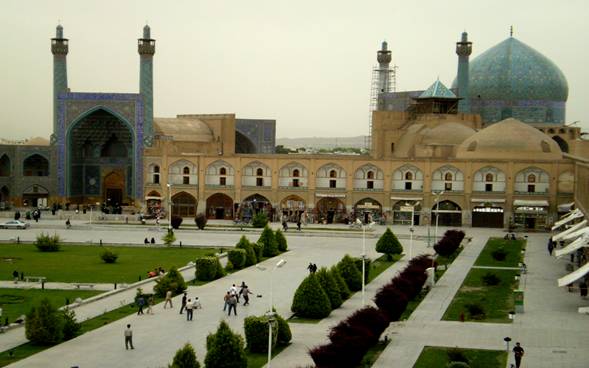 |
| The Shah Mosque as part of the Shah Square in Isfahan, Iran. |
Just like the religion of Islam, Islamic architecture is not confined to an ethnic group, historic episode or a geographical region. It is not governed by a restricted perception or an outlook, nor is it locked up in a style and a set of rigid methods and techniques. Islamic architecture is fluid, flexible and open to all peoples to enrich its infinite orb through their various styles, methods and techniques, and then together to wallow in its spiritual grandeur and enjoy its manifold benefits and advantages. Islamic architecture is a global phenomenon with an outlook that not only makes use of, but also transcends the experiences and ideas of this world. It is a phenomenon with a universal appeal and meaning. It is a product of interplay between the absolute, or permanent, and the relative, or transient, realities, i.e., between the Islamic principles and beliefs that give Islamic architecture its quintessence, and those temporal elements and constituents that give it its ephemeral form. Islamic architecture is a symbiosis between a global religion and life in its totality. It is a union between the material and spiritual spheres, and between the heavens and the earth. Islamic architecture cherishes its perpetual heavenly spirit and identity, never compromising them. At the same time, however, it is ever ready to welcome any contribution by anyone -- even non-Muslims -- so that the former is made even more conspicuous and exalted, and its impact further augmented.
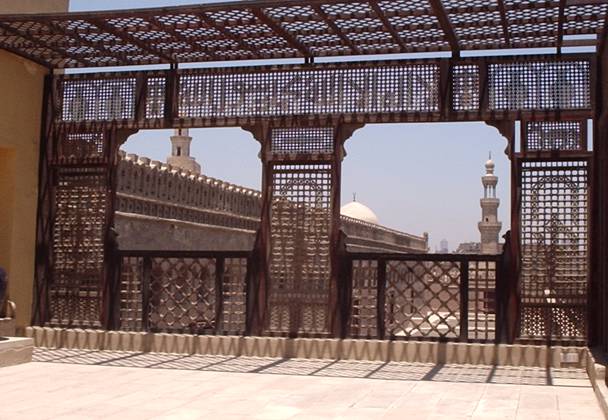 |
| An elaborately decorated screen on the roof of a house in Cairo, Egypt. In the background is the mosque of Ahmad b. Tulun. |
Such was utterly a natural course of action and fully in line with the nature of Islam and its mission. By no means is it fair to accuse, especially the first Muslims, of blindly borrowing from, or imitating, others while embarking on building activities, in the sense that they failed or, at best, were embarrassingly slow in initiating some completely novel and unprecedented styles in architecture. In contrast, it would be strange, embarrassing and repressive if Muslims upon subjecting a territory to the authority of Islam set out to annul and eradicate those indigenous traditions and life systems that people evolved over centuries as most effective in their living conditions and which did not oppose any of the Islamic standards and norms. Hence, such traditions and life systems were kept intact. In demonstrating this Islamic principle, while settling themselves in newly conquered territories Muslims went so far as to reclaim and convert a number of churches and temples into mosques with minimal or no significant structural alterations, and employ non-Muslims in their own building initiatives. Indeed, the whole thing of integrating other people's contributions while evolving the identity of Islamic architecture is rather to be understood as witnessing the Islamic concepts of universality, finality of Prophet Muhammad's message and unity in diversity, being at work and producing some tangible results, while fully conforming to the dictates of the normative Islamization code. As Titus Burckhardt remarked that "art never creates ex nihilo (from nothingness). Its originality lies in the synthesis of pre-existing elements. Thus, the sacred architecture of Islam was born on the day when success was achieved in creating, not new forms of pillars and arches, but a new kind of space conformable to Islamic worship."
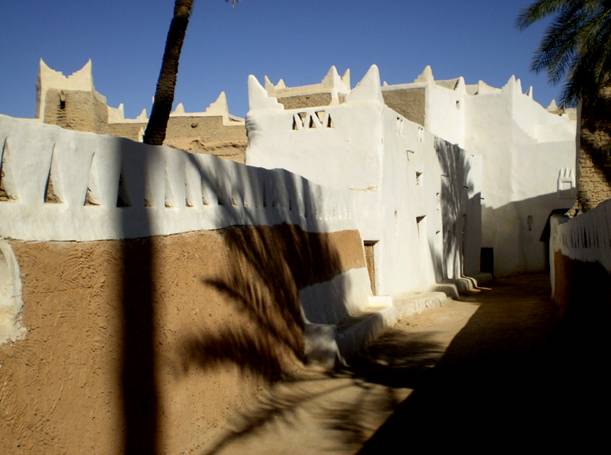 |
| A traditional residential area in Ghadamis, Libya. |
Finally, while dwelling on the theme of the birth of Islamic art and architecture, many scholars' line of discussion is such that it excessively focuses on the geographical, socio-political and cultural aspects, to the point where one feels that the real character of Islamic art and architecture is being rather localized, privatized, downgraded and even de-spiritualized. When one reads what those scholars have written, one almost gets an impression that it was -- for example -- the Umayyads, the Abbasids, the Saljuqs or the Mughals, who were in total charge of Islam and who independently and freely charted the growth if its art and architecture, and not the other way round, that is, Islam was in charge of its peoples: their mentality, traditions and aspirations. It was their point of reference, whereas the ruling Muslim dynasties and the leading socio-political protagonists were no more than the instruments and trustees entrusted with the spread and implementation of the Islamic message on the world scene.
To Muslims, there is nothing more superior and more significant than Islam. Islam is their greatest thing. It is the beginning and end of every Muslim ambition and endeavor. Islam did not come to be inferior or subservient to any person, group or idea. It did not serve the interests of the Umayyads, the Abbasids, the Saljuqs, the Mughals, or any other dynasty or regime. Regardless of how they became the rulers of the Muslim community, the predominant task of those dynasties and regimes was to serve the goals and interests of Islam and Muslims. Against the backdrop of this precept alone are the legacies of Muslim dynasties to be viewed and judged. Surely, if there was no Islam, there would not have been the Umayyad, the Abbasid, the Saljuq or the Mughal and other Muslim dynasties as we know them today. Nor would there have been Islamic art or architecture as we know them today, and which all those dynasties and establishments associated themselves with and so famously patronized.
========= This article is an excerpt from the author's book "Islamic Architecture: Its Philosophy, Spiritual Significance and Some Early Developments".
*****
Dr. Spahic Omer, a Bosnian currently residing in Malaysia, is an Associate Professor at the Kulliyyah of Architecture and Environmental Design, International Islamic University Malaysia. He studied in Bosnia, Egypt and Malaysia. His research interests cover Islamic history, culture and civilization, as well as the history and philosophy of the Islamic built environment. He can be reached at spahico yahoo.com; his blog is at www.medinanet.org.
 The Power of Motherhood in Islam


