
IslamiCity
Listen PodCasts, Live Quran, Watch Videos @VideoHub

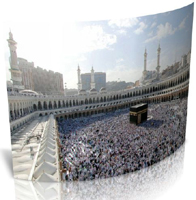
The sacred valley of Makkah is now full with the blessed presence of the pilgrims. As millions of Muslim men and women perform Hajj annually, others can witness this great event through their television and live web streams, thanks to modern science and technology. However, by just looking at the rituals of Hajj, one can hardly understand its greatness and inner dimensions. This is true for the pilgrim as well, especially when he or she performs the rituals of Hajj without contemplating and internalizing its teachings. Indeed, in Islam, the rituals that are devoid of spirit are lifeless, and many a time they are simply underestimation, if not totally misrepresentation of Islam.
Where does the greatness and significance of Hajj lie? And more importantly, how should a person get prepared for this magnificent journey? Before delving into details, it is, however, important to mention that a believer is not always required to understand the deep meaning of every commandment or be aware of its rational exposition. When it comes to fulfilling religious obligations, the Islamic approach is very simple and straight forward: "Sama'a" (listening) and "Ata'a" (obeying). Nevertheless, understanding the inner dimensions of 'Ibadah (devotional worship) is a superior virtue in Islam, for it enlightens the heart and beautifies the acts of the worshiper.
 |
 , his/her whole disposition changes. The pilgrim repents for past sins, seeks forgiveness from people whom he/she might have wronged, and tries to rectify his/her scales where necessary so as not to enter God's court trammeled with the unfulfilled rights of his/her fellow beings. Then, as the pilgrim embarks upon the journey, he/she is careful to harm no one and is free from all kinds of indecency, abuse, squabbles and bickering.
 "Ihram," the simple and humble dress of the male pilgrim, which comprises two sheets of white cotton cloth, is indeed the livery of a servant of God and signifies that after donning it the person is completely at the disposal of God; and in the presence of God all distinctions based on wealth, race, ethnicity, color or region disappear. All believers are one Ummah and they have but one commander (Allah).
The Talbiyah, which every pilgrim recites after wearing the ihram and which is continuously pronounced audibly at every stage of Hajj, is another salient feature of this great worship. The very language of the Talbiyah -"Labbayek, Allahumma labbayek, labbayek laa sharika laka labbayek; innal hamda wa ni'mata laka wal mulk, laa sharika laka labbayek" (Here I come, O my Lord, here I come in answer to your call; there is no God but you (Allah). Here I come, for all domination, all bounty and all goodness belong to you; here I come) - is an unequivocal declaration that the servant has rejected all authorities and allegiances, and has turned his/her entire being to Allah . In other words, the Talbiyah is total commitment and surrender to God.
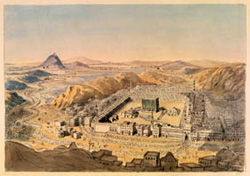
The next ceremony is Tawaf, which is the act of circumambulating the Ka'ba seven times. The Tawaf is symbolic of the resolve of the pilgrim to subordinate all his/her interests and desires to the will of God. The Sa'ee i.e., running seven times between the mountains of Safa and Marwah, is reminiscent of the struggle and desperate search for water by Hajar, the wife of Ibrahim  for her infant son Ismael and Allah's help through giving the well of Zamazam.
Then comes Wuqoof (standing) in Arafat on the ninth of Dhul Hijjah, which is another very essential part of Hajj. This is in fact the main congregation and culmination of Hajj which is indicative of the pilgrim's seeking forgiveness from God for past sins and undertaking to lead a righteous life in the future. Gathering in Arafat also demonstrates the unity of Muslim Ummah and provides the opportunity to plan for common good. It also reminds pilgrims of the Day of Judgment when everyone will have to present his/her account to Almighty Allah. The next rite, the ceremony of Muzdalifah and Mina, especially collecting and throwing pebbles and offering sacrifice, is symbolic of man's determination to resist Satan and to do his/her duty to Allah .
 |
, it drives people to a new level of faith and God consciousness. It also fosters love of Allah and the sincere desire to sacrifice everything for the sake of Allah . Hajj is thus not merely a physical exertion-it is a mental and spiritual journey as well. While performing the various rites, the pilgrim's thoughts are concentrated on God and his/her inner core vibrates with the spirit of intense devotion. Physical pilgrimage is essentially a prelude to spiritual pilgrimage to God.
One scholar has rightly described that the Ka'ba has been placed in the body of the Islamic world just as "a heart in a man's body". As long as the heart beats, a man cannot die. In exactly the same way, the "heart of the world" draws blood from far-off veins and circulates the blood back into each and every artery. "As long as this throbbing of the heart continues and as long as this process of drawing and circulating blood lasts, it will be impossible to end the life of the Muslim Ummah, however disease-ridden it may have become."
Thus, a pilgrim is expected to go beyond the rituals of Hajj and benefit spiritually from this magnificent journey, both as an individual and as part of a collective body. Surely, if Hajj is perceived and performed with these dimensions in mind, it can change the lives of Muslims entirely. It can alleviate or remove their weaknesses, sufferings and disappointments in every aspect.
Indeed, Hajj has not been prescribed for the sake of rituals only or for any trivial purpose. It is meant to provide us with a spiritual rebirth-and is a new life-giving entity. The Qur'an made it very clear: "And proclaim unto mankind the Hajj...That they may witness things that are of benefit to them." (22:27-28)
While preparing and performing the Hajj, every pilgrim must take heed and seek all its benefits.
Dr. Mahbubur Rahman is the Editor of The Message International, a Muslim magazine published from the USA.
 Hajj and Kabah Connecting the Believers


