
IslamiCity
Listen PodCasts, Live Quran, Watch Videos @VideoHub

 |
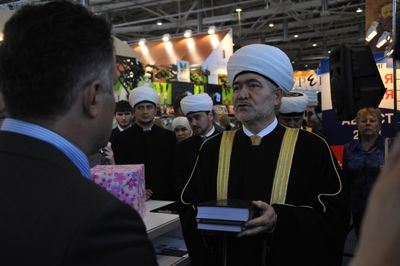 |
| The Head of Russian Council of Muftis, Sheikh Ravil Gaynutdin presenting Islamic literature on Moscow Books Fair |
Reasons of banning
The main reason of recognizing of such quantity of classic Islamic books as extremist literature from one side is very low professional competence of Russian law enforcement agencies and experts on Islamic culture. Police during its raids on different really extremist groups always confiscates a big number of religious books.
As a rule among confiscated materials there are really extremist books but there are classic Islamic works like Seerah, collections of Hadiths or dua'a. After each of such raid a prosecutor organizes religious expertise of confiscated books all together. And this is why such expertise organized by authorities more often than not recognizes all confiscated books as extremist literature.
As for Russian courts they after receiving such rash and thoughtless decisions of experts try in a hurry to ban confiscated literature all together without any differentiation between really extremist works and classic Islamic books. But from another side there is an opinion that Russian law enforcement agencies intentionally widen the list of extremist and banned literature.
But this policy of Russian law enforcement agencies and regional courts radically contradicts the strategy of Russian Federal government which sequentially and step by step works on developing trusted relations with Islamic world and domestic Muslim community. It is demonstrative enough that till now books banned by court decision were not included to the Federal list of extremist materials on the website of Russian Ministry of Justice.
This miscoordination in governmental activity toward Muslim community between Federal and regional levels of power in Russia has been noticed by big number of Russian and foreign experts. And this problem of inconsistency of governmental policy on domestic Islamic field is one the main reasons of raising distrust of Muslim community to Russian bureaucracy.
Other issues
As experts report in all previous years, the most severe persecution in Russia was directed toward particular religious groups. In the same time certain categories of political and civic activists also became targets for "inappropriate anti-extremism". During last decades International and Russian human rights organizations have been criticizing approach of Russian bureaucracy and judicial system to examining religious books through the prism of extremism.
Just a couple of examples. As Human Rights First reports since June 2011, the state prosecutor's office in Tomsk city initiated an epic legal battle to ban a translation of the Hindu "Bhagavad Gita As It Is" as extremist material. The judge dismissed the case and then denied the appeal in March 2012, demonstrating to the wider world that the legal system is capable of preventing egregious misuse of anti-extremism.
In October 2011, Artur Surin, the Deputy Minister of Education of Bashkortostan - a half-Muslim region of Russia - took initiative in "combating extremism" and warned local educational institutions about the dangers of foreign religious organizations of "destructive persuasion," listing one hundred such extremist groups, including Evangelical Christians, Pentecostals, the Jehovah's Witnesses, and Scientologists.
Than human rights groups, the Advisory Council of Protestant Leaders of Russia, and the Federal Ombudsman's Office quickly flagged the case to the government, and the Prosecutor General's Office issued an official condemnation, noting that Mr. Surin's letter mentioned religious groups that are "officially registered and act according to the Russian law."
Decisions for Muslims
For intellectual leaders of Russian Muslim community it is clear enough that the problem of widening list of extremist literature at the expense of classic Islamic works can not be solved only by angry declarations and statements. During this scandal were announced several ideas which might be more effective than declaring one's disagreement with court's judgment.
The first decision was offered by lawyer Rustem Valiullin when he has filed an appeal to the higher court against the judgment of Orenburg district court on Islamic books. The second decision was offered by Russian Scientific and Educational Center "al-Wasatiya". In the official statement on this case "al-Wasatiya" Center declared that it is ready to republished banned Hadith collections and books on Seerah of Prophet Muhammad (peace be upon him).
Against this background Russian Public Chamber - some kind of regular Forum of pro-governmental NGO leaders and activists - suddenly offered more effective initiative. On one of their meetings in this June the members of Public Chamber jointly with representatives of Russian traditional confessions - Christianity, Islam, Judaism and Buddhism - called for changing anti-extremist legislation.
They required from power the acceptance of special law which will be able to protect the Holy Scriptures from accusation in extremism. This initiative may lead to the changing or even abolition of Federal list of extremist materials.
Moreover, "Religious organizations which refer the banned literature should appeal Constitutional Court of Russian Federation", - is convinced Elena Lukyanova, the Head of Institution for monitoring effectiveness of enforcement within Public Chamber.
Two chances
Thus Russian Muslims get a chance to initiate in Russia a serious legal reform in the field of anti-extremist legislation. But the problem is that within Russian Muslim community there is a big lack of professional lawyers, advocates and public activists which understand the logic of Russian judicial system's functioning and have required skills and experience of interaction with official bodies.
That is why this initiative most likely can not be realized by Russian Muslim community single-handed. But the problem can be solved by collaboration of Russian Muslims with other minority religious communities, like Protestants or Judaists.
And such collaboration can give to Russian Muslims the second chance - to demonstrate to all Russian society their peaceful nature and readiness for interaction with different religious and social groups for protecting their freedoms and rights. Exactly in accordance with Prophetic Hadiths and Seerah banned by Russian court as extremist literature.
*****
Dr. Ruslan Kurbanov, senior research fellow of Institute for Oriental Studies of Russian Academy of Sciences, PhD in Political Science
Attachments:
- Photocopy of decision of district court of Orenburg city on recognizing 65 Islamic books as extremist literature.
- Screenshot from website of Russian Ministry of Justice. Page with Federal list of extremist materials.


 Shared Visions of Humanity, Pilgrimage, and Justice in Islam and Judaism
