
IslamiCity
Listen PodCasts, Live Quran, Watch Videos @VideoHub

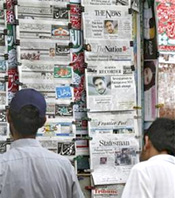 |
| Pakistanis read morning newspapers carrying the headline story on the arrest of a suspect in the Times Square bomb attempt, at a newspaper stall in Islamabad, Pakistan on Wednesday, May 5, 2010. Pakistan's army does not believe the Pakistani Taliban were behind the Times Square bomb attempt as the insurgent group has claimed, a spokesman said Wednesday. (AP Photo/Anjum Naveed) |
Mohib Banda, Pakistan: In his home village in Pakistan, shocked residents remember Faisal Shahzad as a modern father of two from a good family who showed no hatred of America or sympathy with radical Islam.
The 30-year-old naturalised American spent much of the last decade in the United States, where he has been charged on five counts of terrorism, including attempted use of a "weapon of mass destruction" to kill people in New York.
Villagers say the son of a retired air force officer grew up in a comfortable and respected middle-class family, was privately educated and went to university with other sons of the elite in the Pakistani city of Peshawar.
US media reports say Shahzad had worked as a financial analyst in Connecticut, where he lived before his house was repossessed last year because of debt problems.
In the 1980s, when Shahzad was a child, Peshawar was a staging post for the mujahideen who fought against the Soviets in Afghanistan, a place frequented by Osama bin Laden and swollen by a morass of two million Afghan refugees.
But villagers could give no clues as to why the fresh-faced lightly bearded man allegedly drove a Nissan SUV crammed with a large, but malfunctioning bomb into Times Square, nor whether he acted in concert with Islamist groups.
"We were shocked, why did he do this?" said resident Aziz Khan after news spread like wildfire through Mohib Banda, about 25 kilometres from Peshawar, where Shahzad was brought up in an upscale neighbourhood.
"Our village is very liberal. We fear it will be targeted now by security forces. Why have you come here, why don't you go to Peshawar," he said.
It is in the teeming city of 2.5 million people on the threshold of Pakistan's tribal badlands, where according to US authorities, Shahzad underwent bomb making training in one of the most dangerous regions on Earth.
The dusty streets of Mohib Banda, set in fields where threshers were harvesting wheat, are a few kilometres from the Grand Trunk Road that links the capital Islamabad to Pakistan's dangerous north.
The house, which residents say belongs to Shahzad's father and is inhabited by a cousin working for a Pakistani telecoms company and his teacher wife, stands behind a large old-style wooden gate, locked from the outside.
Security officials standing watch in the village confirmed that Shahzad came originally from Mohib Banda.
Residents say Shahzad's father, Baharul Haq, a retired air vice marshal in the Pakistan Air Force, has since settled on hundreds of acres of farmland in Dera Ismail Khan, close to the tribal belt.
One man who spoke to AFP by telephone claimed he was a relative and a lawyer but none of Shahzad's close family members were immediately reachable.
"It looks like some conspiracy to me," said the man, Kifayat Ali.
"They have no relations with any militant group or any jihadi organisation. They don't even have any relations with a political party."
Faiz Ahmed, who told AFP he was a farmer with a transport business on the side, and was one of dozens who gathered as a media frenzy descended on the village, echoed Ali's comments.
"They are very nice, simple and pious people," said Ahmad, adding that Shahzad married a Pakistani girl and has two young children.
He described Shahzad, who was made a US citizen last year and told US immigration he had visited his parents in Pakistan when investigators suspect he underwent militant training, as a "liberal-looking young man".
US media reports say he first went to the United States on a student visa in 1998, graduating from the University of Bridgeport with a computer science degree in 2000 and an MBA in 2005.
"He was clean shaven here but I now see a change. He has grown beard in the United States," said Ahmad, the 50-year-old former mayor of Mohib Banda.
"Shahzad was a modern boy...he spent most of his life with his father who had a house in Peshawar," he said, adding that Shahzad was in the village a few months ago for a family wedding.
With nearly 10,000 residents, Mohib Banda has no religious background and has returned candidates from secular parties, including the Pakistan People's Party of the first woman premier of a Muslim country, the late Benazir Bhutto.
Now a 10-page criminal complaint accuses Shahzad of attempting to use a weapon of mass destruction, attempting to kill people through international terrorism, carrying a destructive device, transporting explosives and attempting to destroy a building.
If convicted, he could be sentenced to life in prison.
Source: Dawn, English daily newspaper from Pakistan
 Map: Israel's Attack Sequence is No Coincidence


