
IslamiCity
Listen PodCasts, Live Quran, Watch Videos @VideoHub

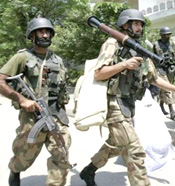 |
| Pakistani soldiers return after storming the Lal Masjid, or Red mosque, in Islamabad July 10, 2007. Pakistani forces killed the leader of the mosque and 50 of his followers. |
The fighting between the students of Lal Masjid and the Pakistani army has left more than fifty dead and many injured. Before the final assault, President Musharraf issued the following provocative statement: "If they do not surrender so I am saying here today that they will be killed. They should not force us to use force. They should come out voluntarily; otherwise they will be killed..." Even before Musharraf's ultimatum, his government was swift to attribute the entire blame for the current crisis on Abdul Rashid Ghazi--the principal of the seminary. However, a close examination of the events preceding the current carnage, suggests that the saga has been facilitated by the Pakistani government.
For the past six months the Musharraf government has tolerated the behavior of the students whenever they chose to challenge its writ. The accumulation of illegal arms, the abduction of Pakistani socialites and policemen, and the seizure of six Chinese women was met with muted criticism from government officials. Furthermore, these activities were not clandestine, and were planned and executed in full view of ISI's headquarters located in close proximity to the confines of the Lal Masjid. The frequent visit of ISI officials and government representatives negates government claims that it was exploring an amicable outcome-- especially when measured against the ferocity of the Pakistani government's response to similar incidents in tribal agencies and elsewhere in Baluchistan. So why did the Pakistani government wait so long to attack the Masjid with overwhelming military force.
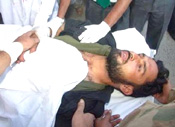 |
| An injured student of the Red Mosque seminary is evacuated to a hospital after an assault by Pakistani forces. |
This question can only be answered in the broader context of the challenges facing Musharraf's rule. At present the Musharraf government has had to contend with both the secular opposition and Islamic forces calling for his removal. The secular forces championed by the Alliance for the Restoration of Democracy (ARD) and Chief Justice Iftikhar have gained momentum and have frustrated America's initiative to get Musharraf re-elected. To diffuse this threat, Musharraf under US auspices has held secret talks with certain leaders of the secular opposition and has deployed force against others. As far as negotiations are concerned, the US on Musharraf's behalf is already engaged in advanced talks with Benazir Bhutto with the aim to break the back of the secular opposition and secure a second presidential term for Musharraf. This also explains Bhutto's recent ambiguous stance on the All Parties Conference (APC) in London, which she has shunned so far.
Whilst the Islamic opposition unhappy with Musharraf's pro-American policies and his neo-liberal attitudes have taken upon themselves to oust him from power. Some have resorted to militancy and others have engaged in protests to vent their anger. But the wellspring of their resentment is fuelled by the religious seminaries which America has identified for secularization or closure. Unlike the secular opposition--where America was keen to compromise and broker a deal- the Islamic forces in the eyes of American policy makers must be secularized at gun point, and any resistance must be crushed. Hence the attack on the Lal Masjid by the military in the absence of martial law, the humiliation of Abdul Aziz Ghazi on Pakistan television, the abrupt cancellation of talks, the media black out and the announcement of 'surrender or die' as a solution to the crisis is an ominous sign for the future of religious seminaries in Pakistan.
What has transpired at Lal Masjid has all the hallmarks of becoming a template for Musharraf to deal with other religious schools and institutions--a recipe for civil war. Not to mention that the timing of the crisis suits Musharraf, as it deflects the public's attention away from the secular opposition and the government's disastrous response to the floods in Balochistan.
What is evident is that the utilization of force by the government to deal with both secular and Islamic forces exposes the lip-service of General Musharraf's mantra of "enlightened moderation." Instead of employing thoughts to battle the ideas of the opposition, Musharraf has resorted to force. The same method has been repeated by Musharraf's allies--America, NATO and Israel-- under the guise of 'battle of hearts and minds' and both have failed to crush the resistance movements in Iraq, Afghanistan and Palestine. So what chance does Musharraf have?
Abid Mustafa is based in the UK and specializes in Muslim affairs.
 The Dogs of Hell


