
IslamiCity
Listen PodCasts, Live Quran, Watch Videos @VideoHub

 |
Gary Hart, the former American Democratic presidential candidate, was on a book tour in Washington. He told an audience that America's "occupation of Iraq has failed" and interests in the Middle East are endangered because administration "ideologues" don't know the limits of Western military and economic power.
Hart suggested that the United States get other oil-consuming countries to join its Persian Gulf security system.
I agree with his first point but have a different take on Gulf security.
The Iraqi insurgency does exemplify the limits of Western military and political clout. And it has stunned the masterminds of the Iraq war, some of whom had planned to make Iraq a loyal, democratic ally as Germany and Japan became after World War II. In fact neoconservatives had told me long before the Iraq invasion that they would make Iraq "an Arab Germany."
A key reason Iraq defied the "German model" is that the West is losing its lure for many Muslims. Muslims today are modernizing but, unlike their parents' generation, becoming disenchanted by the West. In the 1970s about all my journalist friends in the Middle East and South Asia were educated in local colleges and universities. Most didn't have a refrigerator or automobile and showed off their new typewriters. At our get-togethers in Karachi, Pakistan, and Cairo, Egypt, we chatted about Neil Armstrong, the West German economic "miracle" and recombinant DNA.
Some of the children of those friends are now teaching at universities with doctorates from Europe and America or trotting the globe on business. They drive cars, carry laptops and some vacation in the Swiss Alps. I met some of them and was drawn into discussions about American "neocolonialism," post-materialist (values-over-money) writers, and tajdid, or Islamic renewal. They take the amenities of modern life for granted or don't consider modernity the preserve of the West.
Muslim societies are also pulsating with aspirations for freedom. But despite Americans' rhetoric about democratization, many Muslims see America's troops and bases in their lands and support for Israel and repressive Muslim governments trampling their freedom and dignity. Their yearning for freedom threatens their postcolonial states and regimes to which American interests are tied.
Except for Iran, Yemen and Egypt, all South Asian and Middle Eastern states were carved out or restructured by colonial Britain and France. (The British sliced off chunks Afghanistan and Saudi Arabia.) Modern states call for national cultures and bureaucracies. In the West these evolved through centuries of inter-group assimilation. In the postcolonial states, created overnight, dominant culture groups form governments, armies and bureaucracies and impose their rule and cultural patterns on other groups. Some of the suppressed groups use the democratic process to try to wiggle out of those states.
Pakistan, where I lived for years, came unglued in 1971 after its first parliamentary elections based on adult suffrage. East Pakistan voted for an agenda to end West Pakistani domination. A civil war followed and led to its reincarnation as independent Bangladesh. In Iraq ethnic Kurds have voted to loosen their ties to that artificial state, and Sunni Arabs are struggling to avert the Shiite-majority domination.
In these artificial states many citizens identify primarily with their ethnic and sectarian communities. No wonder Iraqi Shiite are getting help from Shiite Iran in their struggle with Sunni Arabs, and Sunni guerrillas from many states are fighting the Shiite and Americans in Iraq. Iraq's internal strife could spread along sectarian lines to neighboring states and exacerbate the anti-regime and anti-American movements there.
Already, some Gulf governments hosting U.S. military bases are shivering from smoldering anti-Americanism and fear that these facilities will increasingly become a lightning rod for "terrorists." Diplomats and intellectuals there are debating an alternative security arrangement, involving leading Asian countries. Gulf States export two-thirds of their oil output to Asia and get a third of their imports from it. Significantly, in January the new Saudi king, Abdullah, made his first foreign trip to China, India and Malaysia.
I believe the security of the world's oil lifeline from the Gulf would be enhanced if it's de-Americanized. Hart's idea of having other nations join a U.S.-led Gulf security arrangement wouldn't do it. That would leave the system as "American" as is the occupation force in Iraq with its Italian, Polish and Japanese elements.
Among the alternative arrangements proposed is that of Christian Koch of the Gulf Security Center think tank in Dubai. He calls for a structure with the participation of ASEAN and NATO, in which America will be involved as the NATO leader. The security of the Gulf's oil and its shipping lanes would clearly be preserved better by a regional grouping including Arab states and Iran in alliance with some outside security structure.
The time is coming when the Americans will have to decide whether their bases and troops in the Persian Gulf are really meant to guard the world's oil lifeline - which is what they have been saying - or maintain American hegemony. If it's the former, the American military presence in the Gulf is about to outlast its purpose and jeopardize the oil trade and infrastructure there. Which means the United States needs to begin discussions with regional governments for the transfer of Gulf security responsibility to a more neutral multinational arrangement. If latter, God help us!
Mustafa Malik, a Washington journalist, covers events in the Middle East and conducted fieldwork on U.S.-Arab relations as a research associate for the University of Chicago Middle East Center.
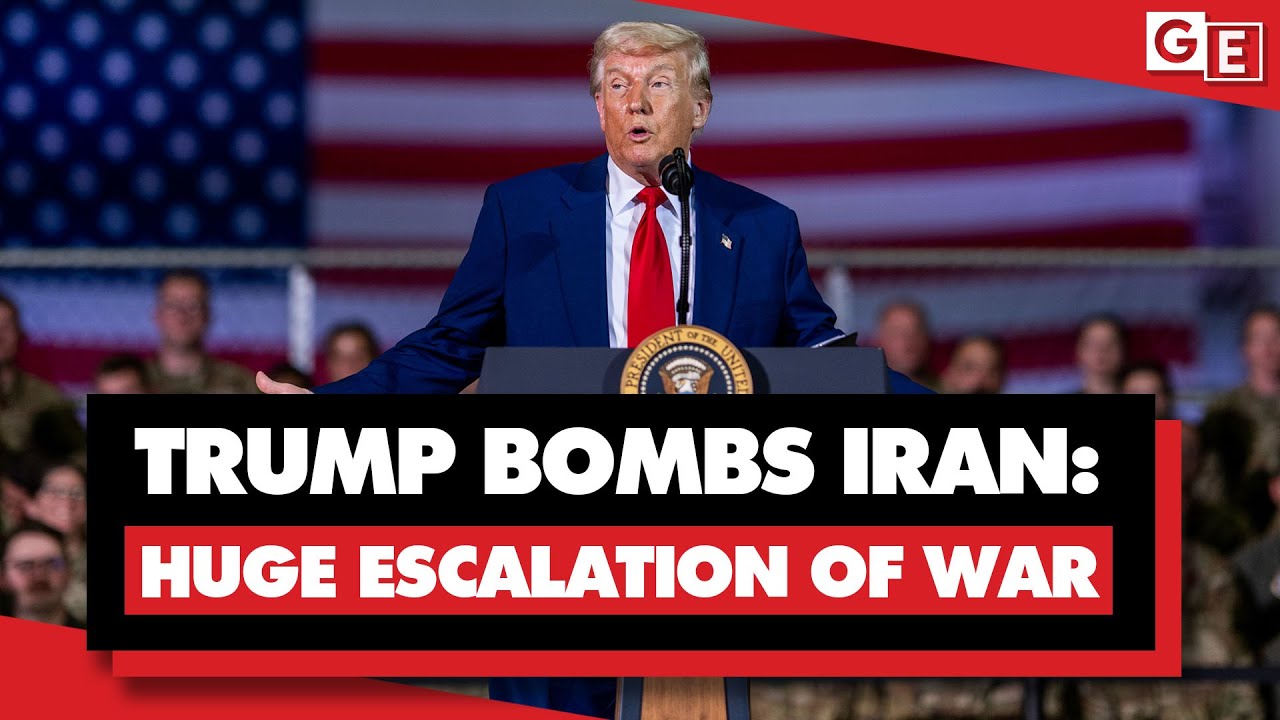 Trump Bombs Iran


