
IslamiCity
Listen PodCasts, Live Quran, Watch Videos @VideoHub

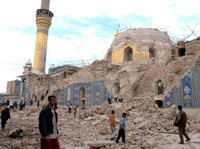 |
| Before the attack the al-Askari shrine in Samarra was known for is distinctive golden dome - built about 100 years ago over historic tombs. |
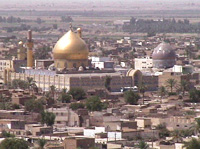 |
| Samarra is situated on the bank of the river Tigris about 60 miles from the city of Baghdad. The city has a significant historical importance because of its two shrines. The first shrine with a golden dome was completed in the year 1905 A.D. Beneath the dome are four graves; Imam Ali al-Naqi (10th Imam) and his son, Imam Hasan al-Askari (11th Imam). The other two are of Hakimah Khatoon, the sister of Imam Ali al-Naqi who has related the circumstances of the birth of Imam al-Mahdi and the fourth grave is of Nargis Khatoon, the mother of Imam al-Mahdi, peace be upon him. The second shrine marks the place where Imam al-Mahdi went into concealment. It has a dome with a delicate design in blue tiles. |
So now we can see who has benefited from the sectarian violence in Iraq: Al Qaeda and its surrogates, Shias, Sunnis or the occupying forces? It would be far fetched to say that the perpetrators of sectarian violence in Iraq are agents of the occupying forces. But the fact is they are helping the occupation.
The blast at the shrine in Samarra is one of the most provocative attacks in the history of Islam. One hopes that the people of Iraq can cope with its consequences. The attack in Najaf two years ago had killed a couple of hundred people including Ayatullah Baqar Al Hakeem and many people were killed last year in Karbala when several blasts took place near the shrine of Imam Hussain.
Of course, nobody is likely to directly claim responsibility for the dastardly act. But it is in the nature of such attacks to unleash a chain of events, which benefit some and harm others.
Ever since the occupation of Iraq, the number of attacks on its Shia community has increased dramatically. Ranging from direct assassinations to suicide bombing, these attacks have killed thousands of Shias. Simultaneously, attacks on Sunnis of Iraq have also increased. There have been reports of bodies of Sunni Muslims found in various parts of Baghdad who were shot in the head.
Most of the people so killed had nothing to do with the violence except that they were its victims. There is a cycle of violence in Iraq in which people from both sects have been killed and which is of no use to either sect. It has however benefited the occupying forces: Shia leaders had to turn to coalition forces with a request to help restore law and order and Sunni leaders have solicited their intervention to help protect them from a majoritarian rule.
The coalition troops have thus found allies among the people of Iraq who would otherwise ask for their departure at the earliest. The continued violence in Iraq has created a demand for the occupying forces to stay for a longer period.
So now we can see who has benefited from the sectarian violence in Iraq: Al Qaeda and its surrogates, Shias, Sunnis or the occupying forces? It would be far fetched to say that the perpetrators of sectarian violence in Iraq are agents of the occupying forces. But the fact is they are helping the occupation.
| One may have heard about the "El Salvador Option" for Iraq, a plan allegedly by Pentagon, talked of targeted killing of 'insurgents' using people from rival groups such as Shias and Kurds to the dirty job. But who knows if such operations actually targeted insurgents. And who knows if the recruits were only from among Shias and Kurds. (An analysis of the 'option' has also been made by Council on Foreign Relations). |
The cycle of violence, which started with attacks against the occupying forces, has turned into sectarian violence. This shift of target has definitely benefited the occupying forces that now appear to be the accepted arbiter of power in the formation of new government.
In the last elections in Iraq, the Shias had won a dominant majority of seats in the Iraqi parliament. Sunnis feared that they would be marginalized politically and economically. But this paled into insignificance compared to the occupying forces' fear that Shias could form a truly 'sovereign' regime.
In the growing tension between Iran and the US-led West, Iraqi Shias' closeness to Iran was also a nightmare for the occupying forces. Also, the more Iraq progresses towards stability as a sovereign nation, the more the legitimacy of the occupying forces' continued presence will be questioned.
United States did not invade Iraq to help it become a sovereign nation. It wanted to turn it into a free-market, client state in this oil-rich region. The cycle of violence in Iraq suits US interests until Iraq is reduced to the desired level of a client state.
US ambassador to Iraq, Zalmay Khalilzad, recently said that any sectarian government in Iraq would be unacceptable and that the US would stop funding if such a government is installed in Baghdad. Similar comments were made by the British secretary of state during his surprise visit to Baghdad a few days before the Samarra blast. US Secretary of State Condoleezza Rice, too, is currently on a Middle East tour and one of the points on her agenda is Iraq's future government.
The blast at Samarra is yet another outrageously sacrilegious act perpetrated by those who want to harm the people of Iraq and change the course of its politics. The best response to the evil act is a demonstration of patience and restraint.
Saqlain Imam is a political commentator based in UK.
 The Dogs of Hell


