
IslamiCity
Listen PodCasts, Live Quran, Watch Videos @VideoHub

 |
Ridley Scott's latest film, "Kingdom of Heaven," is about one of the most obscure and complex periods of world history: the Crusades (1096-c.1300).
"Kingdom of Heaven" is an ambitious portrayal of Europe's emergence from the Dark Ages that established conflict as the way the three monotheistic world religions, Judaism, Christianity and Islam would relate to one another from then until now. To understand this fact is perhaps the strongest reason to see this movie.
The film is familiar territory for Sir Ridley who has a reputation for telling stories through battlefield spectacle ("Hannibal," "Black Hawk Down," "Gladiator"). But "Kingdom of Heaven" may be more successful that these epics because it will attract thoughtful movie-goers who prefer the dramatic experience to interest them on many levels. These include the artistic production quality as well as historical accuracy, religious aspects, the faith dimension and current events.
Through Balian's eyes
The story begins in 1084 with the burial of a lovely young woman (Nathalie Cox) who has committed suicide because her child died during birth. As was the practice of those times, people who committed suicide were not given a Christian burial. The priest (Michael Sheen) who buries the woman steals the crucifix from her neck.
Balian (Orlando Bloom) is the village blacksmith widowed by his wife's suicide. As he works off his despair forging iron at the fire, a strange knight appears at the door. He is Godfrey (Liam Neeson) and he tells Balian that he is his true father. Godfrey invites Balian to come to the Holy Land with him to help King Baldwin of Jerusalem preserve the kingdom. Balian declines.
His next visitor is the priest who buried his wife. The priest taunts Balian about his wife's suicide. When Balian sees that the priest is wearing his wife's crucifix, Balian kills him. He decides to flee immediately and joins Godfrey, hoping he will find forgiveness for his sin in Jerusalem.
Godfrey is killed on the journey but Balian reaches Jerusalem. He seeks peace there, but is not able to find it. He lives on his father's land and notices how Muslims and Christians live well together. Balian meets Sybilla (Eva Green), the king's sister and wife of Guy de Lusigan, an ambitious and stupid knight. Balian and Sybilla are attracted to one another. King Baldwin the Leper (Edward Norton) wants Jerusalem to be the peaceful kingdom of God promised in the Gospels, but some of the knights, both secular and Templar, headed by Reynald (Brendan Gleeson), conspire against the king to provoke a war with the Muslims.
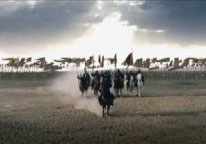
The Muslim army is headed by Saladin (Ghassan Massoud), who marches from Damascus to attack Jerusalem. Saladin is an intelligent, just man who lives by the Koran. How he and the reluctant Balian, the heroes of this based-on-fact film, together resolve the terrible conflagration that ensues, is at the heart of "Kingdom of Heaven."
The question of the meaning of Jerusalem in history, as a holy place and as a symbol, is the climax of the film. At the end, as these two men of conscience gaze up at Jerusalem, Balian asks Saladin, "What does it mean to you?" Saladin starts to walk away and replies, "Nothing." Then he turns back and says, "Everything."
Making connections
Recent epics such as "Troy," "The Last Samurai," "The Alamo" and "King Arthur" have all been box office disappointments. Like some of these, "Kingdom of Heaven" is based on historical facts although the source for Balian's early story seems that of Conrad of Monferrat who fled to Palestine after murdering someone and his relationship with Sibylla almost certainly did not occur. These are incidental to the overall facts of the film which do respect history.
It is impossible not to make the connection to current events, and frankly, director Scott wants us to. "One of the lessons of the film for today," he told journalists recently, "is that we don't learn anything from history; we just keep doing the same things over and over."
Orlando Bloom acquits himself very well in this, his first lead role, though not his first epic ("Lord of the Rings" trilogy, "Troy"). In an interview, the 28-year-old actor called this film his opportunity to take responsibility for his life and work. "Ultimately," he said, "what screams across the movie is what makes for right action. What you do to your fellow man --- this is what matters. This is godliness."
Jeremy Irons is Tiberias, a conflicted knight who has sworn to obey the king no matter who he is. We only see Edward Norton's eyes since he must wear a mask to cover the ravages of leprosy on his face. Yet he manages to engage the audience on an emotional level that the rest of the film never quite reaches.
Writer William Monahan has filled "Kingdom of Heaven" with messages for the audience; much of Balian's dialogue is teaching us about a man's character, true chivalry, honor, peace and the absurdity of war. To director Scott, the meaning of the film is: "If Jerusalem is God's kingdom, then let him have it. If this film isn't about humanity, what is it about? It must be about life and the preservation of life."
Pope John Paul II offered what could be a commentary on a film like "Kingdom of Heaven," when he spoke in Syria in May 2001: "Today, in a world that is increasingly complex and interdependent, there is a need for a new spirit of dialogue and cooperation between Muslims and Christians. Together we acknowledge the one indivisible God, the Creator of all that exists. Together we must proclaim to the world that the name of the one God is a name of peace and a summons to peace."
In Damascus, on May 6, 2001, John Paul II made the first papal visit to a mosque in the history of the world.
The Crusades
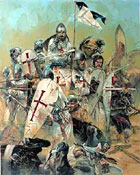 |
The first Crusade, "to bear the cross," was a holy war against Islam called by Pope Urban II at the Council of Clermont in 1095 AD.
"God wills it!" exclaimed the pope, who told the clergy, knights and peasants present that their goal was twofold: to get back the lands of the Christian empire of Byzantium (Constantinople) in from a band of Turks who had recently converted to Islam and to liberate Jerusalem from the "godless infidels" --- Muslims who had occupied Jerusalem peacefully for hundreds of years. The first Crusade was successful; Jerusalem was occupied and a Christian king enthroned.
By offering this assistance to the Christian empire and church of the East, Pope Urban thought he could help mend the first schism between the church in Rome and Byzantium in 1054. Ultimately, this did not prove to be the case.
The Crusades were also about protecting trade routes within and between East and West. At no time during the Crusades did any Christian leader understand the faith and culture of Islam. They demonized Muslims through ignorance and greed and created an enemy to be righteously exterminated.
It must be noted that the Crusades were not explicitly against the Jews. They had not inhabited Jerusalem in great numbers since the Roman destruction of the Temple in 70 A.D. which drove them into exile a second time. Ignorant Christians, however, incited by a terribly misdirected religious fervor, began attacking and killing Jewish people in Europe and the Middle East every time a Crusade was called.
All together, eight Crusades were called over the span of 200 years, though the fighting never stopped. Europeans, in great hordes of poor peasants, knights and whole families, made their way to the East to supposedly liberate Jerusalem. They made the journey because they were promised the kingdom of heaven in return: forgiveness of sins, expiation of all guilt, and a spiritual reward in the kingdom of heaven. Some hoped for material and political gain as well. They died by the tens of thousands on their journey or pilgrimage.
From the First Crusade until 1184-1187, the time of our story, a European Christian king ruled Jerusalem. And for the most part, Muslims and Christians lived peacefully together.
Ultimately, the Crusades were spurred on by misunderstood religious enthusiasm rather than faith. They were a doomed enterprise from the beginning for civilization; we continue to experience their effects even now.
Daughter of St. Paul Sister Rose Pacatte is the director of the Pauline Center for Media Studies in Culver City, and the co-author of "Lights, Camera, Faith: A Movie Lectionary."


 What is the Price of Paradise? - Light Upon Light by IslamiCity - Episode 3...