
IslamiCity
Listen PodCasts, Live Quran, Watch Videos @VideoHub

We live in a universe of cause and effect, the consequence of which are inescapable. Fire burns, diseases infect, time ages, germs destroy, water drowns ... these facts have moral and social implications, all of these are realities with which we have to contend; and each of these challenge our existence, our instincts and our very humanity, writes Sadullah Khan.
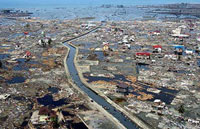 |
| A sea of destruction |
Largest Natural Tragedy
We recently witnessed the largest natural tragedy to strike the human race in modern times. A 9.0-magnitude quake struck 6 miles beneath the ocean and ruptured a 600-mile stretch of fault running north and south off the coast of Sumatra setting off a train of massive waves known as tsunamis (which can accelerate to 500 mph and stretch up to 100 miles long). Within hours, the tsunami resulted in over 150 000 deaths, over 10 million displaced, over 2 million injured, thousands missing; leaving up to five million people across 12 countries (from the Malay Archipelago to the east coast of Africa) without access to the basic requirements for life - water, food and sanitation.
Disturbing Images
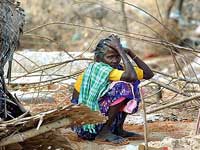 |
| An Indian woman sits in anguish among the wreckage caused by the Tsunami |
We witnessed devastation of biblical proportions, suffering unprecedented in contemporary times, death and destruction beyond belief; affecting among the poorest and most heavily populated areas of the world. The images of the aftermath of the tsunami and earthquake are at once shocking and heart-rendering. By comparison with past disasters, this one has not been confined to just one country or region, neither in terms of devastating impact nor in terms of the humanitarian response it generated. This is the first cataclysmic tragedy in which a large area like the entire Indian Ocean region is a shocked spectator (with the rest of the world), but also a direct victim. In the aftermath, entire villages have been wiped out, groups of bodies were buried in mass graves, hundreds of parents lost their children and thousands of children have been orphaned. Scenes of little children sitting on the sea shore, waiting for the sea to bring their parents back brings tears to the most hardened soul.
What We Realize
From all this we learn that the world is anything but serene, all too vulnerable to natural threats; both earthly (earthquakes, cyclones, tsunamis...) and celestial (meteors...). Any of these hazards may strike at any time and can cause considerable loss to life and property. What is common to all these threats is that in just moments they can reduce a city, with all its inhabitants, to ruin.
These outbursts of nature are reminders to all humanity that we have no control over the planet we inhabit. Each disaster serves the purpose of reminding humankind of its inherent weaknesses, reminds us of our enduring vulnerability in the face of nature; making us realize that neither wealth nor authority, neither science nor technology has any power to resist the forces greater than ourselves.
Suddenly we know the frailty of our place in the universe, just like millions of people all over the world for whom frailty is all-too-familiar. The hope is that our newfound sense of vulnerability will lead to a kind of international empathy and solidarity, which could be the cornerstone of a new spirit of global cooperation --- a cooperation that provides a way to ensure a better world.
We have the challenge to frame the traumatic events into a new crucible of meaning. Witnessing the devastation caused by earthquakes and tsunami does not imply that nature is primarily destructive; the fact that God allows nature to take its course does not imply a lack of compassion. Rather, all this is a challenge to us; the greatest of which is, how we respond in the face of such challenges. We therefore have to respond to Allah's call for helping the distressed rather than debating about Allah's judgment as to why these disasters are allowed to happen.
Allah did not make this world a permanent place. This is a temporary world and everything here is finite and all things have a time limit. Neither are the good things of this world forever nor are the bad things eternal.
My Resolutions for the New Year
In reflecting on the tragedy, my resolutions into this new year are that ...
I will not go to bed another night without reflecting on the advice of our beloved Prophet  who said; "When going to sleep do not assume you will live to see the dawn, when waking up do not assume you will live to see the sunset; take precaution from your health against sickness, take from your life what will benefit you in death."
I must find more ways to help in sharing the burden of others and to make humanity better. I must learn to forgive any hurt or injuries that come my way and treat others as I wish to be treated in every encounter. I must be more cognizant of the fact that my smile, my words, my expression, my support; each can make the difference to someone somewhere who is wrestling with a misfortune of life.
I have no alternative but to commit myself to do all the good I can, by all means I can, in all the ways I can, to all the creation I can, wherever I can, whenever I can, as long as I can, and as best I can.
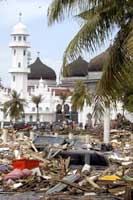 |
| A scene of the devastation in front of the Baiturrahman mosque in Banda Aceh, Indonesia. The tsunami has caused over 100,000 deaths in the province of Aceh. |
What Really Matters
I realize more than ever that all life will come to an end someday, that every day I live is a day further from my birth and every breath I breathe is a breath closer to death. As certain as we are about the occurrence of death, so uncertain are we about its timing and we are therefore instructed, act as if every act could be your last. I recall the admonition of the Prophet who said; Live as you please, but you will die some day; love what you have may, but someday you will be separated.
What I have is only temporary; my life must end and all my possessions will eventually pass on to others. My hopes and my plans will fade with my abilities and my days. Eventually neither my color, nor my gender, neither my language nor my position will matter. What will matter is not what I studied but what I learnt; not who I knew but for what I was known; not what I memorized but for what I will be remembered; not what I said but what I meant; not by how I traveled but where I went; not how much I had but for what it was spent; not what I aspired to but what I attained; not what I thought but what I did, not what I got but what I gave; not what I professed but how I lived, and not how long I lived but what good I did.
To help the victims of this tragedy you can Donate Here
Sadullah Khan was the Director of Islamic Center of Irvine. He has presented lectures on Islamic Civilization at California State University at Dominguez Hills. He is a frequent lecturer for the Academy of Judaic, Christian and Islamic Studies at UCLA (University of California, Los Angeles). He was also an advisor to the Chancellor's Committee on Religion Ethics and Values at UCLA and served as Director of Muslim Affairs at USC (University of Southern California).
You can watch his lectures on Empowerment at IslamiTV
 | Dimensions of the Qur'an The lucid and clear reflections of Sa'dullah Khan, his smooth sailing in the oceans of Qur'anic wisdom and beauty is most encouraging and pleasantly inviting the English reader of the Qur'an to plunge again into the ultimate source of enlightenment and empowerment that we have. |
 The Universe and State of the Ummah


