
IslamiCity
Listen PodCasts, Live Quran, Watch Videos @VideoHub

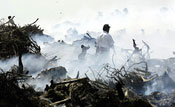 |
| Tsunami devastated Akkrapattai, India |
A friend posed a question to me. He said, "You write about these things all of the time. Does it make sense that the US has allocated $87 billion to spend on Iraq and initially only $35 million to help the people of South and Southeast Asia devastated by the earthquake and tsunami?" Is the US "the most generous nation in the world" as stated by President Bush or is it one of the most "stingy" countries as mentioned by Jan Egeland, the UN relief coordinator? And how have Americans and the American media reacted to one of the largest natural disasters that mankind has experienced?
As we listened to the first media reports of the Indonesian earthquake and the subsequent tsunami last Sunday, those reports were initially lost amongst the holiday season stories of storms and stranded airline passengers. Initial accounts of the Asian disaster placed the numbers killed only as one or two thousand. Those numbers brought to mind the 2,982 people killed in the Sept. 11 crisis and the more than 1300 American servicemen killed in Iraq. America had responded to Sept. 11 and Iraq in a very strong fashion. Would we respond to the Asian crisis and loss of life in a similar fashion?
As more news reports filtered in, it became apparent that the Asian crisis is one of the world's greatest natural disasters. News articles pointed out that you had to go back centuries, in some cases, to find as many deaths caused by an earthquake and, the deaths caused by the Indonesian tsunami, is already the greatest number ever caused by a tidal wave. It was clear that the world would have to pull together to help the people caught in this tragedy.
The American media showed devastating pictures of destroyed cities and villages in Asia and videos of scores of unidentified dead bodies floating in the water. However, the stories about individuals lost in the tragedy were overwhelmingly about Americans and other Westerners. Profiles of fair-skinned victims were shown over and over again yet the darker skinned victims were just part of the mass deaths. Very few, if any, stories emerged about Asian individuals who died or suffered as a result of the disaster while the story of the Western super model who survived the flood was repeated many times. We were not exposed to the "humanization" of the Asian victims.
Possibly because of this, America did not make an official response to the disaster until four days after the tsunami when President Bush came forward. The New York Times pointed out in an editorial that the initial American offer of $15 million was less than half of what the Republicans were spending on Bush's January inauguration. And the UN's Egeland said that the rich nations were being "stingy" with their humanitarian aid.
One had to search far and wide in the Western media to see that Saudi Arabia initially pledged $10 million for relief aid to the Asians. And you had to research even deeper to see that Saudi Arabia has, over the last three decades given foreign aid to 70 countries in excess of $76 billion. More significantly, this amounts to about 4 percent of the Gross Domestic Product (GDP) of Saudi Arabia, one of the highest percentages of foreign aid amongst the world's nations. In contrast, the United States gives about one tenth of one percent of its GDP to foreign aid. Again, significantly, between one fourth and one third of that American foreign aid goes to Israel which has a higher per capita income than some European countries.
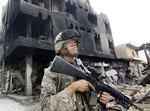 |
| War devastated Fallujah, Iraq |
While individual Americans are reaching into their pockets and donating money for the relief of the disaster victims, our government appears to have other priorities. We spent billions of dollars to destroy buildings and infrastructure in Iraq and now are spending further billions to try to rebuild what we destroyed. Our media spent countless dollars to rush to Asia and tell the story of the destruction there, but we focused much of the media attention on the plight of Western individuals.
Maybe it is this form of media attention that allows us to be less helpful than other nations.
And maybe the "compassionate conservatism" of the Republican Party should focus more of their attention on the plight of our Asian brothers and sisters than on the Republican presidential inauguration.
Dr. Michael Saba is an international relations consultant. [email protected]
 Sorry Cinema


