
IslamiCity
Listen PodCasts, Live Quran, Watch Videos @VideoHub

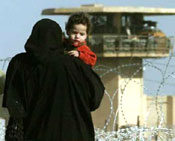 |
| An Iraqi woman holds a young boy as they wait for the release of a loved one at the U.S. run prison of Abu Ghraib. |
"Be on notice," said Secretary of Defense Donald H. Rumsfeld to the Senate Armed Services Committee on May 7. The worst may be yet to come. Senator Lindsey Graham (R-SC), a member of the Committee, put it in more blunt terms: "The American public needs to understand we're talking about rape and murder here. We're not just talking about giving people a humiliating experience." These ominous warnings speak of even worse abuse than the disgusting photos released by "60 Minutes II" reveal. There was a special women's section. There are even videos.
As this scandal widens--and America's image and credibility is further decimated--I can not help but ask myself, "What if there were no photos?" What if "60 Minutes II" and The New Yorker did not release the photographs and details of the abuse at Abu Ghraib prison? Would there have been such a loud and deafening cry of outrage here in America? No, there would not, because it is likely that we Americans would never have known about it.
Allegations of abuse of Iraqi prisoners by American soldiers have been leveled way before this current scandal broke out. In a confidential report by the International Committee of the Red Cross (ICRC), leaked to the Wall Street Journal, some of the abuse was described as "tantamount to torture," and the report said that ICRC began briefing U.S. officials in May 2003, when Iraq was "liberated" and the President declared "mission accomplished." In October 2003, human rights groups had warned top American officials about sexually humiliating practices at Abu Ghraib prison. In fact, Nicole Choueiry, Middle East spokeswoman for Amnesty International in London, said: "[The Coalition Provisional Authority] knew about [the abuse of prisoners] for a long time."
The damning report by Army Maj. General Antonio M. Taguba, which found "numerous incidents of sadistic, blatant, and wanton criminal abuses" inflicted on detainees, was completed in late February but detailed abuses committed between October and December of 2003. Yet, according to Seymour Hersh of The New Yorker, a major investigation into the Army's prison system was already under way in July 2003. This, along with reports by human rights groups, strongly suggest that abuse of Iraqi prisoners has been occurring for a very long time and was much more widespread than U.S. officials contend. Pierre Kraehenbuel, director of ICRC operations, said: "Our findings do not allow us to conclude that what we are dealing with...were isolated acts of individual members of coalition forces. What we have described is a pattern and a broad system."
None of this was known to the American public before the ugly pictures were released. In fact, the Washington Post reported that "U.S. officials said Rumsfeld and the Pentagon resisted appeals in recent months from the State Department and the Coalition Provisional Authority to deal with problems relating to detainees." A senior State Department official said, "It's something Powell has raised repeatedly--to release as many detainees as possible--and, second, to ensure that those in custody are properly cared for and treated." What's more, Senator Carl Levin, ranking member of the Senate Armed Services Committee, said in a hearing about the scandal: "And finally, Secretary Rumsfeld and General Myers, I join our chairman in expressing deep dismay that when you briefed senators in a classified session last week on events in Iraq, just hours before the story broke on television, you made no reference to the impending revelations."
To his credit, Secretary Rumsfeld took full responsibility for his actions: "Let me be clear," he told the Committee, "I failed to recognize how important it was to elevate a matter of such gravity to the highest levels, including the President and the members of Congress." Nevertheless, had the pictures of Iraqi prisoner abuse not surfaced, the American people would most likely have been completely oblivious to the serious violations of human rights being committed by U.S. soldiers. This does every American a huge disservice.
U.S. soldiers are the face of this country before the rest of the world. Everything they do, they do in all of our names. Thank God, the overwhelming majority of them give our country a wonderful name. But if they commit crimes, especially ones as heinous as those at Abu Ghraib, they stain all of America and every single American. Unfair perhaps, but true nonetheless. Far too many times has the American public been kept in the dark about the dubious actions of its government and military around the world. We need to know more about what our government does in our name. This is an essential part of the proper functioning of a democracy. To get caught with our pants down, to get "blindsided" by hideous photographs of sexual abuse of prisoners and then scramble to save face has done damage that is irreversible and irreparable.
The American public should have been notified about the abuse of Iraqi prisoners much sooner. It was not, and this is wrong. Furthermore, the allegations of abuse by U.S. soldiers, without the pictures, should have been enough to rouse the ire that has been roused in America. They did not, however, because they were only words, and "Words don't do it. The words that there were abuses, that it was cruel, that it was inhumane, all of which is true, that it was blatant, you read that and it's one thing. You see the photographs, and you get a sense of it, and you cannot help but be outraged..." I hate to say it, but you are absolutely right, Mr. Secretary. You are absolutely right.
Hesham A. Hassaballa is a Chicago physician and writer. He is author of "Why I Love the Ten Commandments," published in the book Taking Back Islam: American Muslims Reclaim Their Faith (Rodale Press), winner of the prestigious Wilbur Award for 2003 Best Religion Book of the Year by the Religion Communicators Council.


 ‘No More Winning on Islamophobia’: Zohran Mamdani’s Message from New ...