IslamiCity
Listen PodCasts, Live Quran, Watch Videos @VideoHub

A rare Umayyad gold Dinar fetched a whooping US $4.06 million at Morton and Eden's Oct 24, 2019 Islamic Numismatics auction. Add Buyers premiums and this coin will end up costing the buyer a tad over five million US dollars. In April 2011 this same auction house had sold another rare Umayyad Dinar for almost six million US dollars - becoming the second most expensive coin ever sold in the world.
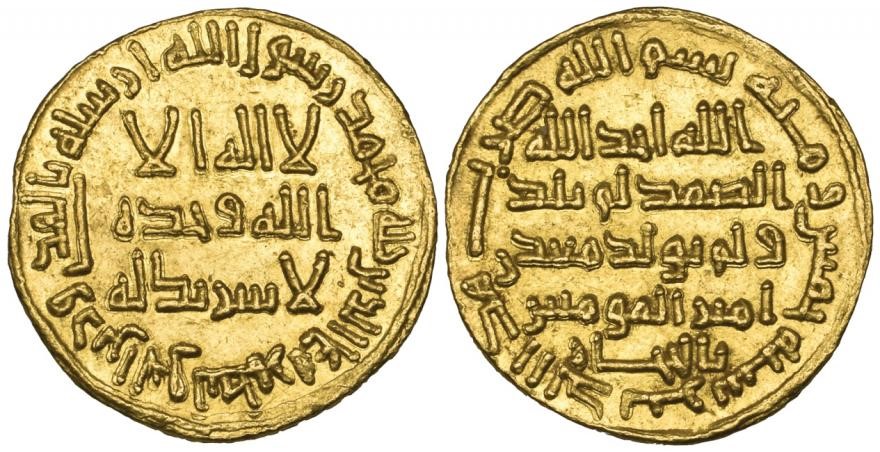 |
| Courtesy: Morton and Eden UMAYYAD, TEMP. HISHAM (105-125h) Dinar, Ma'din Amir al-Mu'minin bi'l-Hijaz 105h. Reverse: In field: Allah ahad Allah | al-samad lam yalid | wa lam yulad Ma'din | Amir al-Mu'minin | bi'l-Hijaz Weight: 4.27g References: Fahmy 128, same dies; Bernardi 48Ed; Walker ANS.16 = Miles, RIC 66. Good extremely fine, extremely rare and an historically important coin. Ex Baldwin's Islamic Coin Auction 19, 'Classical Rarities of Islamic Coinage,' 25 April 2012, lot 17. The only other specimen of this coin to appear at public auction was sold in these rooms, 4 April 2011, lot 12 (for a hammer price of £3.1million). EXTREMELY RARE AND OF GREAT HISTORICAL INTEREST, dinars from the 'Mine of the Commander of the Faithful in the Hijaz' have the distinction of being the first Islamic coins to mention a location within the present Kingdom of Saudi Arabia. The inscription which makes this coin so special is not difficult to translate: Ma'din Amir al-Mu'minin bi'l-Hijaz simply means 'Mine of the Commander of the Faithful, in the Hijaz.' But while scholars continue to study its precise meaning and significance, there are strong grounds for believing that the gold used in their manufacture came from a mine located between the Holy Cities of Makka and al-Madina, which was itself owned not only by several caliphs but which had been given to another former owner by the Prophet (PBUH) himself.
|
Numismatics is more than just a hobby. It tells historians so much about the past. The right to mint coins was one of two things that were fiercely guarded by all Muslim Monarchs - the second being the inclusion of a prayer for the monarch during Friday sermon. Islamic coins provide even more information, than coins of other cultures, as they also contain the mint name (geographical location), and the year of minting, thus providing numismatics and historians with critical information. For those unfamiliar with the Arabic language, Richard Plant's "Arabic Coins and how to read them" will make reading Islamic coins a breeze.
Islamic coinage begun after the newly established Muslim state conquered the Sassanian empire. Umar bin Khattab, the second Khalifa asked a word or two of Islamic terminology (Bismillah) be added to the existing Sassanian coin design; thus, you see the initial Islamic coins having human portraits contained in earlier Sassanian coins. This was followed by Arabic language replacing the Pahlavi script, and the Hijri calendar replacing the Yesdigrid age. Similarly, after defeating the Byzantines, the Muslims initially started marking the existing coins Sahih or Tayyib indicating that the coins were acceptable for usage. This was followed by the removal of the horizontal bar from the cross, and addition of Islamic Terminology.
Khalifa Abd al Malik Bin Marwan was responsible for the complete redesign of the Islamic coins. The obverse of these Umayyad coins had:
لا اله الا الله وحده لا شرك له There is no God except Allah alone He has no partner
The reverse of the Umayyad coins had:
الله احد الله الصمد لم يلد و لم يولد و لم يكن له كفوا احد Allah is the one and only God The eternal and indivisible, who has not begotten, and has not been begotten and never is there
an equal to Him
The margins of the coins are called 'Bismillah,' as it starts with Bismillah and states where the coin was minted and in what year. In Umayyad coins, the name of the Khalifa is not indicated, but, it can be deduced from the year of minting. The Byzantine emperor protested these coin reforms; however, the Khalifa dismissed the Byzantine demands.
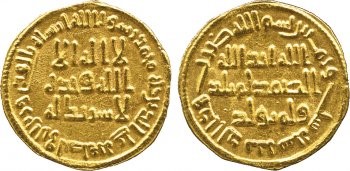 |
| An Umayyad Gold Dinar of 'Abd al-Malik/al-Walid I , 86h, 4.22g. From the author's collection. |
The Abbasids made slight changes to the Umayyad formula, by adding the Khalifa's name to the coins.
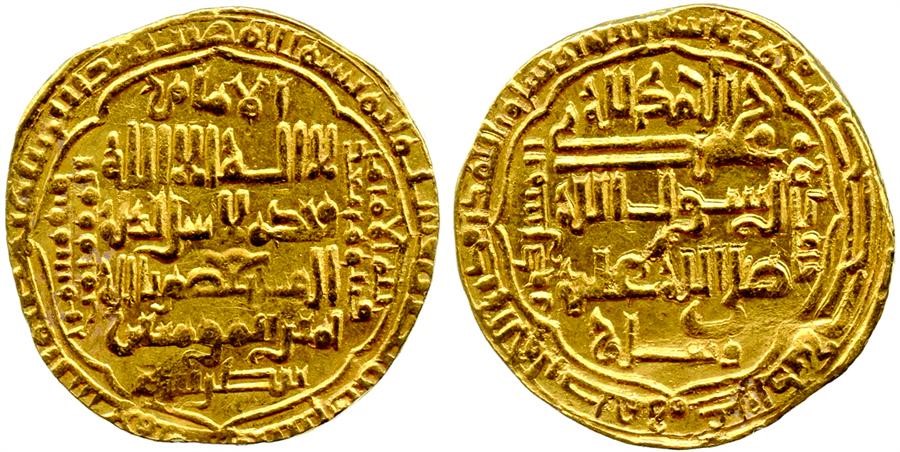 |
| Heavy Gold Dinar of last Abbasid Khalifa, al-Musta'sim (640-656h), Madinat al-Salam 642h, 10.42g (SICA 4:1309-1311; A 275). From the author's collection. |
Reverse: In five lines : Al-Hamdu Lillah/ Muhammad/ Rasulu Allah/ Salla Allah Alayhi/ Wa Sallam, Vertically to the right : Walaw Kariha/ and vertically to the left : Al-Mushrekun. MARGIN : Muhammad Rasul Allah Arsalahu Bil Huda Wa Din Al Hakk Lyuzhirahu 'Ala Al-Dina Kulahu.
Reverse Center:
الحمد لله محمد رسول الله صلى عليه الله و سلم
Sides:
ولو كره المشركون
Margin:
محمد رسو ل الله ارسله ه بالهدى و دين الحق ليظهره على الدين كله ولو كره المشركون
The Ottoman Coins used the Usmani script.
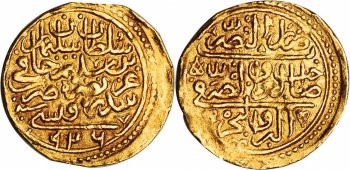 |
| An Ottoman gold Sultani, of Suleyman I, AH 926 (1520), Sidrekapsi Mint, Mint name in one line. The date is given at the bottom. From the author's collection. |
Quality coins from Islamic Spain are also in considerable demand.
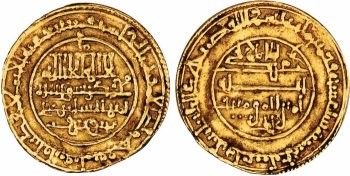 |
| A Murabitid (Spain) gold Dinar, ND, Ali B. Yusuf, AH 500-537; A-466. From the author's collection. |
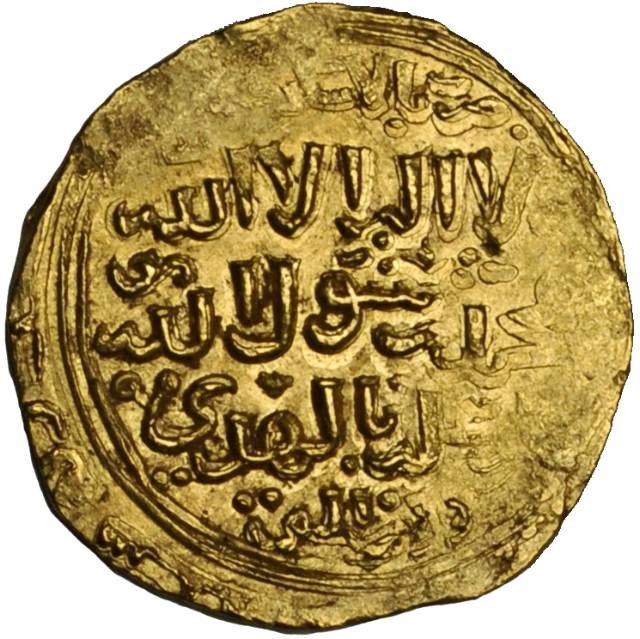 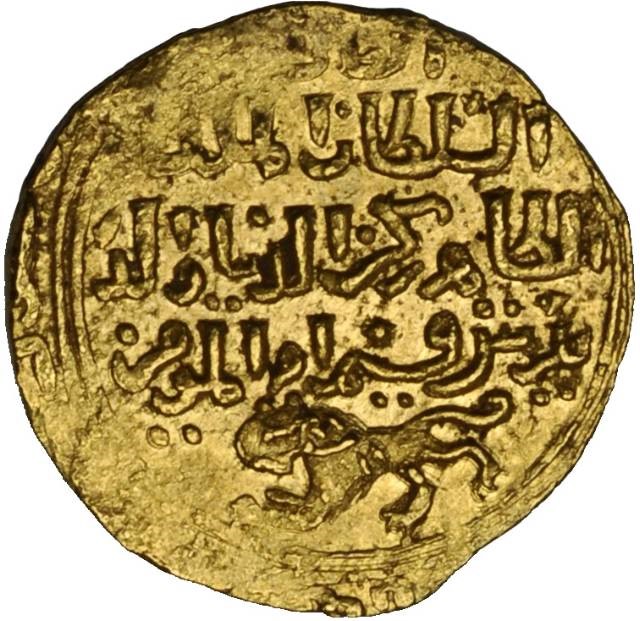 |
| Mamluk, gold Dinar of Sultan Baybar I (AH 658-676) ( 1260-1277), A-880, has a slight Uneven Strike, but is in an almost Uncirculated condition. From the author's collection. |
Sultan Mahmud of Ghazni's following silver dirham has the obverse in Arabic, and the reverse in Sanskrit.
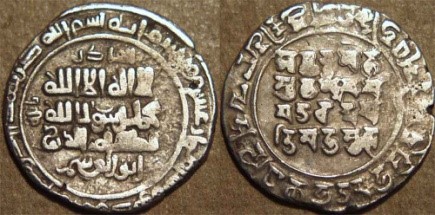 |
| Silver dirham of Mahmud (998-1030), bilingual type, Mahmudpur (Lahore), 2.81 gm., Diameter: 19 mm., Die axis: 7 o'clock, Arabic legend: Shahada followed by yamin al-daula wa amin mahmud al-milla (Mahmud guardian of the faith), al-qadir above, billah at left; Date in the margin: AH 418 (= 1027-1028 CE) / Sanskrit legend in Sharada letters: avyaktameka muhammada avatar nripati mahamuda (the Invisible is One, Muhammad is the manifestation, Mahmud the king). Courtesy: CoinIndia Gallery |
 |
| Gold Dinar of Sultan Mahmud of Ghazni, 24 mm, 3.72 gms, 388-421 AH, (998-1030). From the author's collection. |
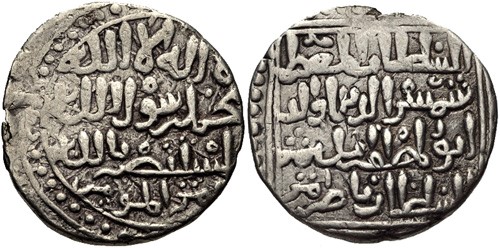 |
| Silver Tanka of Sultan Iltutmish, Delhi, India, AH 607-633 (AD 1210-1235), 26mm, 10.68 gm, 3h. Citing Khalifa al-Mustansir. CIS D38. Obverse: ruler's titles: al-Sultan al mu'azzam, ending with nasir amir al muminin. Reverse: Shahada, and Amirul Momineen al-Mustansir billah. R 835; NW 50E. From the author's collection. |
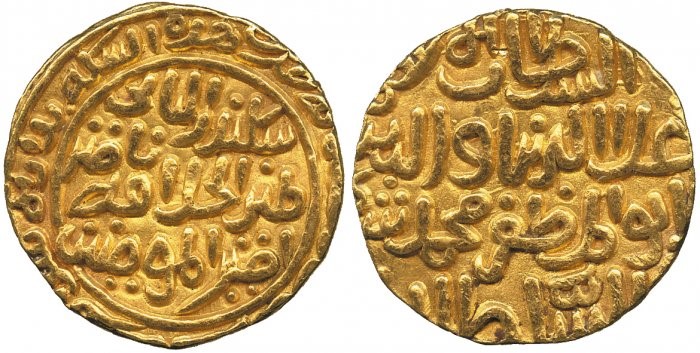 |
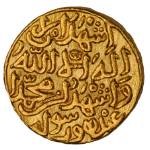
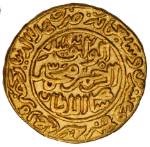
| Gold Tanka of Sultan 'Ala al-din Muhammad (695-715h), Dar al-Islam, Delhi, India, date off flan, 11.00g (G&G D220). Obverse: ruler's titles: al-sultan al-azam Ala al-dunya wal din abul muzaffar Muhammad shah al Sultan. Reverse: Sikandar al thani legend, with mint date in the margin, R998, NW. From the author's collection. |
  |
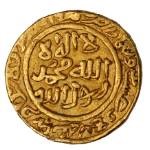
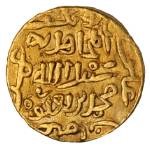
| Gold Tanka of Sultan Muhammad III bin Tughluq, AH 725-752 (1325-51), Fr-459. Hadrat Delhi, India, GG: D 331, 12.8 gram, al-watiq type. Rare. Obverse: Al-wathiq bi-ta yid al-rahman Muhammad shah al-sultan (he who trusts in the support of the Merciful; Muhammad Shah al sultan). Mint and date in margin. Reverse: Ash Shadual Lailaha wo ashShaduan Mohammad abduhuhu wo rasuluhu (I testify that there is no God but Allah and I testify that Mohammed is His servant and His Messenger. From the author's collection. |
  |
| Gold Tanka of Sultan Muhammad III bin Tughluq, AH 725-752 (1325-51), Fr-459. Dar al Islam, Delhi, India GG: D341, Rare, 11 grams, al-mujahid type, R1203; NW 479. Obverse: Al-mujhid fi sabil Allah Muhammad Bin Tughluq Shah (the Mujahid in the path of Allah Muhammad Bin Tughluq Shah). The names of the first four caliphs around. Reverse: Shahadah, with mint and date in margin. From the author's collection. |
|
|
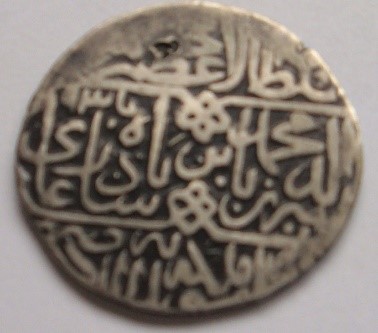
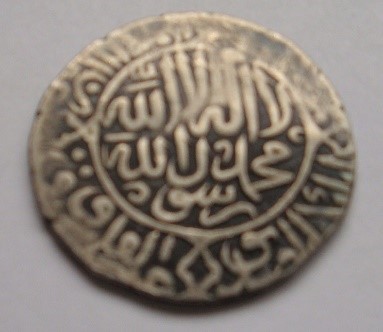
| Silver Shahrukhi of Babur, 1525-1530, Lahore Mint, Mughal Empire Kalima in three lines across field; all within ornate circular frame; titles in outer margin / Name and titles of Babur in three bands across field, each separated by a knotted borderline - the name and titls are given as Zahir al Ad-din Muhammad Babur Bashah Ghazi; mint formula to lower left, date (936 AH = 1529 AD). Lahore mint. 23mm, 4.65 grams. Whitehead (Punjab) 12. From the Author's Collection. |
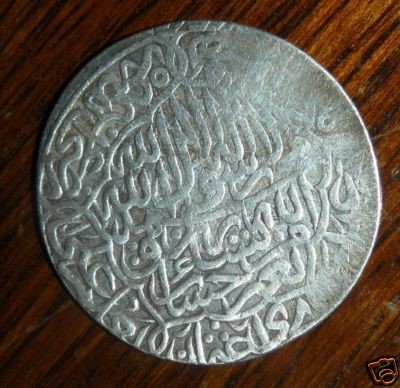 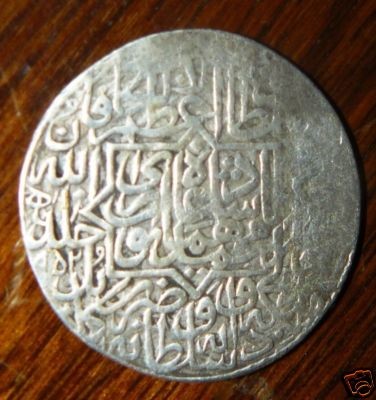 |
| Mughal, Silver Shahrukhi of Mohammed Humayun Obverse: Mohammed Humayun Badshah Ghazi.... Reverse: Shahadah, Names of the four Rashidun Khalifas. From the author's collection |
 |
| Mughal, Silver Rupee of Jahangir, Kashmir mint, AH 1024, year 10 KM 145.10. Obverse: Jahangir Shah Akbar Shah |
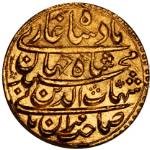 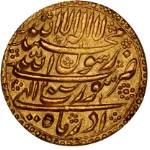 |
| Mughal, Gold Mohur of Muhammad Shah Jahan, AH 1037-68 (1628-58), Fr-787; KM-255.6 Obverse: Sahib e Qiran Mohammed Shihabuddin Shah Jahan Badshah Ghazi. Reverse: Shahadah, Mint name (Surat), and date. From the author's collection. |
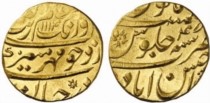 |
| Mughal, Gold Mohur of Aurangzeb, AH 1068-1118 (AD 1658-1707), 10.97 gr, Ahsanabad, year 47. Obverse: Aurangzeb Alamgir; zo go mehar.... Reverse: Maimanat Manoos; Mint and date. From the author's collection. |
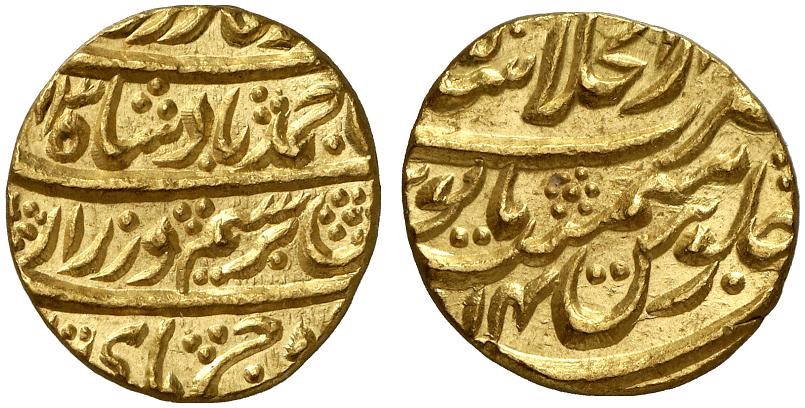 |
| Durranis, Gold Mohur of Ahmad Shah, AH 1160-1186; (1747-1772 A.D.), Shahjahanabad, AH 1173, year 14. AV 10.85 g. KM 765. From the author's collection. |
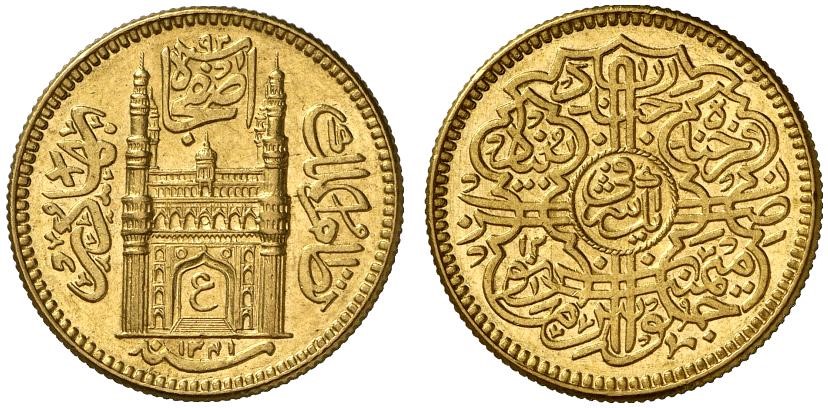 |
| Hyderabad, Gold Ashrafi of Mir Osman Ali Khan Asaf Jah VII, 1911-1967. AH 1341, RY 12 (1918 A.D.). AV 11.20 g. Obverse: Char Minar gateway, with the letter 'Aen' inside the arch, date is below, right margin: 'Nizam ul Mulk,' Top margin: 'Asaf Jah,' left margin: 'Bahadur'. Rev. Calligraphic legend with regnal date, 'Aik (one) Ashrafi,' in the center. KM 44. Mint state. From the author's collection. |
Misbahuddin Mirza, M.S., P.E., a licensed Professional Engineer, registered in the States of New York, and New Jersey, served as the Regional Quality Control Engineer for the New York State Department of Transportation's New York City area. He has written for major US, and Indian publications. He is an avid student of history, Islamic numismatics, and comparative religious studies.
 The Dogs of Hell