
IslamiCity
Listen PodCasts, Live Quran, Watch Videos @VideoHub

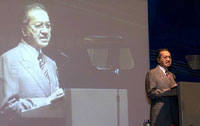 |
Malaysian Prime Minister Mahathir Mohamad's speech during the opening session of the Organization of Islamic Conference made headlines because of several disparaging remarks made against Jews. Mohamad accused the Jews, among other things, of ruling the world "by proxy." Now, I spoke out against those anti-Jewish statements as disturbing and wrong, and I still believe that to be the case. Nevertheless, the media reports on the speech were limited to those few lines about Jews, and they neglected the rest of the speech, which cogently outlined why the Muslim world has stagnated and stumbled on the path of progress.
Mohamad recalled how the early Muslims "produced mathematicians, scientists, scholars, physicians, and astronomers" who excelled in their fields of knowledge "besides studying and practicing their own religion of Islam." The early Muslims accomplished these heroic intellectual feats because they obeyed the first injunction of the Quran: "Read in the name of thy Lord who created" (Quran 96:1).
Muslim intellectual decline began because "halfway through the building of the great Islamic civilization came new interpreters of Islam who taught that acquisition of knowledge by Muslims meant only the study of Islamic theology. The study of science, medicine, etc. was discouraged." Consequently, Mohamad continued, Muslims became more preoccupied with "minor issues such as whether tight trousers and peak caps were Islamic, whether printing machines should be allowed or electricity used to light mosques." This intellectual decline lead to the withering of Muslim civilization, with all of its attendant historical consequences.
His overall analysis was that the Muslims' deplorable state of affairs was due to their total abandonment of Islam's guiding principles for a superficial reading and interpretation of Islam's sources: "This is what comes from the superficial interpretation of the Quran, stressing not the substance of the Prophet's Sunnah and the Quran's injunctions but rather the form, the manner and the means used in the 1st Century of the Hijrah." Furthermore, the use of violence by some Muslims has achieved nothing and has only added to the misery of the Muslims today.
Reading the Western news accounts of the speech, one would easily think that the Prime Minister blamed all of the Muslims' problems on the Jews. This is clearly not the case. In fact, the Prime Minister said, "We also know that not all non-Muslims are against us." All this was either not mentioned or glossed over by the Associated Press. Unfortunately, this is not the first time the media has practiced selective reporting when it comes to Islam and Muslims.
The Council on American-Islamic Relations (CAIR) analyzed the news coverage of the millennium terror plots of 1999. The arrest of the Algerian man who allegedly tried to smuggle bomb-making materials into the United States was covered in 129 stories (113 print, 16 broadcast) on the day of, and the day following, the announcement of his arrest. Twenty-one newspapers ran it on Page One. CAIR also found that in the same month--December 1999--two suspected militia members were arrested and accused of plotting to blow up a California propane plant just outside Sacramento, California. If the plot was carried out, it could have killed as many as half the people within a five-mile radius. The news of the arrest, however, was covered in 51 stories (51 print, 0 broadcast) on the day of the arrest and the following day. Only one of the stories ran on Page One. Many papers ran it as a news brief.
It is unlikely that such selective reporting on things Islamic will cease any time soon. As can be seen by the widespread condemnation of Mohamad's speech, such selective reporting contributes to the image of Islam as a violent, hateful religion. Yet that is exactly why I was compelled to write this article. Indeed, having to constantly defend Islam against the same age-old and tired accusations get very tiring. But it is a job that must be done. My God has called, and it would be inhuman not to answer.
Hesham A. Hassaballa is a Chicago physician and columnist for the Independent Writers Syndicate. He is author of "Why I Love the Ten Commandments," published in the Book Taking Back Islam: American Muslims Reclaim Their Faith (Rodale).