
IslamiCity
Listen PodCasts, Live Quran, Watch Videos @VideoHub

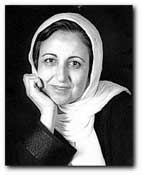 |
Muslim Iranian lawyer Shirin Ebadi, a human rights and democracy activist, has been awarded the 2003 Nobel Peace Prize. Ms. Ebadi has worked tirelessly to promote the rights of women and children in Iran and worldwide. She is the first Muslim woman to win the award.
"As a lawyer, judge, lecturer, writer and activist, she has spoken out clearly and strongly in her country, Iran, far beyond its borders," the awards committee said in the citation.
In her research and as an activist, she is known for promoting peaceful, democratic solutions to serious problems in society. She takes an active part in the public debate and is well known and admired by the general public in her country for her defense of freedom of speech and political freedom.
She is the founder and leader of the Association for Support of Children's Rights in Iran. Ebadi has written a number of academic books and articles focused on human rights. Among her books translated into English are The Rights of the Child. A Study of Legal Aspects of Children's Rights in Iran (Tehran, 1994), published with support from UNICEF, and History and Documentation of Human Rights in Iran (New York, 2000).
Ms. Ebadi served as Iran's first female judge during the Shah's era. But after the 1979 revolution, Islamic clerics ruled that women could not sit as judges. That interpretation of Sharia law is now coming under question and some clerics have called for allowing women judges.
At a news conference in Paris Ms. Ebadi said that in her view, "there is no difference between Islam and human rights."
The newly awarded Noble Laurite also added that she opposed any foreign intervention in Iran.
"The fight for human rights is conducted in Iran by the Iranian people and we are against any foreign intervention in Iran," she said.
In Rome the news was received with some disappointment where Pope John Paul II was being considered among the favorites to win the prize. A Vatican source said Pope John Paul II will send a message of congratulations to Ms. Shirin Ebadi.
In Washington, spokesmen at the White House and the State Department applauded the recognition for Ms. Ebadi.
European leaders appeared jubilant over the selection of an Iranian woman who works as an advocate for human rights. President Jacques Chirac of France called her an "exceptional choice," and Chancellor Gerhard Schroder of Germany celebrated her dedication to "tolerant coexistence and an understanding between cultures."
Conservatives in Iran who run the judiciary are cautious in recognizing this award and see it as outsiders now trying to intervene in Iranian politics. But Iran's reformist Government says it is "happy" with the awarding of the Nobel Peace Prize.
"We are happy that an Iranian Muslim woman was qualified to be noticed by the world community for her activities in bringing about peace," official Government spokesman Abdollah Ramazanzadeh said.
"We hope that we could use her expert views more in Iran."
For his part, Vice President Ali Abtahi says the award highlights the active role of Iranian women in trying to shape how the Islamic republic is run.
"I am very happy that an Iranian and above all a woman has won the Nobel Peace Prize," he said.
"The fact that a lawyer has won this prize gives us hope that the judicial system will change its methods."
Ms. Ebadi was selected among 165 nominees for the prize which comes with award money of $1.3m
 Trump Bombs Iran


