
IslamiCity
Listen PodCasts, Live Quran, Watch Videos @VideoHub

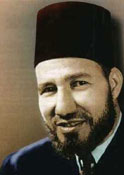 |
| Hasan al-Banna |
He wasn't a wealthy man or a carrier politician. He was neither the son of a prominent family nor the friend of an influential leader. His friends admired him, his foes respected him. His message appealed to the rich and the poor, the male and the female, the old and the youth, the intellectual and the illiterate, the urban resident and the rural peasant. He despised oppression and dedicated his entire life struggling against it. At the time of his tragic death, many people, including his Christian friends, defied government orders not to participate in his funeral and risked their lives for paying respect to his grieving family.
His name was Hasan al-Banna, the Imam, the leader, and the reformer whose legacy not only influenced Muslims in Egypt but also inspired the oppressed, the reformers and the grassroots activists around the world until the present times.
In 1938, at the age of 32, Hasan al-Banna synthesized his concepts of grassroots activism in several concise points. More than 50 years after his martyrdom in 1949 and with all of the socio-economic, political and cultural developments that our world has witnessed, his words couldn't be more relevant today than they were half a century ago.
Following is the clear and simple advice he gave to Muslims:
Be engaged in Dawah (promote the message of our Most Merciful Creator) efforts following the authentic sources of Islam as prescribed in the Quran and Prophet Muhammad's  tradition and as understood by the early righteous followers of Islam.
Abide by the words, actions, and instructions of the Messenger of Allah in all spheres of life, especially in matters of creed and worship.
Recognize the importance of purifying the heart and becoming close to the creator through Dhikr, repentance, love for Allah, and supererogatory acts.
Be organized politically, demanding the reformation of Muslim governments and seeking to re-establish a just and equitable Islamic political order.
Establish athletic associations, understanding that the development of fitness in preparation for worship is an essential part of the training for the individual.
Promote culture and learning, encouraging Muslims to acquire knowledge of Islam and other subjects and culturing their bodies, intellect and heart.
Strengthen their economic status through lawful means.
Develop a welfare system, attending to the problems of the society, discovering their cures and keeping their nations healthy.
Avoid disagreements in matters of jurisprudence.
Remain free from the control of the rich and influential.
Have no alliance with political parties and organizations.
Apply a gradual approach in confronting challenges, favoring practical and constructive aspects of the work rather than seeking publicity and propaganda.
Pay attention to the youth and reach out to people in the cities and villages.
Create a balance between 'intellect and emotion' and between 'reality and imagination'.
Refrain from insulting other groups and personalities.
 Egypt's Former President Mohamed Morsi Dies


