
IslamiCity
Listen PodCasts, Live Quran, Watch Videos @VideoHub

 |
| U.S. Deputy Secretary of State Richard Armitage holds a meeting with his Pakistani counterpart, Foreign Secretary Riaz Khokhar in Islamabad to discuss Kashmir and other issues. May 8, 2003. |
Saying that he was nearing the end of his career, Prime Minister Vajpayee has declared his intention to make a third attempt at solving the Kashmir problem. This is quite a change of tune, since he had insisted since the collapse of the Agra Summit that there would be no discussions between the two countries until Pakistan stopped "cross-border terrorism." Then, the Indian side refused to even recognize Kashmir as the "core issue." In March, Foreign Minister Sinha said that a pre-emptive strike against Pakistan had stronger justification than the U.S. strike against Iraq.
Thus, Mr. Vajpayee's gesture was immediately flashed around the major Internet portals and picked up by editorial writers worldwide as a break through. Prime Minister Jamali responded favorably. But the kudos that came from Colin Powell were reserved for India, since the U.S. chose to show this as an Indian initiative, notwithstanding the fact that President Musharraf had been saying he was ready for talks "any time, any where," for a long time.
Powell's deputy, the indefatigable former Navy seal, Richard Armitage, is in the subcontinent. Why is there such a sudden interest in resolving the Kashmir conflict? The post-Iraq war atmospherics in Washington that have encouraged the U.S. to undertake bold moves in solving the Israeli-Palestinian conflict may be at work here as well. Prior to moving into Baghdad, General Garner reportedly said that the U.S. intends to have the Kashmir issue resolved by December 2004.
Does the U.S. wish to reward Pakistan for having delivered on Musharraf's pledge of "unstinted cooperation" in the war against the Taliban and al-Qaeda? Does it really expect that one of the world's enduring conflicts will burn out quickly? Analysts have long argued that it has trapped both countries in a deadly arms-race and brought them at least once to the brink of nuclear war. The leaders of both countries have given such salience to the Kashmir issue that their citizens have been left far behind in the more fulfilling race for economic development whose results are evident in East Asia.
While idealists have called for disarmament, the realists (i.e., former idealists who kept notes) have said it won't happen. They cite the work of Mancur Olson, and assert that the perpetuation of the Kashmir conflict can only be explained by the existence of special interest groups who benefit from its continuance. These groups engage in parasitic rent-seeking behavior, and cannot be pushed aside easily. The realists question whether Mr. Vajpayee's last attempt at peacemaking will not go the way of his previous two attempts. How will L. K. Advani and George Fernandes occupy themselves, knowing that they will not be fighting a limited war with Pakistan?
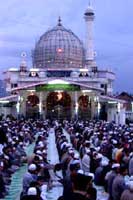 |
| Kashmiri Muslims sit while reciting dusk prayers at Hazratbal shrine |
Are we witnessing a fundamental change in Indian policy toward Kashmir? There may have been a genuine change of heart in the Indian political establishment. But why? Foreign Minister Kasuri suggested on the BBC that India had realized that it could not solve the problem militarily. However, there is no evidence that the Indian army is losing the battle.
Something else must be brewing. India has long desired to become a permanent member of the U.N. Security Council (U.N.S.C.), so that it can step up from being a regional Asian hegemon to a great power on the world stage. It cannot get that position without U.S. support. Last year, the U.S. gave a blunt message to India that it would have to "solve" the Kashmir conflict as a pre-condition for wining the U.S. nomination. As Mr. Vajpayee travels to Russia later this month, he knows he has Russian support for the nomination. By cozying up to China during the past few months, he may be expecting support from Beijing as well.
What type of solution would be acceptable to the U.S.? First came a terse comment from Ambassador Powel that Pakistan had not done enough to control the flow of militants across the Line-of-Control (LoC). Then came a fairly direct comment from Richard Haass of the U. S. State Department, that if Pakistan failed to stop infiltration across the LoC, it would place a ceiling on Pakistan-U.S. relations.
Indian analysts have noted that Vajpayee, who leads a Hindu fundamentalist coalition, cannot make any concessions until Pakistan stops cross-border terrorism. Vajpayee himself has ruled out third-party mediation in the dispute. Thus, what type of "package deal" will he offer Prime Minister Jamali?
It is likely to involve the following parameters. First, Pakistan should stop cross-border terrorism. Second, it should accept the LoC as an international border, implicitly conceding that it had wasted lives and resources over the past 55 years. Third, it should continue fighting the al-Qaida terrorist network, and be prepared to yield a "big fish" terrorist every other month. Fourth, India will ensure that fair elections are held in Jammu and Kashmir, and begin withdrawing its security forces as conditions improve. Fifth, India may provide some measure of autonomy to Kashmir.
If Pakistan accepts this deal, it will continue to be the beneficiary of U.S. economic aid. It will be offered deferment of foreign debt and possibly its outright forgiveness. However, unlike Egypt, which got back the Sinai and state-of-the-art military hardware with which to safeguard it, only surplus military supplies may come Pakistan's way, with none of the coveted land.
Under the best of circumstances, both countries would freeze the Kashmir dispute, restore cultural and sports exchanges and begin to develop trade ties. More than likely, they will freeze the Kashmir dispute and nothing else would happen. Even then, this would be a face saving gesture for both. India would not have to hold a referendum and risk losing Kashmir. Pakistan would not be forced to repudiate an article of faith, since it would claim that it had restored the civil rights of Kashmiris. The special interest groups would be placated through hand-outs. Those "freedom fighters" that don't fall in line would fall from grace, to be hunted down and killed like common terrorists.
General Musharraf has been called Pakistan's most successful politician in history. No one else has been able to promote himself or herself after a military debacle. If he is able to make economic reform a higher priority than Kashmir, he may yet become Pakistan's Deng Xiaoping. But there is one minor detail. On January 12 of last year, he said, "Kashmir runs in our blood." When it comes time to sell Pakistanis on the "package deal," he will have to come up with a clever explanation of how something that is in Pakistani blood will be left to run in Indian veins.
Dr Ahmad Faruqui is a fellow of the American Institute of International Studies, San Francisco.


 Zelenskyy Accuses Pakistan of Fueling Russia’s War—Islamabad Fires Back