
IslamiCity
Listen PodCasts, Live Quran, Watch Videos @VideoHub

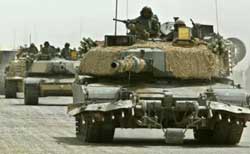 |
One image has perhaps best encapsulated the Western media coverage of the attack on Iraq. With the BBC camera mounted on the turret of an American Abrams tank, viewers throughout the world were treated to the spectacle of a 'turret-eye-view' as the tank swiveled the muzzle and fired a volley of ammunition to bring down an innocuous Iraqi communications tower in the distance. The sense of adrenaline pumping through the tank crew and the BBC's "embedded" unit was almost palpable. The turret and the camera were one. Both were shooting the same thing.
The subsequent souring of this synergetic bond between the media and the Western troops as a consequence of the attacks on journalists in Baghdad has not taken away the symbolism of this image.
Even as Anglo-American forces pounded Baghdad and its citizens into rubble, one of the shameful by-products of the attack on Iraq was the destruction of the credibility of news organizations and journalists. If anything became clear in the oft-quoted "fog of war" it was that the media - especially the venerated icons of Western 24-hour news television - often served as nothing more than an adjunct to government propaganda machines. Despite its claims to "objectivity", the media became part of the "coalition of the willing."
Not only did journalists "embed" themselves with an invading force, meekly accepting whatever restrictions were put on them, they and their desk sergeants even adopted the very language of war that military forces employ to obscure and obfuscate.
So we were told time and again - each time taking a cue from the American war machine - that Umm Qasr or Basra or Nassiriya "has been secured". Secured, meaning made safe. Safe for whom? How about "conquered" or "occupied" or "subjugated", "dominated" or "over-run". But then such "objectivity" would perhaps have raised objections from the people calling the real 'shots'.
We were also constantly told of "pockets of resistance", of fedayeen "militias" as the only ones offering any "resistance" to the American juggernaut. All this to denigrate a Third World country's armed forces as a rag-tag lot of out-of-touch fanatics. As if they could not possibly have any kind of strategy, any facility to plan. When US generals dubbed them "desperate dead-enders" - apparently those who saw no future in a post-Saddam Iraq - no one in the media questioned them. As if it were inconceivable that the people of Iraq may perhaps be not altogether happy with a foreign army conquering their land and installing itself as its ruler. The "battle for the hearts and minds" was a bunch of Royal marines playing soccer with local pubescent boys.
Sometimes the obsequiousness of journalists was astounding. A mere few hours before Donald Rumsfeld got all hot around the collar about the Iraqi television pictures of American POWs, a CNN correspondent "on the ground" voiced over live footage of US soldiers searching prostrate Iraqi POWs. Even as US soldiers summoned each Iraqi one by one, made him kneel with his hands over his head and then lie face down on the dirt track - so that he could be frisked - our helpful correspondent intoned: "You can see that the US forces are not treating these Iraqi soldiers badly, they are not humiliating them, they are not shouting at them..."
Then there is CNN's Walter Rodgers "embedded" - we were told ad nauseam - with the 3rd Infantry Division or the 7th Cavalry or some such. Here is a rough transcription of him interviewing a US army captain on April 6th.
Rodgers: We hear you have been burying the Iraqi soldiers killed whose bodies are lying on the roadsides in the heat...
Army Captain: Yes, we understand it is part of Muslim ritual that bodies should be buried as soon as possible...
(As if anyone - Muslims or non-Muslims - love to dispose of their bodies on the roadsides...)
Rodgers: And have the local population appreciated this gesture which shows your consideration for their culture and values?
Yes, of course, this is the kind of considerateness the Iraqis were looking for all along. Come invade our country. Bomb our historic cities to rubble. Riddle our sons, fathers, husbands (and even our women and children) with bullets and shrapnel. And bury them quickly in true Muslim tradition.
Actually, Mr. Rodgers did not need the army captain. He told us what he needed to tell us himself. The army was the prop in Mr. Rodgers' neighborhood. The captain was the actor to his scriptwriter.
The end result of all the breathless "round the clock" "on the ground" coverage of the minutiae of war - here's a jet flying overhead, there's another explosion, here is another Scud alert, there's more bullets flying - was that viewers were no closer to an understanding of the larger picture than before. We now know about JDAMs and MOABs and "vertical envelopment" (flying forces over enemy ground troops to attack them from the rear and sides) but none of the large television networks ever questioned the legality of the dubbing of US-British army troops as "coalition forces." (Of course how could we forget the 2,000 Australian support troops and the 150 Polish.)
Indeed, nobody even questions whether it is right to call this piece of blatant aggression "war." Was the Iraqi invasion of Kuwait ever dubbed "The Iraqi War With Kuwait"? Does Tomahawk and aerial bombardment of Baghdad qualify it as "war"? Does the full scale Anglo-American tank invasion? When George Bush claimed in the farcical "summit" in the Azores that UN resolutions gave him the legal right to attack Iraq, none of the assembled journalists even meekly pointed out that no less than the UN Secretary General Kofi Annan had two days earlier given his opinion that an attack on Iraq would be illegal under international law. These intrepid Western reporters may as well have been "embedded" right then.
And so on it goes. With another reporter from the "World's News Leader" asking such probing questions from American marines who continue to believe that they are avenging the events of 9/11: "How did it feel yesterday when we had three Scud missile alerts?" - none of which materialized incidentally. Or, "Tell us how impatient you are to get into Eye-rack." Now that they were needed to "up rise" - as former NATO commander General Wesley Clark decided to phrase it in reckless disregard for the language - the Shias were the good guys for once on Western channels.
Meanwhile, anchors routinely informed us that "coalition forces" had "achieved complete air superiority" over Iraq without bothering to mention that Iraq has not had a functional air force since the 1990 Gulf War, when most of its planes were either decimated or sent off to Iran which never returned them. In fact, the Iraqis did not put a single plane up in the air this time. Achievement indeed.
When another brilliant US general said after the first Iraqi suicide attack that "it looks and feels like terrorism", this was reported faithfully by all channels. But nobody asked under what possible definition could the Iraqi tactic be dubbed "terrorism"? Certainly it was an attack on US military personnel, not civilians. The Americans were the invading aggressors, not the Iraqis. And under all international law, the Iraqis have a right of self-defense of their own land. But apparently none of this contextualisation is important to state on BBC, CNN, Sky, et al.
At various points in the campaign, we were also treated to news about the discovery of another potential site for developing weapons of mass destruction - a process quaintly referred to by US General Tommy Franks as "sensitive site exploitation." Given that WMDs were the official pretext for the aggression, the operative part of General Franks' phrase - "exploitation" - may be a clue of things to come. Usually all we get in the end is a gas mask or two but then our intrepid journalists move on with the cavalry.
The high point came when we were told that a site was found with "several vials of liquid and some white powder." You would probably find more than that in a Wall Street broker's office but of course it became the biggest news on all the channels for a day. The consequent news, that the material was found to be innocuous - was it perfume and talcum powder? We were not told - was mumbled quickly towards the end of bulletins two days later.
At another "potential site of chemical weapons", the omnipresent Wolf Blitzer tried his utmost to whip the story into the biggest of the war despite the fact that even the US General in charge pointed out that the suspect chemicals found in rusty drums at a farm was "not weaponized" and was "probably pesticide." The American soldiers suffering from nausea and headaches, the general elaborated, were suffering from heatstroke not the effects of the chemicals, much to Blitzer's obvious dismay.
The "danger" of chemical attack, was constantly mentioned, to remind viewers of the official reason for the aggression. Why legalities of international law should have deterred the Iraqi regime in the face of a patently illegal war out to wipe them out is questionable in itself. But it was left to outside commentators to point out that the fact that such an attack did not occur meant one of two things: either that Iraq did not have the weapons it was accused by the US of having, or that Saddam Hussain was a rather responsible "madman" who did not use them despite extreme provocation. Since both of these viable postulations raise uncomfortable questions for the "coalition", however, they are never raised by the journalists themselves.
Of course there are still some journalists who rose above this sycophancy. (To be sure they were not to be found on Fox News which has done to American news what George Bush has to the United Nations.) But they were quickly marginalized by ever-alert news editors. Thus Rageh Omar of the BBC in Baghdad was always "being monitored by Iraqi government personnel" - and so his concern for Iraqi civilians being blown to bits and being terrorized was suspect. But the intrepid "embedded" corps - who never told us anything since it would give away "secret" military maneuvers - were 'free' to tell us like it us. Actually, since their reports were usually nothing more than what their cavalry commanders fed them, there really was no need to monitor them.
You may think, however, that given their ostensible freedom, our intrepid reporters might actually, once in a while, have given us some of the details they were not supposed to. But you would be wrong. Look what happened to sleazy-talk-show-host-turned-Fox correspondent Geraldo Rivera who apparently drew a map in the sand on an on-air broadcast. He was quickly sacked from his "Humvee" squad where he was "not being monitored."
So BBC anchors regularly prefaced their questions to "embedded" journalists with "I know you cannot give us precise details..." And CNN's Jim Clancy questioning a US military spokesman in Qatar about events was even more helpful, telling him to relate the events "without giving away too much."
It is easy to say that journalists were doing the best they could in the given circumstances. But the reality is they seemed so overawed by the "access" granted to them by the Anglo-American military that they were, like little children with new toys, beside themselves with excitement. They got to ride in armored personnel carriers ("Humvees"), bed down ("embed?") with the soldiers in the foxholes, speak their lingo ("strike packages", "regime targets"). And of course, fix their cameras on tank turrets.
They lost their perspective. And the truth is, they also exposed which side they were actually on.
Source: Dawn
 Israel Can’t Fight All Fronts at Same Time


