
IslamiCity
Listen PodCasts, Live Quran, Watch Videos @VideoHub

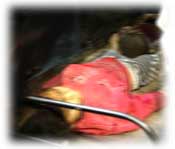 |
| Collateral damage of a bomb that landed in a busy market in the Al Shula'a district of West Baghdad Friday March 28, 2003. |
Each of the three Abrahamic faiths has possessed a long and beautiful tradition of scholarly exploration. In the history of monotheistic religions, Islam, Christianity and Judaism have all adopted a moral reasoning behind what may or may not constitute a just-war. In an era where theological debate has reached a passionate zenith, it is both astounding and heartening to see that much of the leadership of these faiths in America have reached consensus about the unnecessary nature of the current conflict transpiring in Iraq.
It should come as no revelation to anyone that the basic criteria set forth by each religion regarding the requirements to satisfy a just-war are nearly identical to the rules of engagement set forth by the United Nations and its corresponding treaties and conventions. The foremost standards put forward by both the international legal and religious communities are the concepts of "necessity" and "proportionality."
Within the paradigms of both international law and religious doctrine, the "necessity" element includes two components: attempts at peaceful redress (as mandated by Article 33 of the United Nations Charter) and the imminence of the danger posed. Anyone would be hard pressed to say that Hans Blix et al inspecting and disarming Iraq's arsenal was not an attempt at peaceful redress. Imagine the billions of dollars and thousands of innocent Iraqi and American lives that could have been saved had we increased Mr. Blix's staff tenfold and given him six more months to disarm Iraq.
"Proportionality" embraces the notion that civilian casualties should be minimized in the application of force. If the loss of civilian life and order is grossly disproportionate to the relative importance of the military target, then the campaign cannot be justified legally or dogmatically. What sort of immeasurable and disproportionate costs will there be in occupying a sovereign nation for several years, rebuilding essential social infrastructure, instilling a new "democratic" regime and maintaining stability within that sovereign and its neighboring states?
Many American religious leaders see the costs of this war egregiously outweighing any benefits it may reap. Pope John Paul II has worked tirelessly in recent weeks to persuade decision makers against going to war. A new war in the Middle East would be, in his words, "a defeat for humanity."
Former President Jimmy Carter stated in a recent New York Times editorial: "As a Christian and as a president who was severely provoked by international crises, I became thoroughly familiar with the principles of a just war, and it is clear that a substantially unilateral attack on Iraq does not meet these standards." Several prominent Jewish groups have raised a small, yet visible flag against the war as well. The Shalom Center, based in Philadelphia, had several rabbis arrested in anti-war demonstrations outside of the United Nations headquarters in New York. When asked about their arrest, Rabbi Arthur Waskow said that those who were arrested were "joyful and determined."
With the war on Iraq already in full gear, scores of people may see opposition to the war as being moot. Far from being irrelevant, this solidarity amongst people of faith shows that although bombs are being dropped over ancient Mesopotamia as I write; we who oppose the war on moral and religious grounds do so as adamantly as we did before the commencement of the conflict and earnestly pray that a quick and just resolution to this unjust conflict will spare the innocent lives of Iraqi women and children and promptly bring our soldiers home safely.
As a Muslim American, it is my Islamic duty to stand up for injustice, regardless of the identity of the perpetrator and the victim. Muslims worldwide continue to categorically condemn the actions of two Septembers past and will continue to emphatically oppose this war in Iraq. It is my earnest hope that people of all faiths will use the lessons learned from this war to band together and try to bring a little justice in light of this unjust war.
Arsalan Tariq Iftikhar is Midwest Communications Director of CAIR. He attends Washington University School of Law in St. Louis.
 Untangling The Syrian War


