
IslamiCity
Listen PodCasts, Live Quran, Watch Videos @VideoHub

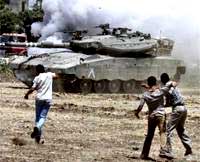 |
| Palestinian youths confront an Israeli tank with stones near the Balata refugee camp in the West Bank. |
True, the Palestinian uprising (Intifada) of 2002 is a continuation of the Palestinian people's decades-long revolt against the Israeli military occupation of their land, which was carried out at several stages, most prominently in 1948 and '67. But one can hardly ignore that the present Intifada is uniquely different from the largely symbolic protests of the 1987 Intifada, or the armed resistance in Lebanon during the Israeli invasion in 1982. Today's Intifada stands somewhere in between, where the resistance remains largely a popular resistance, yet where the methods used to resist have surpassed the traditional stone throwing, although the latter remains a dominating aspect.
Provoking the issue of armed resistance and a people's right to defend themselves are now more significant than ever. Palestinian factions, on one hand, are more actively deliberating a united strategy in their fight against Israel, amid heated discussions on whether Palestinians should or should not resort to violence in their resistance against the Israeli army, which now has reoccupied, almost completely the areas that fell under Palestinian control following the Oslo Accords and related agreements in 1993 onward. Moreover, leading human rights groups, including Amnesty and Human Rights Watch have recognized suicide bombings as "crimes against humanity", and those who plan or perpetrate them as "war criminals."
Yet, this is not a discussion into the particularities of these claims or any others, but an attempt to clear some of the confusion created by the uniqueness of the current Intifada and the claims and counterclaims made by parties involved regarding the legitimacy of the Palestinian resistance, its legality in accordance with international law.
For long, international law remained unclear on the issue of "people's right to defend themselves", while it granted that right to sovereign states. The use of force is only legitimate in two scenarios, according to the Charter of the United Nations. As specified in Article 51 of the Charter, the use of force is limited to self-defense, or, according to Chapter VII, when the United Nations itself embarks on an enforcement action where it decides that there is a threat to peace.
There were always indications within international law that grant an individual or a group the right to self-defense. For example, the Universal Declaration of Human Right's preamble (adopted and proclaimed by General Assembly Resolution 217 A (III) of December 10, 1948), reads: "Whereas it is essential if man is not compelled as a last resort to rebellion against tyranny and oppression, that human rights should be protected by the rule of law."
However, not until the General Assembly 20th session in 1965 where it was recognized, for the first time, "the legitimacy of struggle by the people under colonial rules to exercise their rights to self-determination and independent." More, the assembly invited "all States to provide material and moral assistance to the national liberation movements in colonial territories."
The specified decision has always applied to the Palestinian people and their struggle for freedom. But again, intentional misinterpretation of that law compelled the passing of Resolution 3236, passed by the General Assembly in its 29th session in 1974. The resolution recognized that the collective rights of the Palestinian people were fully and properly recognized. The resolution recognized the Palestinian people's right for self-determination in accordance with the United Nations Charter (which, in retrospect gives them the same right of self-defense granted to sovereign states). In addition, it granted them the right of national independence, sovereignty and right of return to their homes. The resolution had further replaced the mere reference to Palestinians as "refugees" or "the refugee problem", and made them a "principal party in the establishment of a just and durable peace in the Middle East."
In 1975, General Assembly Resolution 3375 recognized the Palestinian Liberation Organization (PLO's), a liberation movement, right to represent the Palestinian people in their aspiration for self-determination, in accordance to Resolution 3236.
Those who still found loopholes in international law to deny the Palestinian people the right to defend themselves had to deal with yet another resolution. Additional Protocol I to the Geneva Convention of 1949, (Act 1 C4), passed in 1977, declared that armed struggle can be used, as a last resort, as a method of exercising the right of self-determination. One can hardly argue that Israel's decades long occupation of Palestinian land, the full-fledged apartheid regime it instituted in the Occupied Territories, the loud violations of the Fourth Geneva Convention, the seizer of the land, the destruction of property, and most importantly, the refusal to honor nearly 70 United Nations Resolutions amid daily killings and assassinations of Palestinians, acts recognized by the Convention and by leading human rights groups as war crimes, qualify Palestinians, as it always did to fight back using armed struggle.
This is not an attempt to propagate the idea of violent resistance, but an attempt to reconstruct, even briefly, the argument that the Palestinian people's struggle, including armed struggle, in the West Bank and the Gaza Strip are defended and protected under international law. In fact, "all states (are encouraged) to provide material and moral assistance to the national liberation movements in colonial territories."
What mostly provoked this subject now is the question of the Jenin refugee camp. During my recent book tour, promoting my book "Searching Jenin: Eyewitness Accounts of the Israeli Invasion 2002" on the East Coast, several Israeli or pro-Israeli students insisted that the Palestinian resistance in the camp was a form of terrorism. During my research, I haven't found one reference in international law that refers to the Jenin fighters who defended the camp until the last man as "terrorists." In fact, I found more than one reference that classifies the Israeli army action as "state sponsored terrorism." This is not a selective reading in international law, but a highlight of relevant resolutions that Israel and its patrons in the United States seem to often disregard.
One might find the title of this article "Do the Palestinians Have the Right to Defend Themselves?" a proactive one, as the answer is self-evident. But considering the process of dehumanization carried out by Israel, using the American media, makes the question less ridiculous than it sounds. Palestinians do indeed have the right to defend themselves against the brutal Israeli occupation, especially when the whole world, including their Arab brethren have failed them. Blaming them for using such a right is inhumane, even ludicrous.
Baroud is the editor-in-chief of PalestineChronicle.com and the editor of the book titled, "Searching Jenin: Eyewitness Accounts of the Israeli Invasion 2002".