
IslamiCity
Listen PodCasts, Live Quran, Watch Videos @VideoHub

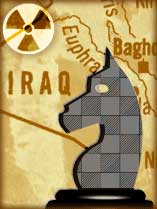 |
Polls indicate that seven out of ten Americans support an attack on Iraq. Many fear that another 9-11 type attack is likely on American soil, and want Washington to pre-empt it. Six out of ten think the Iraqi regime sponsors terrorism, and harbors Al Qaeda fighters. Most are unaware that after Iraq attacked Kuwait in August 1990, Osama bin Laden, then an unknown warrior from the jihad against the Soviets in Afghanistan, offered to create a coalition of Arab forces to push Saddam's army out of Kuwait. But Arab governments concerned about his credibility spurned the offer, and instead invited the US-led coalition of forces into the conflict, causing Osama to refocus his energies.
Americans are convinced the US has overwhelming military superiority over Iraq, and that the war would end quickly. However, it would be an error to conclude that the American people would extend unqualified support for a war against Iraq. Polls show that support for an attack drops to five out of ten people if the allies do not go along with the US. It further drops to four out of ten people if there are heavy US casualties.
While the Bush Administration has concluded that it wants to take out the Iraqi leader, some Americans are beginning to argue that it should limit its actions to the attainment of that objective. Engaging in an all-out war against Iraq from the air, land and sea would hurt the 23 million Iraqis who have not harmed America. While Washington is committed to waging a "precise war" with hi-tech weaponry, most Americans have realized that the term "precise war" is an oxymoron. There is nothing precise about carpet-bombing from high altitudes, and there is no guarantee against massive collateral damage. There is also a growing awareness that economic sanctions have gravely hurt the innocent people of Iraq, and any future US attack should focus on Saddam, not on the people of Iraq.
If Saddam is truly as dangerous as the hawks in Washington make him out to be, some are questioning why the US let him stay in power in 1991. He was certainly a much more dangerous man back then, with much of his army still intact after withdrawing from Kuwait. Going further back in time, why did the US support him during the eight-year war against Iran, knowing full well that he was going to use chemical weapons?
In his address to the Veterans of Foreign Wars, Vice-President Dick Cheney stated, "the risk [sic] of inaction are far greater than the risk of action." Presumably the Pentagon has finished developing its war plans. If things go as planned, the war will end quickly, with Saddam's capture by the US Special Operations Forces. He would be brought for trial in the US, and a grateful nation will re-elect President Bush. A handpicked replacement would be injected into Baghdad, committed to making Iraq the first Arab democracy. The US would implement a Marshall Plan for Iraq, bringing prosperity to its citizens. Washington's strained relations with Arab states would be restored. The coalition against global terrorism would gain momentum. Oil prices would stabilize, and the world economy would emerge from the doldrums.
The odds are stacked against such a rosy scenario. Field Marshall Helmuth von Moltke's dictum, "no battle plan survives contact with the enemy," still applies a century later. There are a number of pessimistic scenarios that one can envisage.
The US may defeat the Iraqi military, but it may be unable to locate Saddam. It may impose a compliant regime in Iraq, but find that its authority - like Hamid Karzai's -- does not extend beyond the national capital. The Kurds may begin hankering for Kurdistan, spread out over Turkey, Syria, Iraq and Iran, opening up the Pandora's box. The Shias in Basra may want to break away into a separate nation, or join Iran. These are the very reasons that prevented President Bush Sr. from pushing on all the way to Baghdad in 1991.
There is also a finite probability that Saddam's Republican Guard would survive the US air campaign, and succeed in luring US forces into urban areas. Images of "Blackhawk Down" would fill TV screens, causing significant domestic discontent to develop in the US. Moreover, the entire war bill, which may be in excess of a hundred billion dollars, would be laid at the door of the US taxpayer. Such spending would exacerbate an already burgeoning US budget deficit, hurt consumer confidence, and delay economic recovery.
During a prolonged war, the global coalition against terrorism would be jeopardized. It would heighten the odds that the US would once again become the victim of "blowback." As British Field Marshal Lord Bramall warned recently, an invasion of Iraq would pour "petrol rather than water" on the flames and provide Al Qaeda with more recruits. To highlight the futility of attacking Baghdad, he quoted a predecessor who said during the 1956 Suez crisis: "Of course we can get to Cairo but what I want to know is what the bloody hell do we do when we get there?"
It is entirely possible that an attack on Iraq, in the face of complete opposition in the Arab and Muslim world, would precipitate another oil embargo. The world would plunge into recession. In an extreme scenario, sensing imminent defeat, Iraq may hit out at Tel Aviv with a concerted attack of Scud missiles laced with chemical and biological agents. This would prompt Israel to carry out a nuclear air attack against Baghdad, killing hundreds of thousands of Iraqis. Faced with mounting street violence, moderate Arab states would be compelled to attack Israel with full force, just as suicide bombers fan out in search of the Israeli Cabinet. The Middle East would be engulfed in catastrophe. The US would find itself boxed into a corner, as it vetoes resolution after resolution in the US Security Council censuring Israel. Sensing US isolation, China may find it opportune to reign a volley of M-11 SRBMs on Taiwan.
President Bush, who has been reading Elliot Cohen's provocative book, Supreme Command, would be well advised to listen to Doug Bandow of the Cato Institute. In a recent article, Bandow writes, "the world would be a better place without Saddam's dictatorship. But there are a lot of regimes that should, and eventually will, end up in history's dustbin. That's not a good reason to initiate war against a state which poses no direct, ongoing threat."
Dr Ahmad Faruqui is a fellow of the American Institute of International Studies, San Francisco.
 Gaza’s Defiance and the Miserable Muslim Rulers with Sami Hamdi


