
IslamiCity
Listen PodCasts, Live Quran, Watch Videos @VideoHub

In 2007, during a visit to Bangladesh, I met with the then Secretary of Foreign Affairs and urged him to reconsider the policy of pushing Rohingya refugees back from the border. These were people fleeing a state machinery already committed to ethnic cleansing with all the early signs of genocide.
Allowing them refuge, I argued, was not only a humanitarian obligation but also a strategic opportunity. Bangladesh could use the crisis to galvanize international attention, demand accountability for Myanmar's racial and religious fascism - aptly termed Myanmarism by fellow human rights activist Dr. Shwe Lu Maung - and push for diplomatic and legal pressure through global institutions.
The Secretary rejected the idea outright. If Bangladesh opened its doors, he insisted, not a single Rohingya would remain in Myanmar, and the burden would overwhelm a poor country. I reminded him that refusing shelter to someone fleeing a knife-wielding attacker is not neutrality-it is complicity. Closing the door in such a moment can determine whether a person lives or dies. I warned that sealing the border would allow the genocide to escalate unchecked.
A decade later, in 2017, the worst-case scenario unfolded. Nearly a million Rohingyas were forced to flee after the Burmese military launched one of the most brutal campaigns of mass violence in recent history. Bangladesh could no longer say "no." What I feared most had come to pass. Yet even after the exodus, Bangladesh failed to play its cards well. It did not mobilize either the Muslim world or the member states of ASEAN, did not pursue legal action aggressively, and did not convert its moral position into diplomatic leverage. It is therefore unsurprising that it was not Bangladesh but the tiny nation of The Gambia that ultimately stepped forward to file the genocide case at the International Court of Justice - a role Dhaka was far better positioned to assume. The crisis, instead of becoming a platform for regional leadership, was allowed to remain framed almost entirely as a humanitarian burden rather than a geopolitical opportunity.
The missed opportunities did not end in 2017. Only after the Interim Government, led by Dr Muhammad Yunus, came to power was a dedicated unit established under Dr. Khalilur Rahman to craft a roadmap for the dignified return of the Rohingya. At Dr. Rahman's invitation, I met him in early January of 2025 in Dhaka to discuss the matter face-to-face. His sincerity and determination were evident, and for the first time in years, there appeared to be an institutional effort to think beyond ad hoc humanitarian management. In March 14, at the invitation of Dr Yunus, UN Secretary-General Antonio Guterres visited Bangladesh. That day, they attended a massive Ramadan solidarity Iftar with roughly 100,000 Rohingya refugees where Dr Yunus pledged to work collectively with the United Nations to ensure that Rohingya refugees can return to Myanmar to celebrate Eid by the following year. Yet even this initiative struggled to gain the strategic clarity and diplomatic assertiveness the moment demanded.
In August of that year, Bangladesh convened what it called a "Stakeholders' Dialogue," jointly organized by the Office of the High Representative for the Rohingya Issue and the Ministry of Foreign Affairs. The event, held at Hotel Baywatch, Cox's Bazar, was presented as a platform to engage global stakeholders in search of solutions to the protracted crisis. But the dialogue was high on rhetoric and painfully thin on substance. I was horrified to learn how ill-prepared the organizers were; some did not even grasp the basic principles of stakeholder analysis. The most glaring omission, however, was the absence of the principal stakeholder, Myanmar. What meaningful dialogue can take place when the central party to the conflict, the very perpetrator of the Rohingya crisis, is not even present? The exercise seemed more like a performance than a strategy.
These missteps reveal how far Bangladesh's foreign policy establishment still has to go, especially when dealing with a brutal and deeply entrenched military regime that has perfected the art of ruling through fragmentation, perpetual conflict, and calculated delay. Engaging such a regime requires diplomatic sophistication, legal acumen, and geopolitical imagination - qualities Bangladesh has yet to cultivate at the scale required. Until Dhaka learns to navigate the complexities of a fractured Myanmar and the hardened mindset of its military rulers, efforts toward repatriation will continue to falter, no matter how many dialogues or committees are convened.
Nearly two decades later, international analysts are finally articulating the very strategy Bangladesh could have pursued all along. In a recent interview in Dhaka, political analyst Sami Hamdi echoed - almost verbatim - the warnings and proposals I raised in 2007. His analysis underscores how Bangladesh's failure to act decisively has allowed others to shape the Rohingya narrative, and how a strategic opportunity remains largely unused.
Hamdi argues that Bangladesh should stop treating the Rohingya crisis solely as an economic and humanitarian burden and instead transform it into diplomatic leverage. With a new government and a politically awakened society, he says Bangladesh now has an opportunity for a fundamental rethink. Bangladesh's geographic position bordering Rakhine (formerly Arakan) State gives it significant political cards to play, and the ultimate goal must be Rohingya repatriation with equal rights and political participation in Myanmar.
Hamdi warns that the absence of a clear strategy from Bangladesh and the wider Muslim world has allowed international actors, especially the United Nations, to frame the debate in ways that make permanent settlement in Bangladesh appear inevitable. To counter this, he urges Dhaka to adopt an assertive diplomatic posture, including pursuing a case against Myanmar at the International Criminal Court and mobilizing Muslim-majority countries behind it. Such pressure, he argues, could even open negotiation channels with China, which has considerable influence over Myanmar.
Hamdi believes Bangladesh is underusing its potential influence across the Muslim world, noting that solidarity from nearly two billion Muslims could be a powerful diplomatic tool. He cites Turkiye's handling of Syrian refugees as an example of how a refugee burden can be turned into regional influence. While acknowledging the economic strain Rohingya refugees create, he argues that a long-term strategy - investing in the Rohingya and preparing them for eventual return - could transform a "ticking time bomb" into a strategic asset. A politically empowered Rohingya population, he suggests, could become Bangladesh's ally inside Myanmar.
His conclusion is clear: Bangladesh is not as weak as assumed. With imagination and assertiveness, it can turn the crisis into a source of regional power.
Hamdi's evaluation confirms what I argued nineteen years ago: Bangladesh has consistently underestimated its leverage. The Rohingya crisis is not only a humanitarian tragedy but also a geopolitical moment that could reshape Bangladesh's regional standing. The question now is whether the new government of Bangladesh will finally listen - and act.
[Dr. Habib Siddiqui is a human rights activist and public intellectual who was one of the first to characterize the Rohingya suffering as genocide. His seminal work, The Forgotten Rohingya: Their Struggle for Human Rights in Burma, remains a foundational text for anyone seeking to understand the complexity and gravity of the Rohingya crisis.]
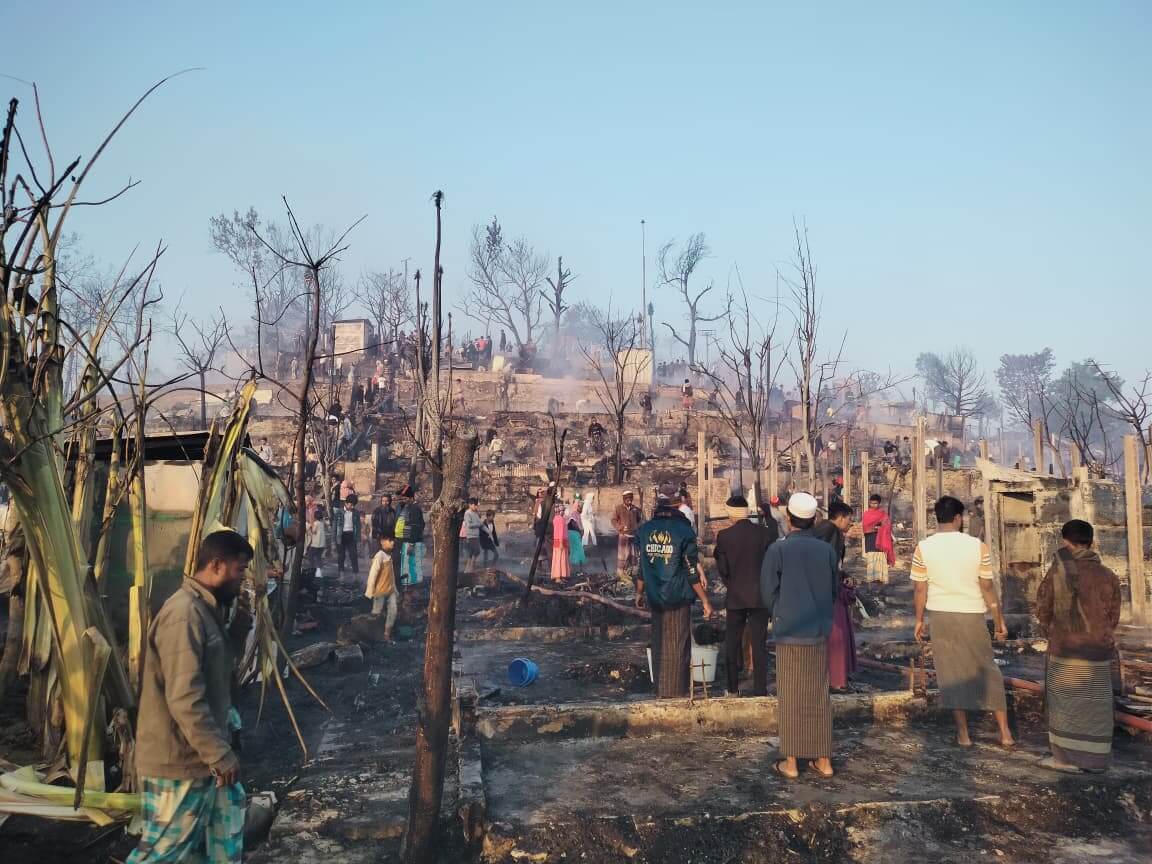 HHRD Humanitarian Support Amid Rohingya Camp Fires


