
IslamiCity
Listen PodCasts, Live Quran, Watch Videos @VideoHub

Across centuries and continents, calligraphy has transformed written language into something more than communication. In both the Islamic world and Japan, the written word has become an artistic and even spiritual discipline. Today, artists from both cultures are discovering remarkable connections between these traditions, creating a unique bridge between the Arab and Japanese worlds.
Saudi artist and designer Noha Raheem represents this emerging cultural fusion. Fascinated by Japanese Kanji, along with Katakana and Hiragana, Raheem began experimenting with Arabic letters rendered in a Japanese-inspired style. Drawing particularly from Kufic and freestyle Arabic calligraphy, she discovered that the extraordinary flexibility of Arabic script allows letters to take unfamiliar forms while retaining their identity and meaning.
Raheem uses traditional Japanese materials-including Sumi ink, calligraphy brushes, rice paper and hanging scrolls-to create Arabic poetry, sayings and Qur'anic verses with a distinctly East Asian visual character. For her, the experiment demonstrates not only the beauty of Arabic but its remarkable adaptability.
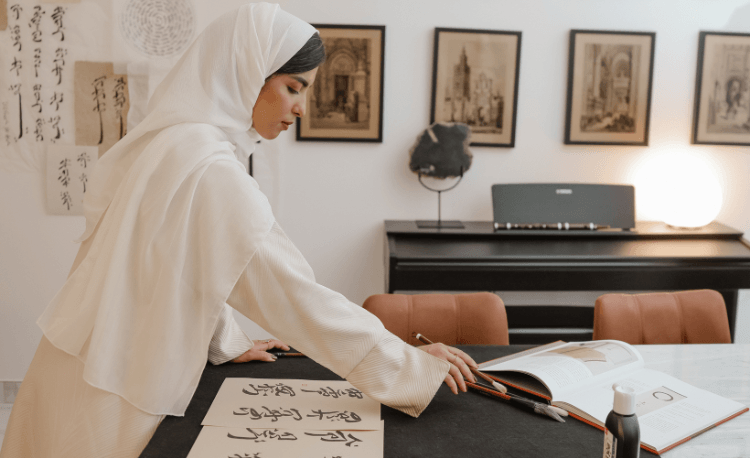
The cultural exchange also flows in the opposite direction.
Japanese master calligrapher Honda Kouichi has devoted much of his life to Arabic calligraphy. Born in Tokyo in 1946 and trained in Arabic language, Honda encountered the art while working in the Middle East. He later studied under renowned Turkish calligrapher Hasan Çelebi and received an ijaza, or traditional authorization in Arabic calligraphy.
Honda's work combines the disciplined tradition of Arabic script with a Japanese sensitivity toward nature, color and empty space. His celebrated Blue Desert, for example, evokes the Saudi landscape while Qur'anic words flow through brilliant blue desert forms. His works have earned international recognition, including a place in the British Museum collection.
For Honda, Arabic calligraphy carries a profound spiritual dimension. Historically refined through the desire to beautifully preserve and present the words of the Qur'an, calligraphy became one of the great artistic traditions of Islamic civilization.
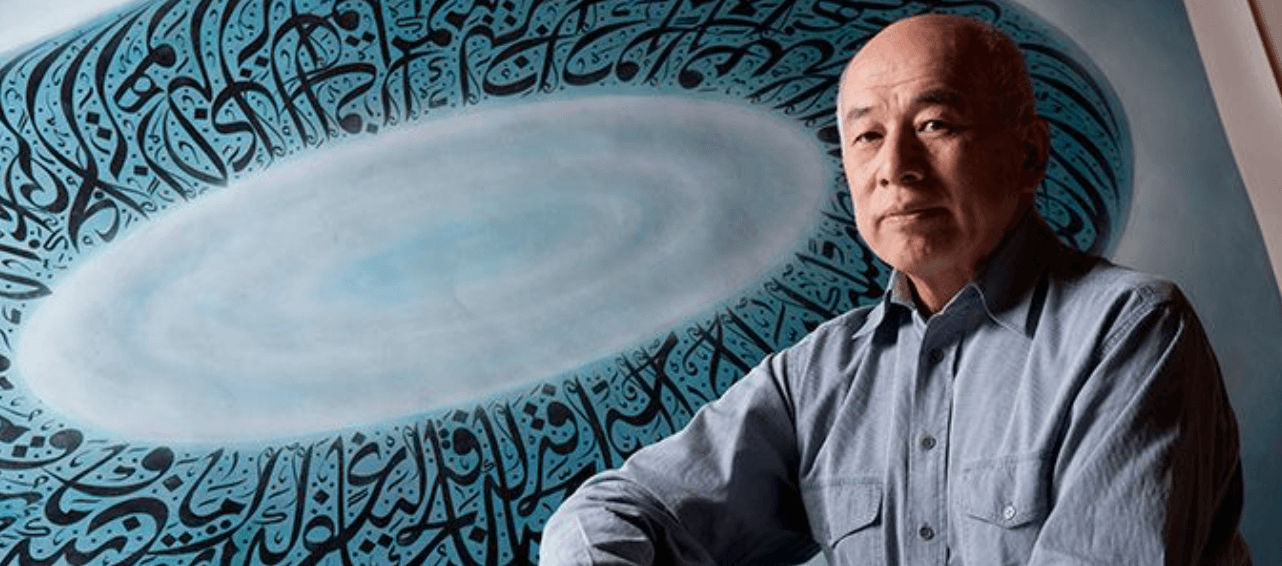
Yet its appeal extends far beyond Muslims. Japanese students often encounter Arabic without understanding the language and are nevertheless captivated by the beauty of its letters.
That fascination inspired the establishment of the Japan Arabic Calligraphy Association (JACA) in 2006. Through classes, exhibitions and cultural exchanges, the organization seeks to introduce Japanese audiences to Arabic calligraphy while deepening understanding of Arab and Islamic civilization.
The journeys of Raheem and Honda demonstrate something larger than artistic experimentation. One moves from Arabic toward Japanese aesthetics; the other from Japan toward the artistic heritage of Islam.
They meet through the written line.
In an age often defined by cultural divisions, their work reminds us that beauty can become its own language-one capable of crossing borders, nurturing curiosity and revealing unexpected common ground between civilizations.
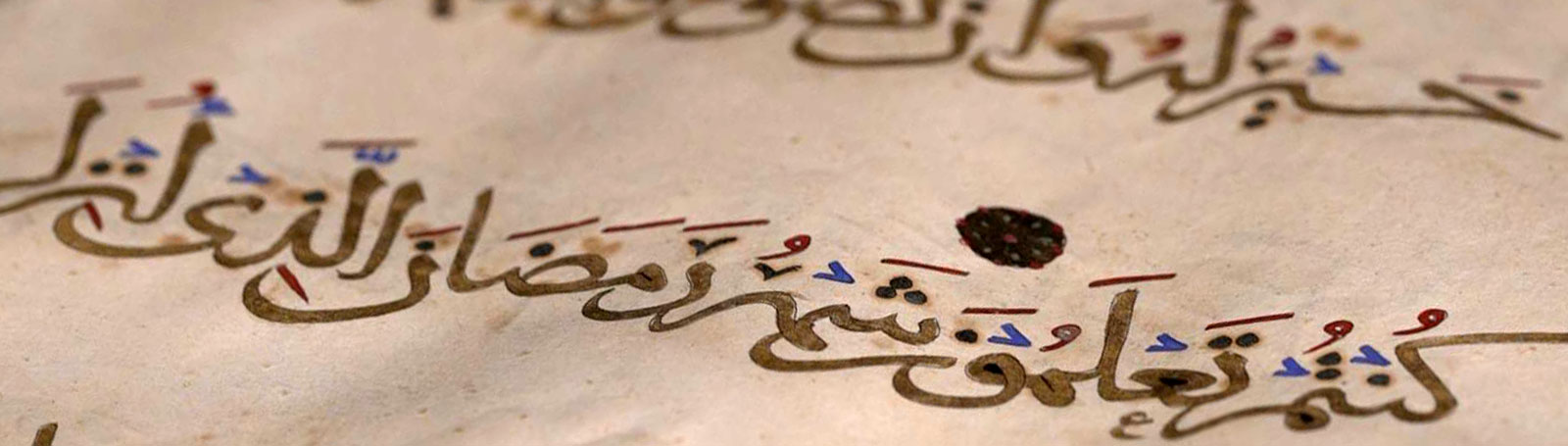 Calligraphy of the Quran


