There are some wounds that history records in numbers, but human beings remember in tears. The Partition of India in 1947 is one of them.
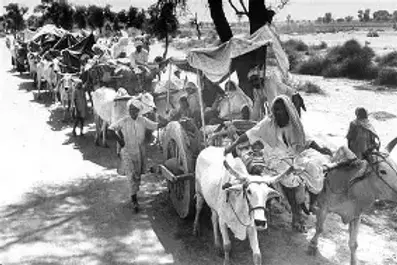
Historians can tell us how many millions crossed the newly drawn borders. They can estimate how many hundreds of thousands died. They can describe trains overflowing with desperate families, columns of refugees stretching for miles, villages abandoned overnight, homes burned, property looted, and entire communities uprooted.
But statistics cannot describe Partition. Only those who lived through it knew what it meant. Only the mother who searched among the dead for her child knew. Only the child who waited for a father who never returned knew. Only the woman who carried the wounds of sexual violence in silence for the rest of her life knew. Only the old man who locked the door of the house his ancestors had lived in for generations, put the key into his pocket, and walked toward a border he had never known existed knew.
And many of them carried that key until they died. They carried the memory of a courtyard, a tree, a neighborhood, a well, a mosque, a temple, a gurdwara, a marketplace, a school, a childhood friend. They carried a homeland that had suddenly become another country.
When Neighbors Became Enemies
Perhaps the most painful question of Partition is not how many people died. It is this: How did neighbors become killers? For generations, Hindus, Muslims, Sikhs, Christians, and others had inhabited the same towns and villages. They spoke the same languages. They ate many of the same foods. Their children played in the same streets. They borrowed from one another in difficult times. They attended one another's celebrations. They mourned one another's deaths. They disagreed. They had prejudices. They sometimes fought. But they also lived together.
Then something terrible happened. Fear entered the neighborhood. Rumor entered the marketplace. Politics entered the heart. Identity became a weapon. A neighbor ceased to be Ramesh, Ahmed, Kartar Singh, Fatima, Shanti, or Harbhajan. He became simply a Hindu. She became simply a Muslim without even knowing what it means to be either one. They became simply Sikhs. And once human beings are reduced to categories, it becomes frighteningly easy to forget that every category contains a mother, a father, a child, a dream, and a human heart. Who created so much hatred? I do not know. How could people who had lived beside one another for generations suddenly raise knives, swords, guns, and torches against one another? I do not know. How could a man look at a girl young enough to be his daughter and violate her because she belonged to another faith? I do not know. How could someone murder a baby? I do not know. How could young men be slaughtered merely because of the names they carried? I do not know. How could the elderly, who had harmed no one and could barely walk, be dragged from their homes and killed? I do not know. Perhaps no explanation will ever be sufficient.
And God's Name Was Shouted
There is another memory of Partition that should trouble every religious conscience. People sometimes killed while invoking God. Depending upon the killer, the cry might be "Allahu Akbar," "Jai Shri Ram," or "Waheguru Ji Ka Khalsa, Waheguru Ji Ki Fateh." Sacred words became battle cries. Words meant to lift human beings toward God accompanied acts that dragged humanity into an abyss. What God could possibly have been honored by the murder of an innocent child? What God could have been glorified by the rape of a woman? What God could have rejoiced when a family was burned inside its home? What God could have demanded that a neighbor murder the neighbor whose family had lived beside his own for generations?
Not the God I believe in.
I refuse the image of a god who requires human blood to establish his greatness. I refuse a religion that teaches me that another human being becomes disposable because he worships differently from me. I refuse any theology that turns hatred into holiness, murder into martyrdom, cruelty into courage, or vengeance into devotion. If someone tells me that God commands me to hate my neighbor because he calls God by another name, I must choose my neighbor over that understanding of God. Because the God in whom I believe is greater than my tribe. Greater than my nation. Greater than my sect. Greater than my anger. Greater even than my understanding of Him.
The God I Believe In
I believe in the God of mercy. I believe in the God who gives life and commands us to protect it. I believe in the God who created human diversity, who gave dignity to His creation, and who does not need human beings to defend Him by murdering one another. If I truly believe in such a God, then my faith cannot be measured merely by how often I pray, how loudly I proclaim His greatness, how carefully I observe rituals, or how passionately I defend my religious community. My faith must also be measured by how safe another human being is in my presence. Especially the human being who is different from me. The Hindu must be safe with the Muslim. The Muslim must be safe with the Hindu. The Sikh must be safe with both. The Christian, the Jew, the Buddhist, the Jain, the atheist, the believer and the unbeliever must all be safe. Otherwise, what have our prayers accomplished? If my forehead touches the ground before God while my heart burns with hatred for God's creation, something has gone terribly wrong with my worship.
The Greatest Test Comes When We Are Hurt
It is relatively easy to speak about human dignity when we are among friends. The real test begins when someone hates us. Can I defend the dignity of someone who insults me? Can I refuse to hate the community from which my attacker comes? Can I distinguish between the person who harmed me and millions of innocent people who happen to share that person's religion? Can I refuse revenge when revenge is being celebrated as courage? That is where faith becomes difficult.
Yet that is precisely where faith becomes meaningful. I cannot demand dignity for myself while denying it to another. I cannot mourn the Muslim killed in one village and remain silent about the Hindu killed in another. I cannot weep for the Sikh driven from his home while ignoring the Muslim driven from his. A mother's tears have no religion. A child's terror has no nationality. Blood has no sect. Grief carries no passport.
Two Nations, One Wound
Every August, Pakistan celebrates its creation on August 14, and India celebrates its independence on August 15. Flags rise. Anthems are sung. Speeches are delivered. Nations remember their beginnings. They should. Freedom deserves celebration. Independence deserves remembrance. But between those two days stands a shadow. Partition. India and Pakistan were born amid one of the largest and most traumatic migrations of the twentieth century. For millions of families, independence and dispossession arrived together. One person's freedom was accompanied by another person's exile. A flag rose while a house burned. A nation celebrated while a mother searched for her missing child. We cannot change 1947. But we can decide what 1947 will teach us. We can use its dead to justify another century of hatred. Or we can allow their memory to forbid us from repeating their tragedy.
I Too Left India
Years later, I too left India. I eventually made another country my home and became a citizen of the United States. But geography does not erase memory. A passport can change citizenship; it cannot erase the landscapes that formed a human being. And so, on these August days, I do not think only as an Indian by birth or an American by citizenship. I think as a human being whose generation lived close enough to 1947 to understand that civilization is more fragile than we sometimes imagine. The distance between neighbor and enemy can become frighteningly short. A rumor can shorten it. A political speech can shorten it. A lie repeated often enough can shorten it. A religious leader preaching hatred can shorten it. A politician seeking votes can shorten it. And when society finally crosses that distance, returning can take generations. That is why the memories of Partition must not become weapons. They must become warnings.
Before the Last Witnesses Are Gone
The generation that witnessed Partition is disappearing. Soon there will be no trembling voice left to say: "I was there." No old woman to remember the night her family fled. No elderly man to describe the friend of another religion who hid him from a mob. No survivor to remember the train that arrived without the people who had boarded it. When the witnesses are gone, we will be left with history books. And history books cannot cry. We must therefore preserve not only the history of Partition but its moral meaning. We must tell our children that Hindus suffered. Muslims suffered. Sikhs suffered. Women suffered in ways that remained hidden for decades. Children suffered without understanding why. And amid the madness, courageous human beings also protected neighbors of other religions-sometimes risking and losing their own lives. Those people must also be remembered. Because they proved something enormously important: Hatred was never inevitable. Even in the darkness of 1947, people still had choices. Some chose murder. Others chose humanity.
My Prayer This August
On the anniversary of Pakistan's creation and India's independence, I offer neither a political argument nor a verdict upon history. I offer a prayer. May no child in India, Pakistan, Bangladesh, or anywhere else in the world ever have to run from his home because someone has decided that his religion makes him an enemy. May no woman ever again become the battlefield upon which men fight their religious or national wars. May no train ever again cross a border carrying corpses instead of passengers. May no family ever again lock the door of its ancestral home knowing that it may never return. May no Hindu fear a Muslim. May no Muslim fear a Hindu. May no Sikh fear either. May no human being fear another because of the name by which he or she calls upon God. And when someone tries to teach our children hatred, may we have the courage to stand between the child and the hatred and say:
No. Not again.
We have already paid that price. We have already buried those children. We have already violated those daughters. We have already burned those homes. We have already filled those trains. We have already drawn borders through villages, families, memories, and human hearts. Enough.
Seventy-nine years after 1947, India and Pakistan do not honor their dead by inheriting their hatred. They honor them by refusing to create more dead. And perhaps the finest monument we can build to those who perished in Partition will never be made of marble or stone. It will be a generation that finally refuses to hate.
A generation that can enter a mosque and recognize prayer, enter a temple and recognize devotion, enter a gurdwara and recognize service, enter a church and recognize hope-and encounter another human being and recognize itself. That is the future for which I pray. I believe in a merciful God, a compassionate God, a God whose mercy is greater than our divisions. And if I claim to worship that God, then I must defend the sanctity of every life and the dignity of every human being-even the dignity of the person who hates me.
For when all the flags have been folded, all the speeches forgotten, all the borders redrawn, and all our arguments have become footnotes in history, one question may remain: When hatred came to our door, did we pass it on-or did we stop it? For the sake of those who suffered in 1947, may our answer be: It stopped with us.





 France, Middle East and Global Power Shifts: Key Developments


