
IslamiCity
Listen PodCasts, Live Quran, Watch Videos @VideoHub

Sarmad is a chain smoker. His love marriage has turned out to be the opposite of what he had envisioned. Ego clashes, unmet expectations, personality conflicts, broken hopes, sinusoidal waves of mood swings, and unforeseen flaws in both partners have reduced their home to a perpetual shouting contest.
What once appeared to be a joyous relationship destined for eternity now stands on the verge of collapse. He is unable to see any light at the end of the tunnel. In an attempt to suppress his tensions and frustrations, he turns to excessive smoking.
One day, his friend invites him to attend a session with a scholar. Reluctantly, he agrees and sits in the car as his friend drives him to an unfamiliar house in the city. In a small room, a few people are seated, asking questions, while a humble man in his mid-fifties responds with eloquence. Sarmad listens attentively. He is immediately struck by two things: the questions mirror his own, and the answers are imbued with immense wisdom, penetrating insight, unusual clarity of thought, harmony, and resonance.
For the first time in his life, Sarmad feels at ease with a religious personality. He begins to realize that the vacuum within his soul can only be filled by faith. He comes to see that life is not merely about science, logic, and mathematics, but also about spirituality, poetry, and art.
Within two hours, he is shown a mirror-without offense. He begins to recognize flaws within himself that had previously remained hidden. He also begins to see virtues in his wife that had gone unnoticed. He confesses to his friend that much of his misery was self-inflicted and unnecessary.
With a sense of calm and a partially restored inner balance, he returns home and greets his wife with a smile. He says nothing, but silently resolves to begin a new chapter in their relationship. The next morning, he buys her a card and writes that both of them should forgive each other completely and start afresh. His wife is deeply touched by this gesture and reciprocates.
Every week, Sarmad attends the same gathering with the same scholar. Gradually, his wife notices a transformation-he becomes more mature, more peaceful, wiser, deeper, more pleasant, and more tolerant. This transformation affects their relationship so profoundly that his wife describes it as a turning point that saved their marriage from the brink of disaster. After a long time, they begin to enjoy each other's company again.
Jokingly, she asks which marriage counselor he hired and how much he paid. Sarmad replies, "He is a man of God, and he offers this service completely free of cost."
The world is filled with many Sarmads, whose saviors are none other than the men of God.
When you hear the word revolution, what comes to mind? A political movement, technological advancement, economic transformation, scientific paradigm shift, the overthrow of a government, or the adoption of a new cultural trend. A revolution is something that generates immediate and visible change on a massive scale.
But there also exists a silent revolution-one that does not make headlines, does not trend on social media, and is not recorded in history books. Its positive impact on individuals, its invaluable contribution to the betterment of society, and its quiet breakthroughs in human lives are profound, yet it never becomes the talk of the town. This transformation is brought about by the unsung heroes of society who serve humanity silently-without flags, noise, or recognition. Their work deserves applause, yet their sincerity transcends the need for it. People may fail to acknowledge them, but the Almighty does not.
Who are they? They are the Sufis.
What do they do? They transform hearts. They uplift those crushed by life's harshest trials. They offer a vision of life that is deeper and more meaningful than the ordinary. They present religion not merely as a system of commands and prohibitions, but as a journey of inner discovery. They ensure that one does not rush to change the world before first undergoing inner transformation.
Islamic thought places great importance on preserving the lives of those who embodied knowledge and action. It is no surprise, then, that we possess a rich legacy of countless individuals whose lives were deemed worthy of record. Among them all, one trait remains constant: none attained greatness without a singular commitment-service to humanity. A service that is unpaid, often unpraised, and frequently unrecognized; a service whose sole motivation is the pleasure of God. What a profound manifestation of selflessness and magnanimity.
It is a common misconception that Sufism teaches escapism from the challenges of life. Here, one must recognize the vital distinction between Islamic mysticism and other forms of mysticism. Mysticism, in general, often places primary emphasis on acts of worship, meditation, and prolonged solitude. In contrast, Islamic mysticism places its greatest emphasis on service to humanity.
Such service is impossible without engagement with society, for one cannot serve others in isolation. In fact, this very service becomes a means of spiritual purification, for when a Sufi interacts with people, he must consistently cultivate two essential qualities: the patience to endure the unpleasant behavior of others, and the sincerity to seek only the pleasure of God.
Here, we are reminded of the distinction between a preacher and a Sufi. A preacher speaks; a Sufi embodies. A preacher relies on voice to persuade; for a Sufi, silence itself is eloquent. A preacher may consider his duty fulfilled once the speech ends; a Sufi continues until the needs of the seeker are met.
A preacher may assume he carries the mission of the prophets; a Sufi recognizes that he is not even the dust beneath their feet. The preacher's influence lasts as long as his words echo; the Sufi's influence endures until the final breath.
Had there been no Sufis, Islam might not have reached us in the form we know today. Our faith owes much to the beauty of their character and the excellence of their conduct. Countless individuals entered Islam not through argument or debate, but through being drawn to the scent of the moral and ethical example of the Holy Prophet ﷺ. The Sufis did not win hearts by confrontation, but by compassion-seeing people not as adversaries, but as the family of God.
The Holy Prophet ﷺ said, "He who is ungrateful to his benefactor is ungrateful to God." In our time, certain novice YouTubers who criticize the Sufis of the past embody a striking ingratitude. Ironically, many of them might not have been Muslims at all had it not been for the very Sufis they criticize. Islamic history is incomplete without their extraordinary role.
Just as a child cannot comprehend a doctoral thesis, these critics lack the depth required to understand the works of such spiritual giants. In attempting to highlight perceived "flaws," they inadvertently expose their own intellectual shallowness.
It is a false perception that Sufis lack a serious commitment to the pursuit of knowledge and are merely immersed in ecstatic spiritual states. Any genuine student of Islamic thought will readily acknowledge that:
Superman in Islam is an Urdu work centered on Imam Ja'far al-Ṣādiq (R.A.), who is undoubtedly among the greatest figures in history. It is presented as a compilation of findings from a French university research group concerning his early contributions to modern science and philosophy. Many non-Muslim scholars have paid tribute to the Imam.
Yet, due to the corrosive effects of sectarianism, such is the ignorance among many modern Muslims regarding their own intellectual and spiritual heritage that some Sunnis refrain from exploring the life and works of this Imam, considering him relevant only to the Shia tradition. What a tragedy it is that while Western intellectuals have undertaken serious efforts to study the Imam, a significant portion of the Muslim world has yet to transcend sectarian boundaries.
The Muslim world today stands fragmented-divided by mistrust, bias, ill will, and prejudice. What can unite it is not the rejection of our rich legacy, but the humble acknowledgment that those towering personalities of the past understood and practiced Islam with a depth that modern reformers often fail to attain. A sincere return to that legacy is not regression-it is the path to revival. The way forward, paradoxically, lies in reconnecting with what lies behind.
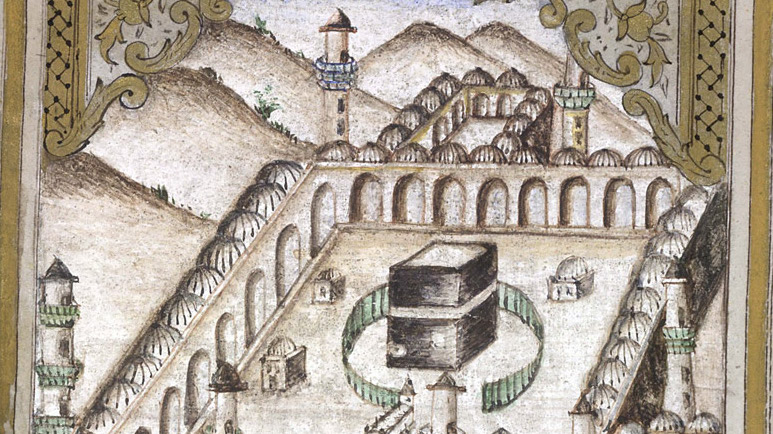 Islamic Pilgrimages and Sacred Spaces


