
IslamiCity
Listen PodCasts, Live Quran, Watch Videos @VideoHub

His academic journey began at Aligarh Muslim University, the institution founded by Sir Syed Ahmad Khan with the ambitious vision of preparing Indian Muslims to meet the challenges of the modern world without compromising their religious and cultural identity. Aligarh offered far more than formal education. It cultivated a generation of scholars and leaders who believed that faith and modern knowledge were not adversaries but complementary sources of human progress.
At Aligarh, Ahmad immersed himself in history, law, political science, and constitutional thought. More importantly, he absorbed the university's broader philosophy-that education must ultimately serve society. It was here that he discovered not merely a profession but a vocation: to devote his intellect to the pursuit of justice and the advancement of public life.
His quest for learning eventually took him to England, where he pursued advanced studies at the School of Oriental Studies in London before continuing at Fitzwilliam House, Cambridge. There he earned a Master of Letters (M.Litt.) in History. This achievement represented far more than an academic qualification. It refined an already remarkable intellect and exposed him to diverse legal traditions, historical methodologies, and comparative political thought.
Within the libraries and lecture halls of Cambridge, surrounded by manuscripts, historical records, and some of the foremost scholars of his generation, Ahmad developed the intellectual framework that would guide his entire career. He learned to view civilizations comparatively, to appreciate the continuity between legal systems, and to understand history as a guide to public policy rather than merely a record of past events. These formative years equipped him with a rare ability to bridge Eastern and Western intellectual traditions, an ability that would later prove invaluable in the service of a nation yet to be born.
Ahmad rapidly established himself as one of those exceptional officers.
By 1934, he had been appointed Judge of the Court of Sessions and Appeal, assuming one of the most demanding judicial responsibilities within the colonial administration. Yet these professional achievements unfolded during one of the most turbulent periods in India's modern history. The Civil Disobedience Movement had intensified demands for independence, nationalist politics had gained unprecedented momentum, and communal tensions were increasingly threatening the social fabric of the country.
Amid these political upheavals, Ahmad earned a reputation for impartiality, intellectual rigor, and unwavering commitment to justice. His judicial temperament remained remarkably calm even when confronted with politically charged disputes.
One of the defining moments of his colonial career came in 1940, when communal violence erupted during the Meerut riots. At a time when public confidence in official investigations was fragile and accusations of administrative bias were widespread, Ahmad was entrusted with conducting the inquiry into the disturbances.
His investigation demonstrated exceptional fairness, independence, and moral courage. Rather than allowing political or communal pressures to influence his judgment, he approached the inquiry with scrupulous attention to evidence and due process. His conduct reinforced the principle that justice must remain impartial even in times of social conflict. Within a colonial legal system often criticized for unequal treatment, Muhammad Basheer Ahmad emerged as a jurist whose personal integrity inspired confidence across communal boundaries.
His commitment to scholarship found institutional expression in the establishment of the Aligarh Historical Research Institute, where he served as Chairman of its Editorial Board. Through this institution, he encouraged rigorous historical research grounded in primary sources and scholarly objectivity.
He also lectured extensively on history, constitutional law, political science, and jurisprudence, helping shape a new generation of scholars who understood that academic inquiry carried moral responsibilities as well as intellectual ones.
His leadership extended beyond academia. During the difficult years of the Second World War, in 1943, he served as President of the Rotary Club of Fyzabad. Even in civic life, he demonstrated the same philosophy that governed his scholarship and judicial service: leadership was not measured by authority or prestige, but by one's contribution to the welfare of society.
For Ahmad, education, law, and public service were inseparable. Knowledge acquired in the classroom found its highest purpose when translated into institutions that promoted justice, civic responsibility, and national progress. This synthesis of scholarship and service remained one of the defining characteristics of his remarkable life.
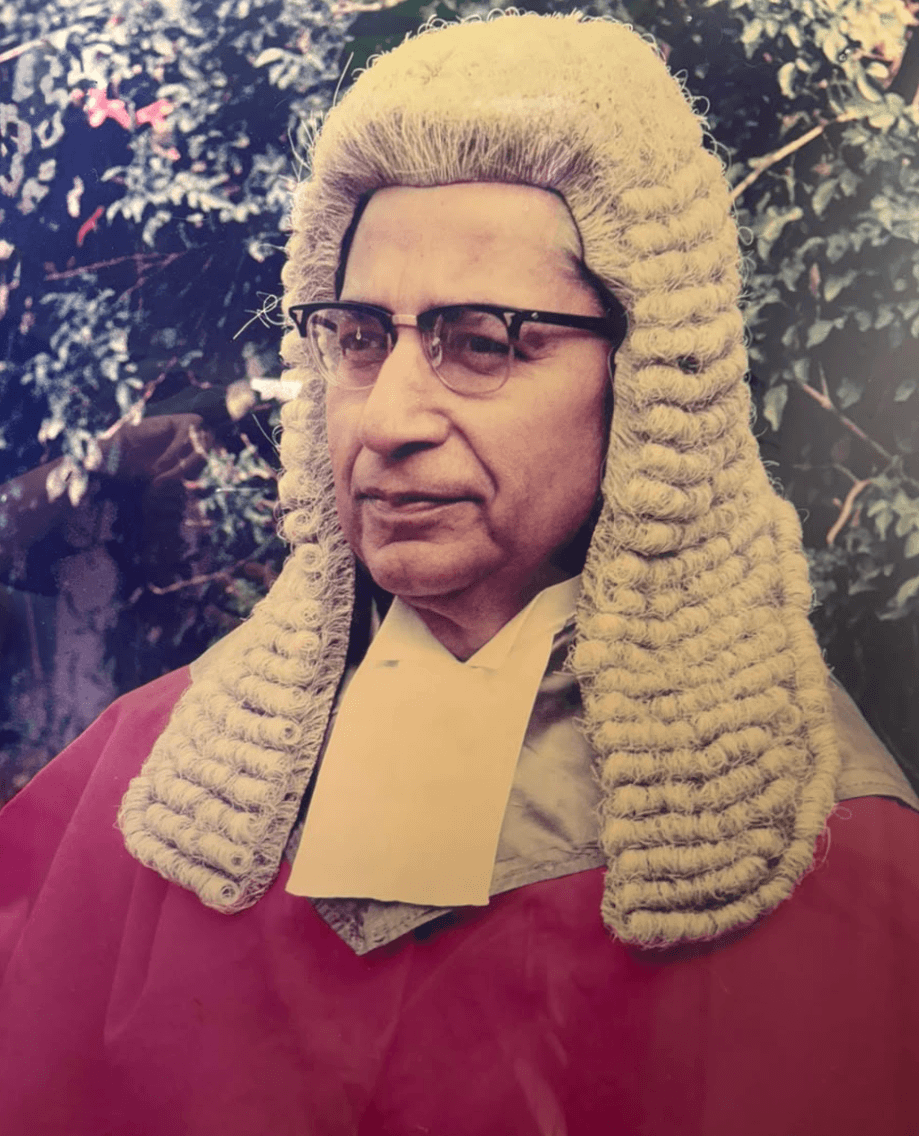
For Justice Muhammad Basheer Ahmad, Partition was not merely a historical event to be observed from a distance; it became the defining chapter of his public life. At a time when the newly created state of Pakistan required experienced administrators, constitutional thinkers, and principled public servants, he answered that call with unwavering dedication.
He was appointed Secretary of the Pakistan Constituent Assembly, placing him at the very heart of the nation's constitutional development. The office demanded far more than administrative efficiency. It required intellectual clarity, political wisdom, and an intimate understanding of constitutional law. Every debate, every committee report, and every legislative proposal carried profound implications for the future of a country still struggling to define its political identity.
Between 1947 and 1952, Justice Ahmad served on several of the Assembly's most important bodies, including the Assembly Drafting Committee and the Board of Ta'limāt-i-Islāmiyā. These committees confronted one of the greatest constitutional challenges of the twentieth century: how to reconcile the principles of Islamic jurisprudence with the institutional requirements of a modern democratic state.
This was no ordinary legislative exercise. It required balancing enduring religious values with constitutional governance, parliamentary accountability, judicial independence, and the practical demands of administering a modern nation. Justice Ahmad's scholarship in history, comparative law, and constitutional theory made him uniquely qualified for this responsibility.
While many of Pakistan's founders inspired the nation through political leadership, Justice Ahmad quietly helped transform their ideals into constitutional institutions. His contributions were seldom dramatic, but they were indispensable. Through careful drafting, meticulous research, and thoughtful legal analysis, he participated in laying the constitutional foundations upon which the young republic would gradually build its political future.
Justice Muhammad Basheer Ahmad became one of those distinguished representatives.
He represented Pakistan at the Commonwealth Parliamentary Conference in London in 1948, followed by subsequent conferences in Sydney in 1950 and Ottawa in 1952. These meetings provided newly independent Commonwealth nations with opportunities to exchange constitutional ideas, parliamentary practices, and legislative experiences.
His participation reflected the confidence that Pakistan's leadership placed in his intellect, judgment, and diplomatic abilities.
He also represented Pakistan at meetings of the Inter-Parliamentary Union held in Rome, London, and Rio de Janeiro, where legislators and constitutional experts from around the world discussed the challenges of democratic governance during the early years of the Cold War.
In every international forum, Justice Ahmad projected the image of a thoughtful constitutional scholar rather than a political ideologue. His calm demeanor, scholarly depth, and command of comparative constitutional law earned him the respect of colleagues from many nations.
One particularly symbolic moment came in 1953, when he attended the Coronation of Queen Elizabeth II in London.
For many observers, the ceremony marked the continuity of the British Commonwealth. For Justice Ahmad, however, it represented something far more profound. Only a few years earlier, he had served within the institutions of British India. Now he attended as the representative of an independent and sovereign Pakistan. The transformation reflected not only the political evolution of South Asia but also his own remarkable journey-from colonial civil servant to constitutional architect of a new nation.

By this stage of his career, he had accumulated decades of experience as a judge, constitutional adviser, historian, administrator, and scholar. These diverse experiences enriched his judicial philosophy.
Those who appeared before him encountered a judge whose decisions reflected meticulous legal reasoning rather than personal preference. His judgments were marked by clarity, intellectual discipline, fairness, and compassion. He believed that justice required not only fidelity to legal principles but also sensitivity to the human realities behind every dispute.
For Justice Ahmad, the courtroom was more than a place where statutes were interpreted. It was an institution through which public confidence in the rule of law was either strengthened or diminished. Every judgment therefore carried both legal and moral significance.
One remarkable episode during this period illustrates the international respect he commanded.
He spent one month working alongside Lord Parker, Chief Justice of the United Kingdom, exchanging legal ideas and judicial experiences. This collaboration represented far more than professional courtesy. It symbolized an intellectual dialogue between two legal traditions-Britain's centuries-old common law system and Pakistan's evolving constitutional judiciary.
The experience demonstrated Justice Ahmad's belief that legal systems, while rooted in different historical traditions, could learn from one another through scholarship, mutual respect, and comparative study.
Indeed, some of his most enduring contributions emerged not from the courtroom but from his writings.
His landmark work, The Administration of Justice in Medieval India, fundamentally changed the study of legal history in South Asia. At a time when historians devoted most of their attention to kings, military campaigns, and dynastic politics, Justice Ahmad turned his attention to a subject that had received comparatively little scholarly consideration: the functioning of courts, judges, and legal institutions.
Drawing upon original manuscripts, legal digests, fatwas, and historical chronicles, he reconstructed the administration of justice under the Delhi Sultanate and the early Mughal Empire. Rather than presenting abstract theories of Islamic law, he examined how judges actually decided cases, evaluated evidence, interpreted legal principles, and balanced justice with mercy.
His work illuminated the daily operation of judicial institutions and revealed that the strength of medieval governments rested not merely upon military power but also upon their capacity to administer justice fairly and consistently.
His scholarly interests, however, extended far beyond legal history.
In The Problem of Rural Uplift in India, he examined the structural causes of rural poverty, emphasizing education, infrastructure, agricultural reform, and institutional development as essential ingredients of social progress.
In The Influence of Muslim Culture in India, he explored the rich interaction between Persian, Central Asian, and indigenous Indian traditions, demonstrating how cultural exchange shaped law, architecture, education, governance, and public life.
His work, The Meaning and Scope of Law among Muslim People, reflected his lifelong engagement with Islamic jurisprudence, examining not merely legal rules but the philosophical foundations of law as an instrument of morality, social order, and justice.
Perhaps his most ambitious scholarly undertaking was the monumental Select Constitutions of the World, published in four volumes. Through a comparative study of constitutional systems across nations, Justice Ahmad sought to identify the principles that sustain effective governance while respecting local traditions and political realities.
Taken together, these works reveal an extraordinary range of scholarship. Justice Ahmad was simultaneously a historian, constitutional theorist, jurist, sociologist, educator, and comparative political thinker. Across every field, his scholarship reflected the same conviction: knowledge exists not for intellectual prestige alone but for the service of humanity.
Those who knew him remembered not his titles but his character. Friends, colleagues, students, and associates consistently spoke of his quiet dignity, refined manners, intellectual generosity, and unwavering integrity.
His residence in Karachi's PECHS Society reflected the simplicity with which he lived. It was a home distinguished not by extravagance but by learning, discipline, and hospitality.
Outside the demands of judicial and scholarly life, he enjoyed playing tennis and golf, pursuits that reflected his appreciation for discipline, balance, and physical well-being.
His personal life embodied the same harmony that characterized his professional career. He believed that fulfillment came not from power or public recognition but from maintaining equilibrium between duty, scholarship, family, civic responsibility, and personal contentment.
He demonstrated that education is the seed from which national transformation grows.
He proved that justice must always be tempered by courage, fairness, and compassion.
He showed that leadership derives its legitimacy from service rather than privilege.
Above all, he affirmed that integrity remains the indispensable foundation of enduring nationhood.
From the classrooms of Aligarh to the libraries of Cambridge, from the courtrooms of British India to the Constituent Assembly of Pakistan, from the High Court Bench to the world's parliamentary forums, Justice Muhammad Basheer Ahmad devoted his extraordinary abilities to the pursuit of knowledge, justice, and public service.
Justice Ahmad passed away on July 7, 1979 at the age of about 75. His life continues to remind us that genuine greatness is never measured by wealth, power, or fame. It is measured by the institutions we strengthen, the principles we defend, the knowledge we leave behind, and the countless lives enriched through our commitment to truth, justice, and humanity.
Muhammad Basheer Ahmad, (1941), The Administration of Justice in Medieval India (PDF), The Aligarh Historical Research Institute, Aligarh University.
 Legacy of Aga Khan IV 1936 - 2025


