
IslamiCity
Listen PodCasts, Live Quran, Watch Videos @VideoHub

We have officially entered the age of Artificial Intelligence.
In just a few years, AI has gone from being a futuristic concept to a tool used by millions every day. Students are using AI-powered chatbots to complete assignments, professionals are using them to write reports, and content creators are generating images, videos, and even voices with a few simple prompts.
Today, artificial intelligence can write essays, create realistic images, clone voices, generate videos, and answer questions in seconds. What once seemed like science fiction has become reality.
As Muslims, this raises important questions.
Should we be excited about these developments? Should we be worried? Is AI a threat to our faith, our communities, and our future, or is it simply another tool that can be used for good or bad depending on the hands that hold it?
Traditional computer programs follow fixed instructions. They do exactly what they are told to do. Artificial intelligence is different because it learns patterns from data and adapts its responses based on what it has seen before.
Think about how streaming services recommend movies. They observe viewing habits and identify patterns. AI operates in a similar way but on a much larger scale.
Rather than possessing true understanding, AI analyses vast amounts of information and predicts the most likely response.
This distinction is important because AI may appear intelligent, but it does not possess wisdom, consciousness, or independent reasoning in the way humans do.
Today, AI can generate realistic photographs of events that never happened, videos of people saying things they never said, and voices that sound identical to real individuals.
As these technologies improve, distinguishing fact from fiction becomes increasingly difficult.
This challenge is not entirely new. Islam has always taught believers to verify information before accepting or spreading it.
Allah says in the Quran:
"O you who believe, if a sinful person comes to you with news, verify it, lest you harm people in ignorance and then become regretful for what you have done." (Quran 49:6)
The principle remains the same, even if the technology changes.
In a world filled with AI-generated content, Muslims must become more careful, more thoughtful, and more committed to verifying information before sharing it.
In reality, AI systems are known to "hallucinate"-a term used when they confidently provide information that is completely false.
An AI chatbot may invent quotations, misquote sources, or even generate religious rulings that have no basis in authentic scholarship.
This is particularly concerning when it comes to Islamic knowledge.
For centuries, Muslims have relied upon scholars who not only possess knowledge but also wisdom, context, and understanding. A scholar considers circumstances, intentions, and consequences before offering guidance.
AI cannot replace this process.
While AI may become a useful tool for searching Islamic texts or helping scholars access information more efficiently, it should never become a substitute for qualified scholarship.
The danger of "Sheikh Google" may soon evolve into the danger of "Sheikh AI."
When books became widely available, some worried that people would stop memorising information. When calculators became common, others feared people would forget basic mathematics.
Today, similar concerns are being raised about AI.
If students use AI to write every assignment, will they stop learning critical thinking? If professionals rely on AI for every task, will they lose important skills?
These concerns are not without merit.
Technology can make life easier, but ease does not always lead to growth.
Islam has always encouraged effort, reflection, and the pursuit of knowledge. Knowledge gained through struggle often carries greater value than information obtained instantly.
The challenge for Muslims will be ensuring that AI remains a tool that enhances human ability rather than replacing the effort required to develop wisdom and understanding.
We are already living in a time when loneliness is increasing and marriage rates are declining in many parts of the world.
AI companions, virtual relationships, and personalised digital personalities could further reduce meaningful human interaction.
Technology should bring people together, not isolate them.
Islam places tremendous importance on family, marriage, community, and real human connection. No matter how advanced technology becomes, it can never replace genuine relationships built upon mercy, love, and companionship.
In reality, many experts argue the opposite.
The more we understand technology, the more we appreciate the complexity of Allah's creation.
Despite all of humanity's scientific achievements, we remain unable to create even the simplest forms of life from nothing.
AI does not create. It rearranges. It imitates. It analyses. It generates based on information it has already been given.
Every AI model depends entirely on resources, intelligence, and materials that Allah created in the first place.
Rather than diminishing faith, technological advancements can remind us of the limits of human power and the perfection of the Creator.
Artificial intelligence can help Muslims:
Used responsibly, these technologies can become powerful tools for learning and spiritual growth.
The printing press, the internet, and social media all faced resistance when they first appeared.
The lesson is not that every new technology should be accepted without question. Rather, it is that Muslims should engage with emerging technologies early enough to shape them positively.
If Muslims are absent from the development of AI, others will define how it is used.
We need Muslim engineers, researchers, entrepreneurs, educators, and scholars contributing to this field so that ethical values and community needs are represented.
Like every technology before it, it carries both benefits and dangers.
It can educate or mislead. It can strengthen communities or isolate individuals. It can be used to spread truth or to spread deception.
The future of AI will largely depend on how humanity chooses to use it.
For Muslims, the path forward is clear: embrace beneficial innovation, remain aware of its risks, verify information carefully, seek knowledge from trustworthy sources, and ensure that technology serves humanity rather than replacing the values that make us human.
The AI revolution is here. The question is not whether it will change the world-it already has.
The real question is whether we will help shape that change in a way that benefits humanity and brings us closer to Allah rather than further away from Him.
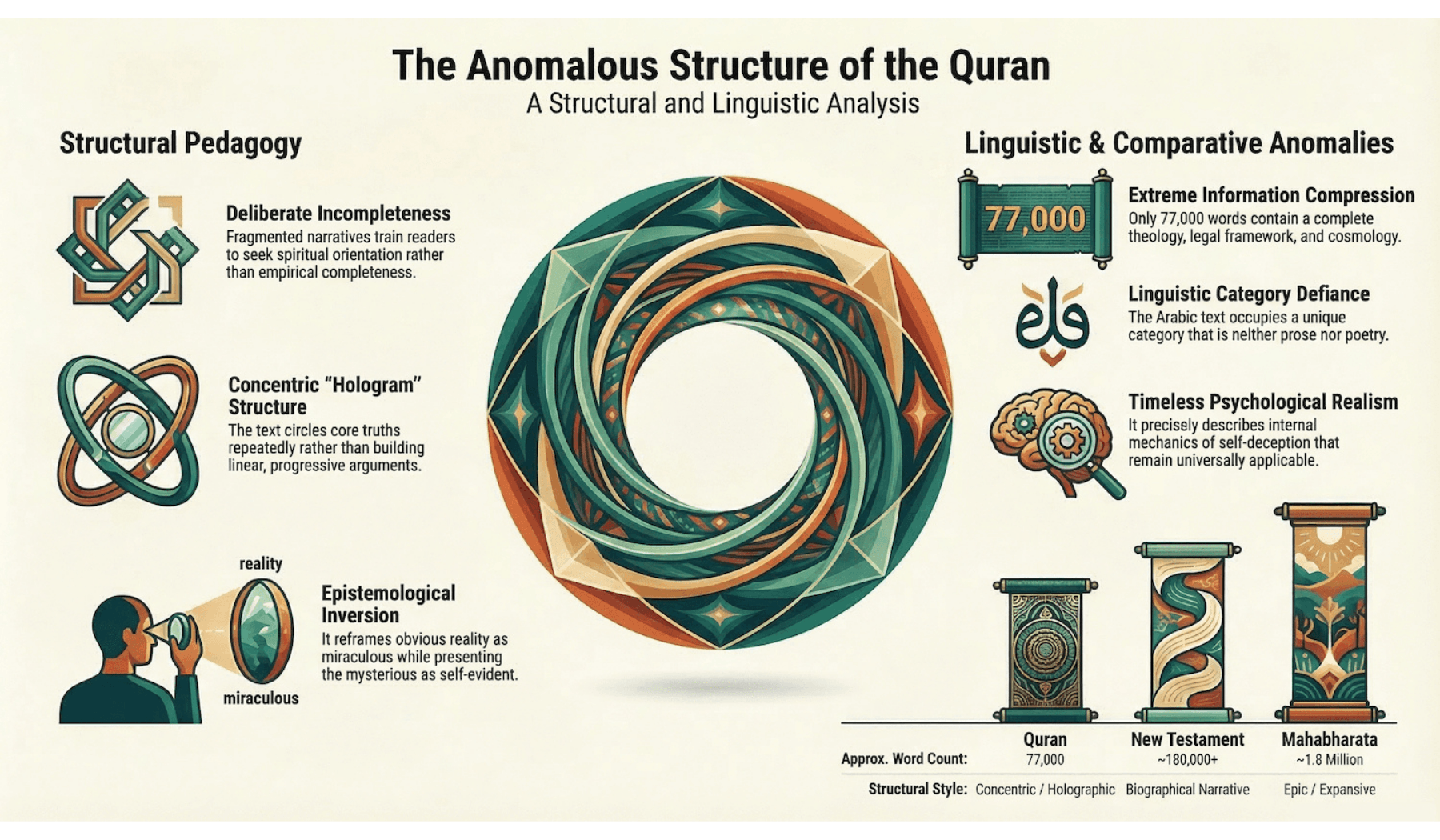 An AI Exploration of Quranic Structure


