
IslamiCity
Listen PodCasts, Live Quran, Watch Videos @VideoHub

The origins of the Houston Islamic Arts Festival date back over a decade. In 2014, a group of local Houstonians, bonding over a shared passion for Islamic art, curated an art show that was exhibited at a local mosque.
This initial art show laid the foundation for the present-day Islamic Arts Society. The Islamic Arts Society is a Houston-based nonprofit that organizes the Islamic Arts Festival. Their mission is to share the rich heritage of Islamic Art and organize events to celebrate Islamic culture and promote the positive image of the Muslim community amongst the Houston community at large.
The Islamic Arts Society hosts year-round events, creating a cultural bridge between the Muslim and non-Muslim communities. Artist talks, demonstrations, and community panels create an environment where people can engage with the cultural and historical significance behind the artwork. Since its inception, this festival has grown into the largest one of its kind in the United States. Artists and their connoisseurs flock from across the nation to Houston to partake in the beautiful display of Islamic heritage. The festival is a testament to Houston's best trait, diversity.
This year, the 12th annual festival took place on November 15th and 16th at the University of Houston. It was inaugurated by Houston Mayor, Mayor Whitmire, who officially designated the weekend as Islamic Arts Festival Days.
Throughout the weekend, various elements of Islamic art were showcased. In the Houston ballroom, painters, glass workers, woodworkers, mosaic artists, and calligraphers took center stage. Downstairs in the theater, short films, storytelling, comedy show, and Sufi music performances entertained the guests. The films narrated present-day Muslim experiences in America. Meanwhile, an academic seminar brought together artists, museums, and scholars of Islamic art for a meaningful dialogue.
We cannot talk about the festival without retracing its most important root: its spiritual connection to Islam. Even more contemporary pieces draw heavy inspiration from religion. For instance, calligraphers on-site wrote verses from the Quran. Turkish paper marbling drew in a large crowd, each person captivated by the delicate act of shaping drifting pigments into ethereal, mesmerizing patterns. And Henna artists who, through meticulous tracing of floral and geometric designs, turned skin into temporary canvases.
The festival and its artists portray the Islamic world in a manner that counters Western misconceptions. It is a diverse, nuanced culture that does not exist as a monolith. Artists use the festival as a platform to highlight their individual heritage. This consequently seeped into the pieces they showcased. Distinctions can be seen in the work displayed by artists of different nationalities, even when it was the same art form. It was a harmonious visual journey that gave the viewer a glimpse of the historical beauty of the Islamic world. The mosaics and handmade tiles echo patterns seen throughout Ottoman, Persian, and Andalusian heritage. Their interlocking forms are not merely decorative but rooted in a worldview that finds meaning in order, symmetry, repetition, and the search for the infinite. Many of the painters and contemporary visual artists reinterpret miniature-painting conventions, architectural motifs, and textile patterns, folding historical elements into modern media.
What makes this festival stand out is not only the variety of media represented but the way historical knowledge is thoughtfully woven into the programming. Many art festivals offer beautiful objects, but few provide the context that helps visitors understand why these objects carry meaning.
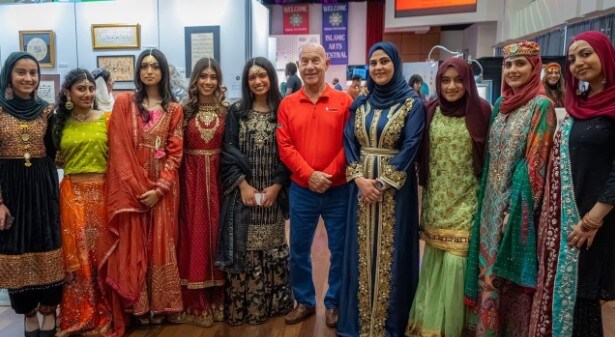
During the festival, artists are available to explain their art to visitors and the significance behind the piece. Because of this, the festival feels like both a museum and a community gathering. It preserves tradition while giving space for artistic innovation. Visitors leave with a layered understanding of Islamic culture that counteracts the oversimplified narratives that often circulate in the West.
Reflecting on the festival's beginnings in 2014, the transformation is remarkable. What began as a small show in a mosque has expanded into a multi-room, multi-level, multidisciplinary event that draws artists and visitors from across the nation.
Early festivals emphasized traditional forms and regional crafts, while the most recent one incorporated contemporary painting, experimental film, multimedia installations, and performance arts. The programming has become broader and more ambitious. Curated galleries now share space with live demonstrations, workshops for children, and public conversations about identity and art. This evolution shows a festival that is growing in scale while maintaining its roots in community connection.
The Houston Islamic Arts Festival is more than an art event. It is a cultural space where history, spirituality, and creativity come together. The beauty of the festival lay in its ability to draw people of all religions, ethnicities, and ages. Visitors of all backgrounds and demographics joined together to celebrate this signature Houston event. The festival reminds us that art rooted in community and faith has the power to bridge divides, challenge misconceptions, and celebrate the diversity of the Islamic world.
Whether someone attends for the calligraphy, the tiles, the films, or simply for a cup of chai, they will leave with a deeper appreciation for the beauty and breadth of Islamic artistry. For anyone interested in culture, art, or community building, this festival is a quintessential experience that reflects the very best of Houston.
Esther Maina is a political science undergraduate at the University of Houston and an intern at the Islamic Arts Society.


 Celebrate the Beauty of Faith and Culture at the Islamic Arts Festival