
IslamiCity
Listen PodCasts, Live Quran, Watch Videos @VideoHub

On the day of the Fath Makkah (the liberation/opening-to-Islam of Makkah), the Prophet declared its primordial sanctity. The narration is found both in Sahih al-Bukhari and Sahih Muslim:
"Allah has made Makkah a sanctuary since the day He created the heavens and the earth, and it will remain a sanctuary by virtue of the sanctity Allah has bestowed on it till the Day of Resurrection. It (i.e. fighting in it) was not made lawful to anyone before me, nor will it be made lawful to anyone after me, and it was not made lawful for me except for a short period of time. Its game should not be chased, nor should its trees be cut, nor its vegetation or grass uprooted, not its luqata (i.e. lost things) picked up except by one who makes a public announcement about it."
Al-'Abbas bin 'Abdul Muttalib said: "Except the idhkhir, O Allah's Messenger, as it is indispensable for blacksmiths and houses." On that, the Prophet kept quiet and then said: "Except the idhkhir as it is lawful to cut."
Moreover, the Prophet was once asked: "O Messenger of Allah! When was the prophethood established for you?' He said: "While Adam was between (being) soul and body" (Jami' al-Tirmidhi).
Almighty Allah also says in the Qur'an: "Indeed, the first House (of worship) established for mankind was that at Makkah - blessed and a guidance for the worlds. In it are clear signs (such as) the standing place of Ibrahim (Abraham). And whoever enters it shall be safe. And (due) to Allah from the people is a pilgrimage to the House - for whoever is able to find thereto a way. But whoever disbelieves - then indeed, Allah is free from need of the worlds" (Alu 'Imran 96-97).
It follows that the overwhelming idea and phenomenon of Makkah-first as a barren sacred valley and later as a bustling holy city-signified the pinnacle of Allah's magnificent act of creation. After this came the creation of humanity itself, for whom the world stood as a locus of existence and operation, replete with resources, facilities, means, and services. Since man was created only to worship his Creator and Master, Makkah embodied this very raison d'être, serving as its receptacle and greatest resource.
It was the epitome of the human story and destiny: a microcosm of existence and its purpose, the center of life's gravity from the beginning, through the turbulent chapters of terrestrial drama, and until the end. Simply put, life without Makkah is unimaginable, and Makkah without humanity unthinkable. They were created for each other, their bond sealed in heaven.
It might well be said that in view of the fact that life itself is sacred, Makkah-its most eloquent and unambiguous representation-is sacred as well. And since human life is the most sacred of all, sacred too is the city that personifies the greatness, consequentiality, and sanctity of man as Allah's vicegerent on earth. And certainly, it was because of this that only Allah could make Makkah holy-no one else. Such was the magnitude and gravity of the matter that the prerogative belonged solely to Allah Himself. No human being, not even a prophet, could confer such sanctity
It is further emphasized that the consecrated status of Makkah is not confined by worldly parameters. Its sanctity transcends time and space, extending infinitely-vertically and horizontally-across the boundless vistas of life's ontological unfolding.
If the appointment and declaration of Makkah's otherworldly status occurred and is sustained at the highest level of existence, in the unseen dimension above the seventh heaven, then it is only reasonable that its functionality likewise extends from the moment of the universe's creation until the Day of Resurrection. That is, beyond the end of this world and its terrestrial context, into the domain of the Hereafter, when the heavens will be replaced with other heavens and the earth with another earth.
Still, there is another hadith in which it is said that Prophet Ibrahim made the city of Makkah a holy sanctuary. This was underscored when Prophet Muhammad (peace and blessings be upon him and his family) declared Madinah to be a sanctuary just as Ibrahim had declared Makkah.
The Prophet is reported to have said: "Prophet Ibrahim made Makkah a sanctuary and asked Allah for blessing in it. I have made Madinah a sanctuary just as Ibrahim made Makkah a sanctuary, and I have asked Allah for blessing in its measures-the mudd and the sa'-as Ibrahim did for Makkah" (Sahih al-Bukhari).
Obviously, this hadith raises a certain perplexity regarding who exactly, and at what point in time, made Makkah a sanctuary and a holy land. In one narration it is said that it was Almighty Allah, decreeing its sanctity from the very moment the universe was created.
In another, it is attributed to Prophet Ibrahim, during his own era, which is centuries and generations after the commencement of human presence on earth. As will be seen later - parenthetically - a similar quandary surrounds the creation and the beginning of existence of the Ka'bah, the Sacred Mosque in Makkah (al-Masjid al-Haram), for the two realities are indivisible.
According to Imam al-Nawawi, those who believed that the sanctification of Makkah was established from the day Allah created the heavens and the earth maintained-responding to the hadiths that seem to suggest otherwise-that this sanctification later became hidden and remained concealed until the time of Ibrahim, when he manifested it and made it known, since he is described in some narrations as the one who initiated its proclamation.
Nevertheless, those who held that it was in fact Ibrahim who made Makkah a holy sanctuary explained the hadith which states that Makkah's status as a sanctuary dates back to the creation of the world by saying that its meaning is that Allah inscribed in the Preserved Tablet (al-Lawh al-Mahfuz), or elsewhere, on the day He created the heavens and the earth, that Ibrahim would later declare Makkah a sanctuary in the physical world by Allah's command.
Thus, the superficially contradicting accounts are reconciled by distinguishing between primordial decree and historical enactment. By the decree of Almighty Allah, the emphasis is on divine preordination, whereby Makkah's status as sanctuary was woven into the very fabric of existence. By contrast, Ibrahim's enactment centuries later reaffirmed and manifested this sanctity in human history. His consecration was not a new decree but a historical actualization of what Allah had already ordained.
In this way, Allah's sanctification is original and eternal, while Ibrahim's was a renewal and proclamation in his time. Prophet Muhammad then extended this paradigm by consecrating Madinah, mirroring Ibrahim's act with Makkah.
By such means, he stressed the continuity of divine will across prophetic missions, while elevating Madinah as the cradle of the Muslim community, rendering the two holy cities as ontological as they are spiritual twins. For that reason, scholars have long debated and remain divided over which of the two sanctuaries-Makkah or Madinah-holds greater importance and higher sanctity.
Makkah was not chosen by accident nor by the design of any person or group. Rather, it was woven into the very architecture of creation itself, standing at the summit of the hierarchy of existential realities and priorities. It is as if everything, since time immemorial, was meant to lead and converge upon Makkah, to be at once direction, source, and destination.
As a result, Makkah became the criterion for selecting, generating, and living the benchmarks of life. It became the wellspring of civilizational energy and cultural refinement. From it everything originated, remained bound to it, and to it everything returned for authentication and approval. Hence its honorable title: Umm al-Qura, the Mother of all cities and settlements.
When Makkah, due to unfortunate circumstances, was submerged in polytheism and corruption-through the schemes of those entrusted with safeguarding its purity and inviolability-a clear separation was maintained between its exalted status and the misconduct of its inhabitants. Their actions were not conflated with its holiness, nor was its sanctity diminished by their failings.
Allah says: "Our Lord! Rescue us from this town whose people are oppressors' (al-Nisa 75). The commentators of the Qur'an are unanimous that the "town" in this verse refers to Makkah, and that "the oppressor" as its description denotes its people. The masculine form is employed because of the grammatical nature of what is ascribed to them, namely, wrongdoing and oppression.
Al-Alusi adds in his tafsir "Ruh al-Ma'ani" that wrongdoing was never attributed to Makkah itself, even metaphorically, unlike other towns mentioned in the Qur'an: "And how many a town have We destroyed that exulted in its livelihood" (al-Qasas 58), or "Allah presents the example of a city that was secure and content... but it denied the favors of Allah" (al-Nahl 112). In the case of al-Nisa' 75, however, the reference is explicitly Makkah, and the treatment is different. Makkah was spared from having wrongdoing ascribed to it, as an honor and exaltation granted to it by Allah Most High.
Through the cycles of the lesser pilgrimage ('umrah) and the greater pilgrimage (Hajj), such process is continually renewed, resuming time and again in a rhythm that extends on and on, nourishing souls, sustaining societies, and, by extension, preserving life as a whole. The enduring cycle reflects a weighty truth: that the spiritual, emotional, and intellectual sustenance of humanity lies at the very heart of Islam, which is the same truth revealed to all prophets.
At the axis of this reality stands Makkah, home to the Ka'bah and al-Masjid al-Haram - the Mother of all cities and the archetype of all mosques. As such, it serves as symbol and source, being the emblematic heart of human existence and the fountainhead of all meaningful and productive living.
From this, the truth shines forth that all roads lead to Makkah, and from there return to carry a piece of its sanctity to every part of the world, only to come together again, sustaining a dynamic cycle of renewal. Those who reject the truth of Islam inevitably reject this paradigm, yet history bears witness to the effect that shortly after its revelation, Islam and Islamic civilization became a global phenomenon, with Muslims shaping the demographic and cultural landscapes of countless major centers.
Seen in this light, the Makkah-world-Makkah interaction was and remains global in character, especially today, when the organized presence of Islam and Muslims is found virtually everywhere, and Islam continues to be the fastest growing and most widely spreading religion.
As a short digression, this continuum, aimed at the wellbeing of humanity and the earth in every dimension of goodness, stands in stark contrast to the Roman maxim "all roads lead to Rome."
The proverb was most probably coined not by the Romans themselves but centuries later-perhaps in the 12th century-nonetheless reflecting the reality of the Roman road system, deliberately designed to converge upon Rome. The advanced road system, needless to recall, was constructed to sustain the march of legions, extend the reach of empire, enforce subjugation, and exploit the defeated and weakened.
That phrase once epitomized a so‑called civilization built not on truth but on falsehood, not on cooperation with heaven but rebellion against it. It was a mantra of arrogance and defiance, which ultimately inflicted more harm upon humanity than benefit. At its core lay the spirit of individual and collective egocentrism-exclusionary nationalism-that restrained and stifled rather than liberated, empowered, and advanced.
No wonder, then, that since the Western experiment in (un)civilization represents the culmination of the Roman enterprise, the West perfected the art of ethnocentric nationalism. Isolationist policies, exclusionary patriotism, and the practice of othering came to occupy the most prominent place. What Rome once embodied in arrogance and defiance, the West inherited and systematized, transforming egocentrism into ideology, and exclusion into principle.
Therefore, everything is to be seen through the lenses of the West and its global proclivities towards Westernization. The West is imagined as the world itself, with the universe existing only because of it. The doctrine was clear: you are like us and with us, or you are nothing and against us. For this reason, the greatest legacy of the West has been painful and bloody colonization, followed by neo-colonization, denoting wounds from which the world and the human race may never fully recover.
What was presented as civilization became domination, and what was claimed as progress became exploitation. The paradigm of Western supremacy left behind scars that continue to shape the global order.
The emphasized relationship between Makkah, humanity, and the world is akin to rain which is concomitantly a natural cycle and a divine sign. Just as rain begins with vapor rising from the earth, gathers in the sky, and descends again to revive barren soil, so too does divine guidance, embodied in the mission and calling of Makkah, descend to renew weary societies. The Qur'an reminds us that rain is not merely a natural cycle, but an act of mercy: "It is Allah who sends down rain after they have despaired and spreads His mercy" (al-Shura 28). In this light, rain becomes a symbol of revelation itself, emerging in response to human yearning, gathered in the unseen realm, and sent down by Allah to restore life, meaning, and hope.
And just as rain falls upon the earth from every direction, yet nourishes it in accordance with divine measure, so too do human longings and aspirations ultimately coalesce at the sacred city of Makkah. From this blessed land-the cradle of revelation and the axis of renewal-guidance radiates outward to the world. Civilizations, like parched earth, falter when deprived of guidance, yet flourish when touched by the descent of divine truth and when properly oriented towards the right direction: the qiblah of truth and the qiblah of the pure human disposition (fitrah).
Rain, therefore, is both sustenance and sign; it is a covenant between earth and sky, and a reminder that renewal comes only through the will of Allah centered upon His chosen sanctuary, Makkah.
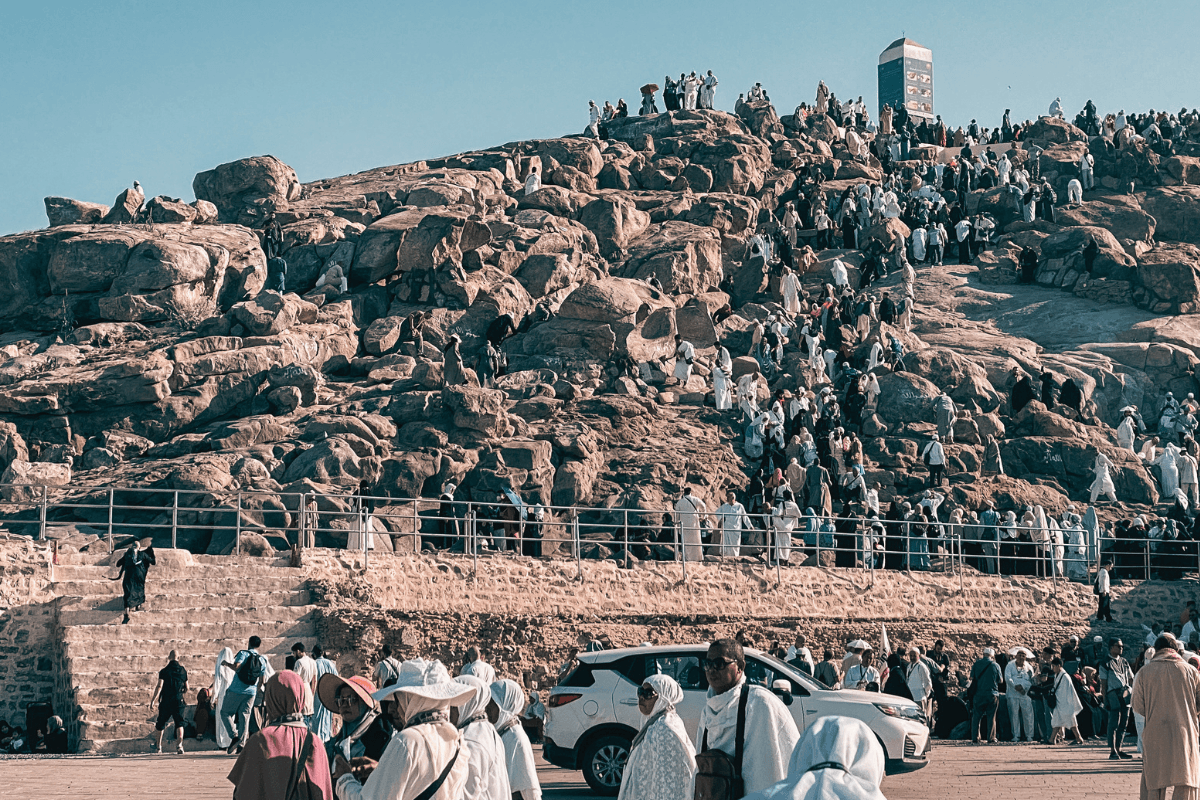
What we witness in Makkah-multitudes thronging it throughout the year, and especially during the appointed season of Hajj-is the living realization of this Qur'anic miracle. When Makkah was barren, uninhabited, and devoid of signs of life, the above promise was made-one that, to the limited measure of human standards, seemed nothing short of astonishing and impossible. However, what seemed beyond human reach was willed by Allah, and history bowed as witness.
Its fulfillment affirms that spiritual life descending from above is the most vital and most powerful force, capable of bringing forth life on earth regardless of human circumstances or ecological conditions. Beyond doubt, the duty of every vivacity and potency proceeding from on high is to awaken vivacity and potency below, to direct them, and to elevate them back towards their primordial origin. This is what may be called spiritual gravity, which is a gravity that works in the opposite direction of its earthly counterpart. Whereas material gravity pulls downward, spiritual gravity draws upward, lifting the human condition towards transcendence, truth, and divine nearness.
For that reason, when a person journeys to Makkah, he or she must recognize that their presence is itself part of that miracle. They are connected to the highest layers of history and reality. They are not mere spectators but protagonists; they are an essential ingredient in the unfolding story of life, truth, and humanity's destiny. Surrounded by millions in such a small valley, each pilgrim should cry out from the depths of the heart: Allah is the Greatest, All‑Knowing, and All‑Kind. He is the best Disposer of human affairs-the One who renders each person relevant, assigning them a place and a role within the dynamics of life. None is left without meaning; none is without purpose. Each soul is woven into the architecture of fate, dignified and uplifted by His wisdom.
A person goes to Makkah because he or she has responded to the heavenly call, once in the primordial past, and now in the present. Their presence is not accidental; it is the resonance of a covenant inscribed before time. They are there because of their relationship with the greatest who ever graced the face of the earth: Prophets Ibrahim and Muhammad (peace be upon them). To walk in Makkah is to walk in their footsteps and to be summoned into the same orbit of import and experience. No one can deny that such is the biggest privilege, issuing from the privilege of being a Muslim and a servant of the Lord of the Worlds. To belong to His covenant is to be dignified with relevance. The privilege of faith is the fountainhead whence flows every other honor, including the call to Makkah and the companionship of prophets.
Ibn Kathir said in his tafsir: "And His (Allah's) saying, 'And proclaim to the people the Hajj' (al-Hajj 27) means: call out to mankind, inviting them to perform pilgrimage to this House which We commanded you (Ibrahim) to build. It is mentioned that Ibrahim said: 'My Lord, how can I convey this to people when my voice cannot reach them?' Allah replied: 'Call, and upon Us is the conveyance.'
So he stood upon his station-some say upon the stone, others say upon (the nearby hill of) al‑Safa, or upon (the hill of) Abu Qubays-and proclaimed: 'O people, your Lord has established a House, so perform pilgrimage to it.' It is said that the mountains lowered themselves until his voice reached the ends of the earth, and was heard even by those in wombs and loins. Everything that heard him-stone, clay, and tree-responded. And whoever Allah decreed would perform Hajj until the Day of Resurrection answered: 'labbayk allahumma labbayk' (here I am, O Allah, here I am). There is not a single soul among the people of Islam who does not yearn to behold the Ka'bah and to circumambulate it. From every direction and from every land, people set out towards it."
 Towards a Better Experience of Makkah


