
IslamiCity
Listen PodCasts, Live Quran, Watch Videos @VideoHub

Following the passing of Prophet Muhammad (pbuh), Islam knew no sectarian divisions. There was neither Shi'ism nor Sunnism; such distinctions arose only in later generations.
At that time, there was only pristine Islam, embodied by the Prophet's companions (sahabah), the finest generation of believers, and the nascent Muslim society striving to overcome the challenges that followed the departure of their Messenger.
By the testimony of both the Qur'an and the Prophet's tradition, this community-despite its internal hierarchy of merit-was the best that has ever lived, and the best that ever will.
The Prophet (pbuh) spoke often of the virtues of adhering to the jama'ah (the consensus of the Ummah), to the Qur'an, and to his Sunnah. The Sunnah defined the way Islam was to be understood, practiced, and lived, as taught and exemplified by the Prophet himself-the most excellent model for the faithful.
At the same time, both the Qur'an and the Sunnah warned, in uncompromising terms, against disunity, schism, and sectarianism-against anything that might imperil the dignity and honor of the community.
However, what was most feared, and most warned against, was destined to come. Its arrival was certain, decreed by divine wisdom whose depths Almighty Allah concealed for reasons beyond human reach. That inevitability marked the most severe trial faced by the community of the final Messenger to mankind.
Islam and life are bracketed together here deliberately, for Islam is an all-encompassing code of existence, while life itself-created and sustained by its Master-is what Islam universally represents. The two are virtually synonymous.
These existential foundations include the core precepts of Islamic 'aqidah (faith), principal rites of worship, moral and ethical principles, family values, socio-economic justice, the sanctity of human life, dignity, property, and the environment. They extend to architecture, urban planning, sustainability, hygiene, and safety-everything encompassed by the maqasid al-shari'ah, the higher objectives of Islamic law: preservation of religion, life, lineage, intellect, and property.
Our routine interactions seldom rise beyond scholarly engagements. While discussions often carry a strong religious and philosophical tone, profound disagreements rarely emerge.
It is only when we touch upon sensitive, distorted, and politicized historical episodes, military confrontations, or rigid jurisprudential disputes that sectarian identities begin to surface.
This reality affirms that mainstream Sunnis and Shi'is-especially moderate branches such as the Twelvers (Imamiyyah or Ithna'ashariyyah) and the Zaydis-are all Muslims, together constituting the ummah.
They are brothers and sisters, bound by shared rights and responsibilities. They are called to be awliya'-friends, helpers, and protectors of one another-while remaining firm against enemies of Islam and compassionate among themselves.
Where they differ, however, is largely in politics and jurisprudence. Politics, defined as the struggle for power and governance, and fiqh, the science of applying divine guidance to worldly conditions, are inherently diverse.
Differences here are inevitable, even necessary, reflecting the laws of human society and existence. To expect uniformity is to deny the very nature of life.
Sectarianism was engineered by enemies of Islam, and now it is deliberately sustained by the same alliances of tyranny and deceit. It sprang from the whispers of evil, within and beyond. And today, those whispers have become globalized institutions, reviving and feeding division.
What is needed, therefore, is an ethics of disagreement, which is an Islamic framework for conflict resolution rooted in values of faith and morality. Its guiding principle must be the separation of the fallible from the infallible, the human from the divine, ensuring that the divine always governs the human.
Unfortunately, history shows that politics and fiqh were often manipulated, exaggerated, and distorted, serving vested interests rather than truth. As emotions overtook reason, mediocrity, fanaticism, and rigidity reigned, obscuring the venerable traditions of the pioneers of Islamic civilization.
As a result, mere differences were overstated and transformed into sectarian and denominational strife. With that, the doors were flung wide open for satans-simultaneously from among men and jinn-to intrude, manipulating the ways in which many thought and acted.
They disagreed in externalities, but they cherished the internal substance. Their example, nevertheless, has been muddled by the turbulence of later history.
Most of those exemplary figures were among the most prominent political, religious, and intellectual leaders of what is now labeled Sunnism and Shi'ism. However, they themselves never spoke the language of sectarianism. They did not define their mission in terms of "Sunni" or "Shi'i" identity. Their language was the language of Islam, anchored in the Qur'an, the Sunnah, and the higher objectives of faith.
The tragedy of subsequent generations lies in their inability to preserve this clarity. The luminous legacy of the first generations was neglected, leaving Muslims vulnerable to division and estrangement.
According to one view, the period of the sahabah was deliberately allowed to be fraught with unprecedented trials and tests so that they might become teachers for the generations to come. Their lives were not meant to be sheltered from turmoil, but rather immersed in the most dreadful circumstances-political upheavals, social transformations, and spiritual tests-so that they could demonstrate how a believer ought to behave when confronted with such hardships.
Their integrity was unquestioned, their credibility unparalleled. On the contrary, those who rip at the fabric of the ummah stand naked of integrity, stripped of credibility-reduced to nothing.
The lesson is clear: the path forward requires rediscovering and reviving the spirit of those early exemplars. Their refusal to reduce Islam to sectarian labels, their insistence on principle over faction, and their ability to navigate disagreement without compromising unity remain the most vital antidotes to the crises of our time.
Muslims must awaken to this painful reality. They must stand up and be counted before it is too late. On the Day of Judgment, endless hard questions will be asked. Among them: for what crime were the innocent children of Gaza slaughtered? For what crime was the ummah humiliated and divided? The answers will not be easy, and excuses will not suffice.
The time for complacency has passed. The time for unity, courage, and clarity has arrived. Sectarian distractions must be set aside, for the true adversary is not within, but without, and it is the institutionalized axis of evil led by Western imperialism and Zionism.
The sooner this process begins, the better, because the current situation of the Muslim world is such that both Sunnis and Shi'is stand to lose nothing by engaging in dialogue, yet they stand to gain almost everything.
It is striking that many Muslims proudly call for and actively participate in dialogues with Christians, Jews, Hindus, Buddhists, and others, establishing institutions and spending vast resources worldwide for this purpose-an effort that is at once appropriate and praiseworthy. Yet, paradoxically, the same enthusiasm is often withheld when it comes to dialogue with fellow Muslims.
This neglect is as ironic as it is tragic, since Sunnis and Shi'is share far more in common than what casual observers might assume. What can genuinely unite them outweighs what presently divides them, and the latter must be carefully reviewed and re-evaluated in light of the former.
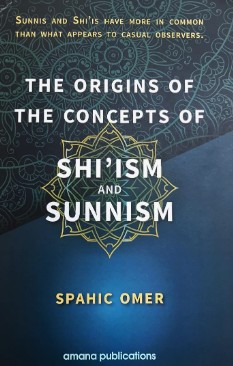
This article is based on the author's book "The Origins of the Concepts of Shi'ism and Sunnism" published by Amana Publications in the United States in 2016. Click Here to buy The Origins of the Concepts of Shi'ism and Sunnism Paperback - 1 July 2016
 History of The Persian Empire


