
IslamiCity
Listen PodCasts, Live Quran, Watch Videos @VideoHub

Wars are rarely what they claim to be. Nations speak the language of security, deterrence, and national interest, yet beneath the official vocabulary often lies a deeper struggle of identity, ideology, and belief.
The conflict between the United States, Israel, and the Islamic Republic of Iran is frequently explained through the familiar framework of geopolitics: nuclear proliferation, regional influence, oil routes, and military alliances. But when political leaders themselves invoke God, prophecy, crusades, and religious destiny, the question becomes unavoidable: Is this conflict merely strategic-or is it increasingly being framed as a civilizational and religious war?
When senior political leaders invoke divine authority in wartime, it transforms the meaning of the conflict. During a televised interview, U.S. Defense Secretary Pete Hegseth described American resolve in terms not only of military superiority but divine backing: "Our capabilities are better. Our will is better. Our troops are better. The providence of our almighty God is there protecting those troops."
Later, quoting Psalm 144-"Blessed be the Lord, my rock, who trains my hands for war"-he framed the battlefield through the language of sacred struggle. Such language is not new in wartime. Leaders have often invoked God to sustain morale.
Yet when the adversary is described as religious fanatics seeking an apocalyptic nuclear weapon, the conflict begins to sound less like a conventional geopolitical rivalry and more like a struggle between two competing visions of faith and history.
Hegseth has repeatedly argued that the United States is fundamentally a Christian nation, rooted in biblical values and destined to defend those values globally. At a National Prayer Breakfast, he declared: "America was founded as a Christian nation... It remains a Christian nation in our DNA."
This worldview aligns with a movement commonly called Christian nationalism, which holds that America has a unique divine mission and that its political institutions are inseparable from Christian identity. For adherents of this view, international conflict can easily take on moral and theological dimensions, where geopolitical adversaries are not merely rivals but represent opposing civilizations.
The symbolism surrounding Hegseth has also stirred controversy. He has spoken openly about tattoos, including the Jerusalem Cross, a medieval symbol associated with the Crusader states, and the phrase "Deus Vult" ("God wills it"), a slogan historically linked to the medieval crusades.
These symbols have deep historical resonance. The medieval Crusades-wars between European Christian kingdoms and Muslim powers over control of the Holy Land-remain a powerful memory in both Western and Middle Eastern historical consciousness.
When modern policymakers reference such imagery, critics argue that it risks reviving the perception that contemporary conflicts are continuations of ancient religious struggles.
In his book American Crusade, Hegseth described a world divided between two forces: Western civilization, rooted in Christianity, and Islamist movements seeking political dominance. He wrote that Americans and Israelis must stand together to push back against Islamist ideologies culturally, politically, and-if necessary-militarily.
This framing echoes a broader narrative sometimes called the "clash of civilizations," a concept popularized by political scientist Samuel P. Huntington, who argued that future global conflicts would be driven more by cultural and religious identities than by ideology or economics.
Whether one agrees with Huntington or not, the rhetoric increasingly used by some leaders suggests that many policymakers themselves interpret global conflicts through such lenses.
The religious framing is not limited to one side. The modern Iranian state emerged from the Iranian Revolution, which replaced the U.S.-backed monarchy of Mohammad Reza Shah Pahlavi with an Islamic republic led by clerics.
Iran's political system integrates religious authority into governance through the doctrine of Velayat-e Faqih (Guardianship of the Jurist), developed by Ruhollah Khomeini.
For Iran's leadership, resistance to Western dominance is often framed not merely as national defense but as a religious duty to resist oppression and imperial influence. Thus, both sides occasionally draw upon religious language, even while pursuing strategic objectives.
Yet beneath the religious rhetoric lie powerful geopolitical realities: Control of energy routes and oil markets, Military dominance in the Persian Gulf, the security concerns of Israel, Regional rivalry between Iran and Saudi Arabia, and the global power competition involving the United States, Russia, and China.
These interests ensure that the conflict is fundamentally strategic, even when clothed in religious symbolism.
The real danger emerges when political conflicts are framed as sacred struggles. History shows that wars fought for territory or power eventually end through negotiation or exhaustion.
But wars fought for divine destiny or civilizational supremacy can become far more difficult to resolve. When leaders speak in the language of prophecy, crusade, or holy mission, they risk transforming political disputes into existential battles where compromise becomes impossible.
In reality, the Iran conflict may not be a purely religious war. It remains deeply rooted in strategic competition. But the narratives used to justify it increasingly borrow from religion.
That narrative serves powerful purposes. It mobilizes domestic support. It demonizes adversaries, and it transforms geopolitical rivalry into a moral crusade.
And once a war becomes a battle between good and evil, rather than competing interests, the path to peace becomes far narrower.
The deeper question, therefore, may not be whether the war is religious or strategic. It may be whether the world is entering an era where political conflicts are increasingly framed as civilizational wars-between faiths, cultures, and identities.
If that transformation occurs, the consequences could be profound. Because wars for power can end. But wars for the soul of history rarely do.
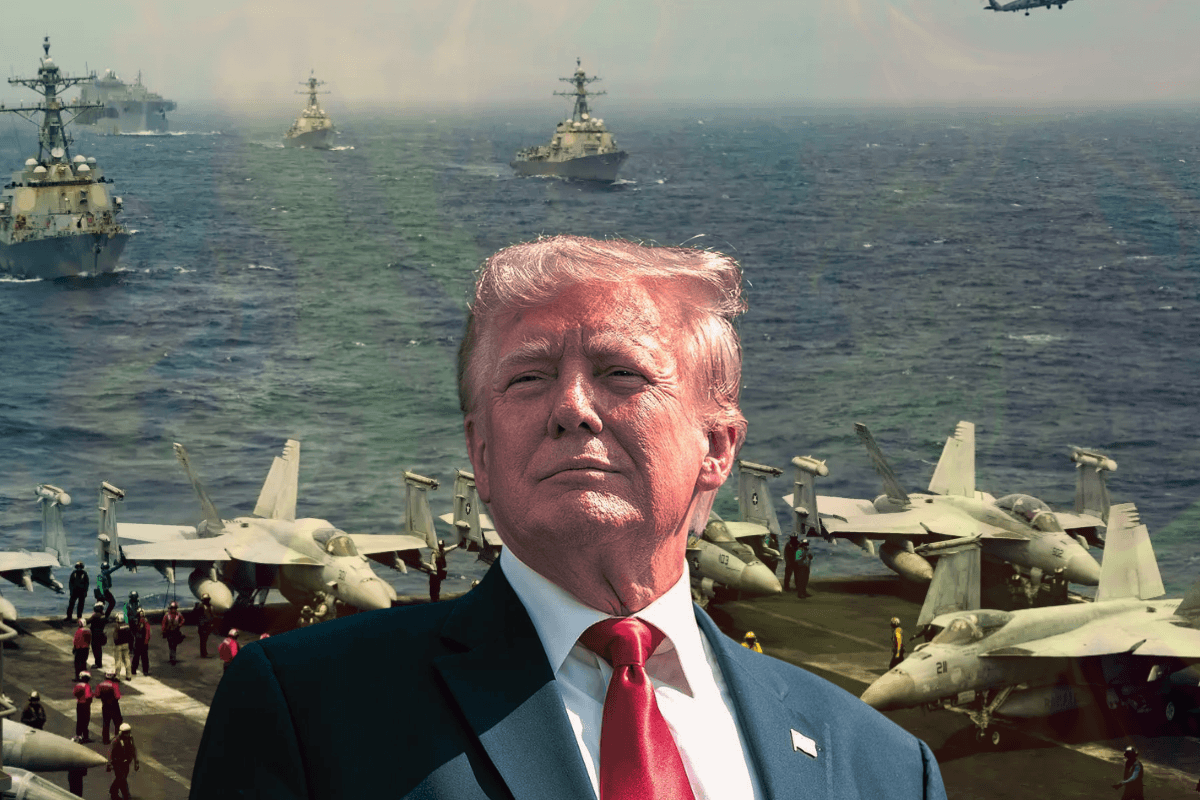 Who Gave Trump the Strait of Hormuz?


 /hqdefault.jpg&w=414&h=232&q=10&zc=1"
data-src="https://www.islamicity.org/wp-content/plugins/blueprint-timthumb/timthumb.php?src=https://img.youtube.com/vi/Es4SVCVsl5s" frameborder="0" allowfullscreen>/hqdefault.jpg&w=414&h=232&q=100&zc=1"
class="lazyload w-100 wp-post-image"
width="414"
height="232"
alt="Scott Ritter: What Ceasefire?"
loading="lazy"
decoding="async"
style="width:100% !important; height:100% !important; object-fit:cover; display:block; max-width:none !important;;border-radius:3.01px;"
/>
/hqdefault.jpg&w=414&h=232&q=10&zc=1"
data-src="https://www.islamicity.org/wp-content/plugins/blueprint-timthumb/timthumb.php?src=https://img.youtube.com/vi/Es4SVCVsl5s" frameborder="0" allowfullscreen>/hqdefault.jpg&w=414&h=232&q=100&zc=1"
class="lazyload w-100 wp-post-image"
width="414"
height="232"
alt="Scott Ritter: What Ceasefire?"
loading="lazy"
decoding="async"
style="width:100% !important; height:100% !important; object-fit:cover; display:block; max-width:none !important;;border-radius:3.01px;"
/>