
IslamiCity
Listen PodCasts, Live Quran, Watch Videos @VideoHub

Universities are fundamentally community-oriented knowledge institutions whose role is to equip individuals with the competencies required to live a good and meaningful life, befitting their roles as vicegerents (khulafa') entrusted to safeguard the way of life (ad-din) and to administer the world. These two roles are closely interrelated.
Vicegerency (stewardship) is entrusted to humankind so that they may lead and manage society through the responsible administration and cultivation of the world, in accordance with divine guidance and sound knowledge. To fulfil these tasks, duties, and responsibilities, human beings must be equipped with essential competencies, namely knowledge, skills, abilities, and other desirable personal qualities.
Developing such competencies requires the involvement of multiple stakeholders, including the university. The university community, consisting of scholars, intellectuals, and students, must be actively engaged in the generation, transmission, sharing, and application of knowledge, skills, and values. These missions are fundamentally linked to the learning process itself and are powerfully expressed in the first verse revealed to the Prophet Muhammad (peace be upon him): Iqra' ("Read"), an imperative that signifies the centrality of knowledge, learning, and intellectual cultivation in human development.
The injunction to read (Iqra') signifies more than the act of reading texts. It points to several essential intellectual tasks, including learning from the Qur'an, observing the signs in the natural world, reflecting upon created beings, and understanding human actions and social realities. This affirms that both empirical observation of the world and guidance from the Qur'an are primary sources of knowledge, and that each requires disciplined, structured processes of learning, inquiry, and development. Viewed in this light, the Qur'an underscores the need for individuals to equip themselves with appropriate knowledge, skills, and competencies in order to serve their communities effectively in specific social and historical contexts.
This educational responsibility is further grounded in the Qur'anic injunction that a group within the community should devote themselves to deep and sustained learning so that they may later return to guide and educate their people (Qur'an, al-Tawbah 9:122). This verse expresses a profound principle, in that knowledge is not sought for personal gain alone, but for the benefit of the wider community. It situates the university as a community-centered institution in which members of society invest time, energy, and resources to acquire knowledge, develop skills, cultivate abilities, and internalize values, so that they may contribute meaningfully to the communities to which they belong.
Therefore, it is imperative to establish systems and institutions of learning that enable seekers of knowledge to acquire the intellectual, professional, and moral capacities they need before returning to their communities to bring about positive change, development, and improvement, in a manner faithful to the spirit of this divine injunction.
From the perspective of education providers, the university, therefore, should be a fully functioning knowledge center, instead of only a credentialing body. It should function as a civilizational institution responsible for the cultivation, transmission, and application of knowledge for the common good. University is a place where learners interact with scholars and are exposed to a flourishing intellectual ecosystem that provides them with formative experiences, shaping them woth job-related skills as well as the essential life-enabling competencies required for responsible citizenship, ethical leadership, and meaningful participation in society. In contemporary scholarship, the university's core functions are commonly understood as intellectual, social, and educational (Clark, 1998; Barkan, 2011; UNESCO, 2015). These three functions are mutually reinforcing and define the university's role in a knowledge-based society, as discussed below.
This educational function is a core component of the university's mission, as it underpins the formation of good citizens and the nurturing of a knowledgeable and competent workforce grounded in ethical and social responsibility. Taken together, these roles affirm that universities are not merely training centres, but formative institutions that shape intellect, character, and social responsibility (Newman, 1852/1996; Barkan, 2011).
At the higher education level, the Malaysian Higher Education Plan, or Rancangan Pendidikan Tinggi Malaysia (RPTM) 2026-2035, provides strategic direction for the development of the national higher education sector over the next decade, building upon and extending the Malaysian Education Blueprint 2015-2025 (Higher Education). The overarching objective of the plan is to cultivate nation-builders who are goal-driven, resilient, and humanity-centered (GRH). This underscores a holistic approach to higher education that goes beyond academic and technical training alone. The plan aims to nurture individuals who have purpose, can face challenges, and care about others, and who use their knowledge and skills to contribute to building a better nation and society. In other words, the RPTM is not only about producing graduates with skills or qualifications, but about shaping people who can contribute meaningfully to the nation and society.
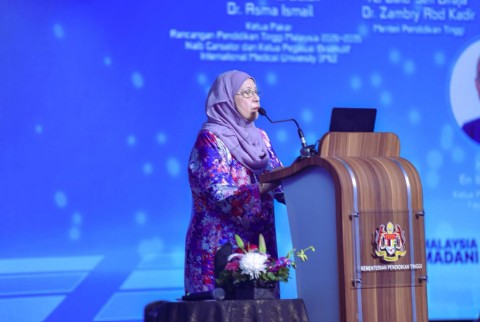
The RPTM was formulated through a comprehensive, inclusive, and evidence-based process that reflects national priorities, global trends, and stakeholder needs. Its development was guided by scoping exercises, international benchmarking, and a review of 58 previous studies and policy documents produced by the Ministry of Higher Education. Led by local expertise and informed by international best practices, this participatory approach enhanced the quality of the plan, fostered shared ownership among stakeholders, and strengthened the prospects for successful implementation.
In retrospect, the Malaysian Education Blueprint for Higher Education (PPMPT) 2015-2025 faced several disruptions and challenges arising from rapidly changing circumstances, most notably the COVID-19 pandemic. Despite these disruptions, Malaysia's higher education system demonstrated resilience and adaptability, achieving significant progress across multiple fronts. During this period, notable achievements elevated Malaysia's higher education institutions and laid strong foundations for the sector to move forward in nurturing humanity-centred nation-builders. The RPTM represents a continuation of the PPMPT, focusing on further expanding and strengthening the initiatives introduced under the earlier plan.
The higher education sector in Malaysia must continue to prepare the nation to navigate increasingly complex and challenging socio-economic conditions. The evolution of universities can be understood in generational terms. The first-generation higher education ecosystem emphasized teaching, focusing on educating students, transmitting knowledge, and awarding degrees within disciplinary and classroom-based structures. The second generation shifted its focus to research, prioritizing the creation of new knowledge through systematic inquiry, publications, and postgraduate training. The third generation expanded the university's role to include entrepreneurship and innovation, highlighting the commercialization of knowledge, industry engagement, technology transfer, patents, spin-offs, and strategic linkages with industry.
In contrast, the fourth-generation university foregrounds the idea of the university as an ecosystem embedded in society or a "societal university" whose core mission is to co-create solutions with communities and stakeholders in addressing complex, interrelated challenges. The emphasis thus shifts from outputs alone to outcomes and impact, with greater attention to sustainability, well-being, and shared prosperity.
In this context, the newly launched RPTM focuses on strengthening the higher education ecosystem, empowering it to remain relevant amid uncertainty and complexity, as well as enhancing its capacity to function as a center of knowledge that shapes the future, drives societal transformation, and nurtures balanced, future-ready graduates.
These pressures call for reform processes that are not only strategic, but also adaptive, evidence-informed, and participatory. In this context, universities are entrusted with the responsibility to shape not only a skilled workforce, but also morally grounded, socially responsible citizens who are committed to the common good and capable of contributing meaningfully to society and sustainable civilizational development.
Shukran Abd Rahman is a Professor in the Department of Psychology at the AbdulHamid AbuSulayman Kulliyyah of Islamic Revealed Knowledge and Human Sciences, International Islamic University Malaysia, and serves as Principal Director of the Office for Strategy and Institutional Change, IIUM. His research interests include career development, higher education change and development, organizational policy and strategy, academic culture, and graduate employability.
 MIT: Fiery Speech at the Gaza Encampment


