
IslamiCity
Listen PodCasts, Live Quran, Watch Videos @VideoHub

From the very beginning, when Islam and Christianity - and, to some extent, the wider world - entered into official interaction and overlap, the sentiments were far from perfect.
More often than not, despite attempts to cast the encounter in optimistic light, tensions prevailed, oscillating between apologetic defenses, polemical assaults, agitation, resistance, and outright bigotry. The principal culprit was Christianity and the broader world it represented, for they felt exposed and ideologically threatened by Islam's role: to open both the Pandora's box of accumulated distortions and the can of worms of truth long buried.
Originally, since time immemorial, there was only Islam with its ultimate veracity. Today we face tragic falsifications and painful misrepresentations, the defiant constructs of those who rejected the pristine truth and the prophets who delivered it.
Thus, Islam's task is to sort out this religious mess, occasionally naming the culprits, and paving the path towards the future. Predictably, others grew uneasy and resentful at the prospect of exposure. Islam's exclusive concern - to convey the historically blurred and buried truth - was blown out of proportion by those protagonists who sought to preserve pseudo-editions of revelation under the guise of myriad religions and philosophies. While Islam's goal was revival and restoration, the goal of others was to defend their status and position. As Islam grew and spread exponentially, so did the latter's fears and desperation.
Their most common strategy was to undermine and assail the source of the distress: Islam and the Muslims. To that end, the words of Allah remain timeless: "Never will the Jews and the Christians be satisfied with you until you follow their religion" (al-Baqarah 120). And again: "Those who disbelieve are allies of one another. If you do not also ally yourselves, there will be fitnah on earth and great corruption" (al-Anfal 73).
This establishes, positively, that Islamophobia - defined as the excessive and empirically unjustifiable fear, hatred of, or bias against Islam, Muslims, and Islamic civilization, expressed through policies, attitudes, language, literature, and condoned individual as well as collective behaviors - is as old as Islam's dealings with others. What we witness today is but another chapter in the centuries‑long evolution of this phenomenon, though it is the most systematic, the most aggressive, the most frantic, and the most pervasive.
This is to be expected, for the nature of contemporary civilization, and the way the modern world functions, affords an unprecedented degree of limelight and transparency, whether for good or for evil. Simply put, nobody and nothing can hide indefinitely, nor can anyone lie to themselves or others and manipulate public opinion forever. As the proverb goes: one may do whatever one wishes, but not for as long as one wishes.
To this reality, the recent and ongoing weaknesses of Muslims have contributed their share. Indeed, corresponding to the rapid spread of Islam and the resounding voice of its truth - echoing in every corner of the globe through globalization and the shrinking of the world into a single village - the efforts and voices of Islamophobia, and the armies of Islamophobes, have grown in equal measure. This makes clear that Islamophobia is here to stay, given that confrontations between truth and falsehood are perennial and universal. Anyone who thinks otherwise, and hopes for a different prospect, is deluded, whether within Islamdom or beyond.
And so, new crusades had to be meticulously planned and launched. The motto was clear: if you cannot defeat them, join them, but on our terms, not theirs. At long last, the Christian West turned upon Islam what it had inflicted for ages upon itself and others: campaigns of forgery, prevarication, and alteration. Western societies had to remain or become anything, so long as they were not learning the true Islam, nor - God forbid - embracing it. Even being nothing - a lost, immoral, hopeless wretch - was thought preferable.
All of a sudden, after more than a millennium of Islam, Muslims, and Islamic civilization shining with brilliance and dominating the world - excelling most prominently in the fields of both religious and worldly sciences - the confused, hypocritical, and devilish Western consciousness presumed itself qualified to study Islam from scratch. Worse still, it sought to impose its outcomes upon both Muslim and non‑Muslim minds as "authoritative" Islamic scholarship, designed to overshadow the hitherto articulated thoughts and ideas of the ummah. Consequently, a legion of pseudo‑scholars and pseudo‑institutions embarked on executing this exceptional mission, determined to make its vision a reality. To the West, such was a case of the blind leading the blind; to Muslims, it was as absurd as teaching the owl to fly.
No wonder, then, that Orientalism has been widely criticized by those able to see through it as a dishonest and biased intellectual project. It often masqueraded as objective scholarship, while in reality serving political, imperial, and ideological purposes. Far from being neutral, much of it was shaped by colonial assumptions, religious prejudice, and Eurocentric superiority. Orientalism created a distorted image of Islam as irrational, backward, violent, fatalistic, or overly sensual, set against a supposedly "rational, progressive, and moral" West. Universities across Europe competed to establish Arabic and Islamic studies departments, often without Muslim voices. Islam was treated as an exotic and outdated curiosity, interpreted through Biblical or Greek categories, while its authentic internal coherence was ignored.
The paramount goal was the cultural, religious, historical, and civilizational stripping down of Muslims, clothing them instead in the garb of the "Other." Physical colonization of Islamdom was to be accompanied - and perfected - by intellectual and spiritual colonization. The way Muslims think and behave today, the way their educational curricula are designed, the way modern Western media portray Islam and Muslims, and the aggressive labeling and treatment of Muslims in many Western societies are undeniable proofs that Orientalism, imposed and monitored by force, was unfortunately successful to a large extent.
Without Islam's spirituality and morality, there is nothing else to say or know. Without the Prophet's final prophethood and the Qur'an as revelation, there is nothing else to say about the Prophet. For that reason, each of the four times the Qur'an utters the name of Muhammad, it binds him inseparably to his station as the Messenger of Allah. Without it, all meaning fades, authenticity dissolves, consequence vanishes, and even excitement dies away.
In fact, everything such a person may say - even if his intentions appear somewhat honest - amounts to inaccuracies, distortions, misinterpretations, and outright lies. This is precisely the situation with the universe of Orientalism and its orientalists. They rejected the identities of Islam and the Prophet, yet they studied and wrote about them, posing as experts. Experts of what, one may ask? Of fabrications, of pretenses, of illusions mistaken for substance. How more paradoxical and hypocritical can the issue be? It is like researching and writing about a flower while insisting all along that it is a mysterious rock fallen from the sky. What a life: to dwell in shadow, to wear a mask as a face, and to call it a career.
In sum, this is neither surprising nor absurd for the Western man. As the master of deception and manipulation, he is accustomed to it. His history, thought, and life are all saturated with similar paradoxes. As said before, he merely seeks to export the same virus and contaminate Islam and Muslims thereby. He knows that only by extinguishing the sunlight of Islam can his faint candlelight be noticed and "appreciated" in the suffocating darkness of his hedonistic and nihilistic paradigms.
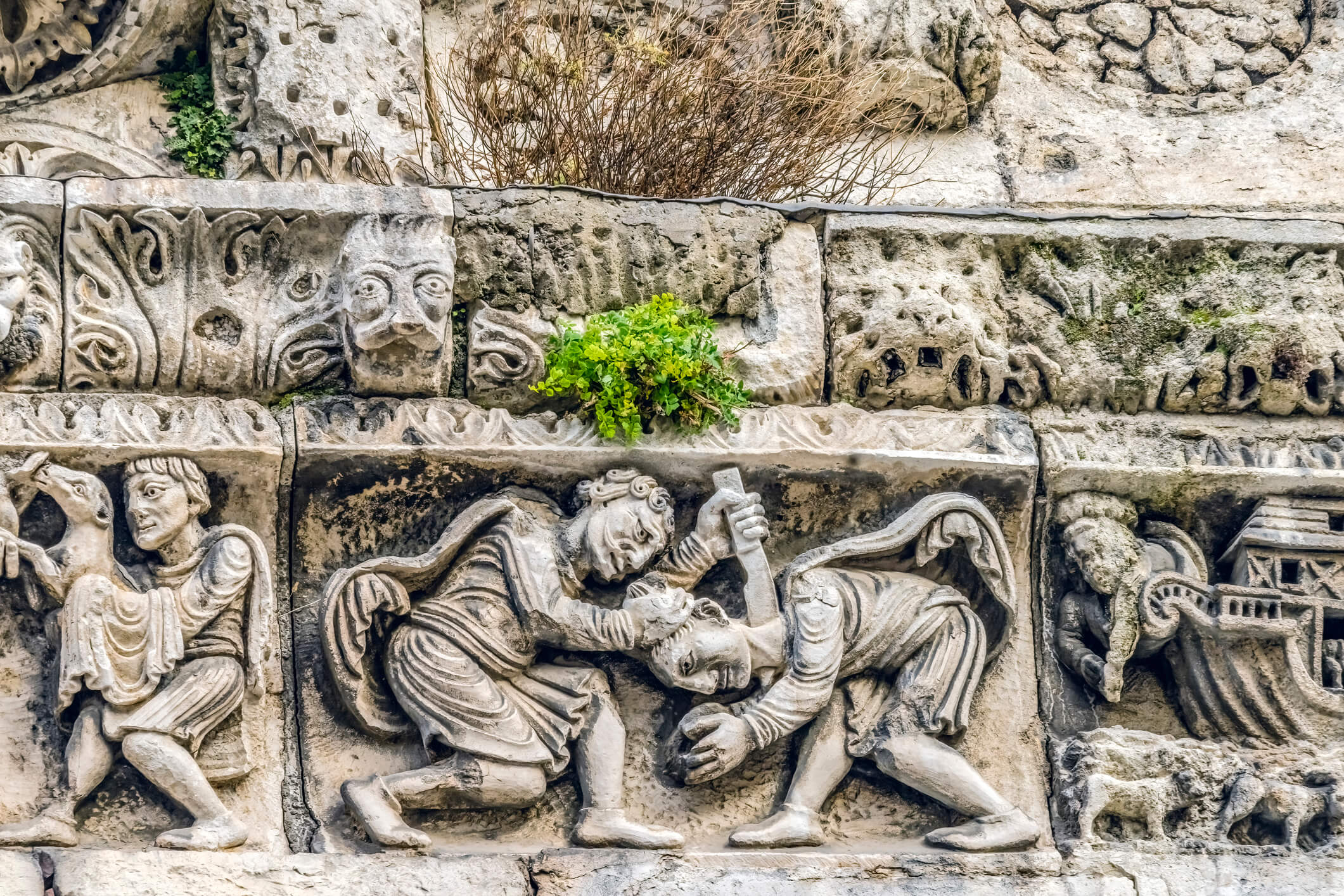 From Qabil’s Jealousy and Murder to Islamophobia


