
IslamiCity
Listen PodCasts, Live Quran, Watch Videos @VideoHub

The night of Zohran Mamdani's victory was not a partisan triumph, nor merely a political ascent-it was something more elemental.
It was the quiet turning of a wheel, the slow fulfillment of a promise carved into the conscience of America. It was not the victory of Muslims or Democrats, not the triumph of progressives over conservatives-it was a victory of the Constitution, a renewal of faith in the words first breathed by the Founders and later etched upon the tablets of human aspiration: "We, the People."
In the pulse of New York's streets that evening, liberty did not speak through slogans-it spoke through history. The same city that once received the tired and the poor now crowned a son of immigrants, a man whose name, accent, and heritage once would have drawn suspicion, not celebration. But this time, America chose hope over hesitation. The torch in the harbor was still burning.
Thomas Jefferson, author of the Declaration, wrote: "All men are created equal, endowed by their Creator with certain unalienable Rights." George Washington, in his 1790 letter to the Hebrew Congregation of Newport, promised: "The Government of the United States... gives to bigotry no sanction, to persecution no assistance."
Those words were not mere polite, they were prophecy. Two and a half centuries later, they reached across time and settled upon the shoulders of a candidate born to Ugandan Indian parents, raised among the mosaic of Queens, and determined to make democracy speak in every accent of New York.
The Constitution's first breath-the First Amendment-was written precisely for such a day. "Congress shall make no law respecting an establishment of religion, or prohibiting the free exercise thereof..." It was drafted to ensure that faith would never be a barrier to freedom, that belief would not disqualify citizenship.
Mamdani's victory was therefore a constitutional echo-a reminder that the parchment still holds. It said to every mosque, church, synagogue, gurdwara, and temple: your voice is part of this symphony.
On that November night, those words came alive again. Mamdani's win was not the story of a man, but the resurrection of a promise-that liberty still embraces the stranger, that the poem on the pedestal is not nostalgia but national scripture.
Every civilization has its sacred texts; America's scripture is the Constitution, interpreted through the Bible's mercy, the Qur'an's justice, the Gita's duty, the Guru Granth Sahib's oneness, the Dhammapada's compassion, and the Jain Agamas' nonviolence. Together, they whisper a single truth: "The Divine belongs to all."
From the Bible we hear: "Let justice roll down like waters, and righteousness like a mighty stream." From the Qur'an: "O mankind, We created you from a male and female and made you nations and tribes so that you may know one another." From the Gita: "I am the same to all beings; none is dear to Me, none is hated."
From the Guru Granth Sahib: "Recognize all of humankind as one." From the Buddha: "Hatred does not cease by hatred, but only by love." Each text, each tradition, in its own tongue, affirms the creed that America dared to write into law: freedom of conscience, equality of souls, and justice for all.
Therefore, the government must depend on civic virtue-the readiness of ordinary people to defend the rights of others as their own. In this light, Mamdani's victory was not the success of a politician, but the success of a principle: that the marginalized can still speak, that democracy, though battered, has not lost its voice.
For decades, power in many American cities was monopolized by wealth and patronage. Billionaires funded campaigns; marginalized voters were treated as props, not partners. But in 2025, the electorate of New York reminded the nation that democracy cannot be purchased-it must be lived.
In neighborhoods from Jackson Heights to Harlem, from the Bronx to Staten Island, voters crossed old lines. African American elders who had marched in the 1960s stood beside Muslim youth fasting through Ramadan. Jewish teachers, Hindu shopkeepers, Latino nurses, and white dockworkers stood in the same line, not to divide but to declare: America is still theirs. That was the spirit of the First Amendment-the right "to assemble peaceably," and in that assembly, to renew the republic.
In a time of global unrest, with polarization deepening and faith often politicized, his victory said something radical: that religious identity need not divide civic responsibility. It reminded Americans that the wall between Church and State, built by the Founders, was not meant to exclude faith but to protect freedom-to ensure that belief would be personal, never coercive. John Adams wrote, "Liberty must at all hazards be supported. We have a right to it, derived from our Maker." Mamdani's ascent affirmed that this liberty, derived from the same Maker invoked in every tradition, still belongs to each citizen.
For Muslims in America, it was particularly poignant. In an era when the word "Muslim" was too often twisted by prejudice, the sight of a Muslim elected mayor of the nation's largest city was not just symbolic-it was redemptive.
Yet Mamdani himself refused to let identity overshadow vision. Hamdani spoke of housing, wages, education, and justice-the secular sacraments of American democracy. Thus, his faith did not narrow his politics; it deepened his humanity. In that sense, he embodied what the Qur'an calls stewardship, the responsibility to care for creation through compassion and equity.
Consider the words carved above the Supreme Court: "Equal Justice Under Law." These words are not a description-they are an aspiration. They are the national prayer. When the electorate of New York elevated a man whose ancestry traces to Africa and Asia, whose faith prays toward Mecca, and whose conscience beats toward equality, they were extending the American narrative, not rewriting it. For the first time in years, the torch of the Statue of Liberty did not flicker-it blazed.
When Jesus said, "Love your neighbor as yourself," when the Qur'an said, "Stand firm for justice, even against yourselves," when the Buddha taught compassion for all beings-they were all, in essence, writing the same Constitution of the heart. Mamdani's election was the meeting of those streams: the rational Enlightenment of the 18th century and the moral enlightenment of faith traditions older than nations.
It said, "The Republic still works." For centuries, immigrants have stepped onto American soil carrying nothing but faith-faith in liberty's promise. Mamdani's parents took that same faith from Uganda to Queens. Their son brought it back to the steps of City Hall. In that circular motion lies the poetry of democracy: the journey from exclusion to inclusion, from exile to belonging.
From the harbor to the hinterland, the statue still stands-its torch lifted high, its eyes turned toward the world, its promise renewed by every generation willing to believe that freedom is not a gift of ancestry but a covenant of conscience. And on that November night in New York, amid the noise and the light, America whispered again to itself:
Give me your tired, your poor, your huddled masses yearning to breathe free...For the torch is still lit, and the dream still lives.
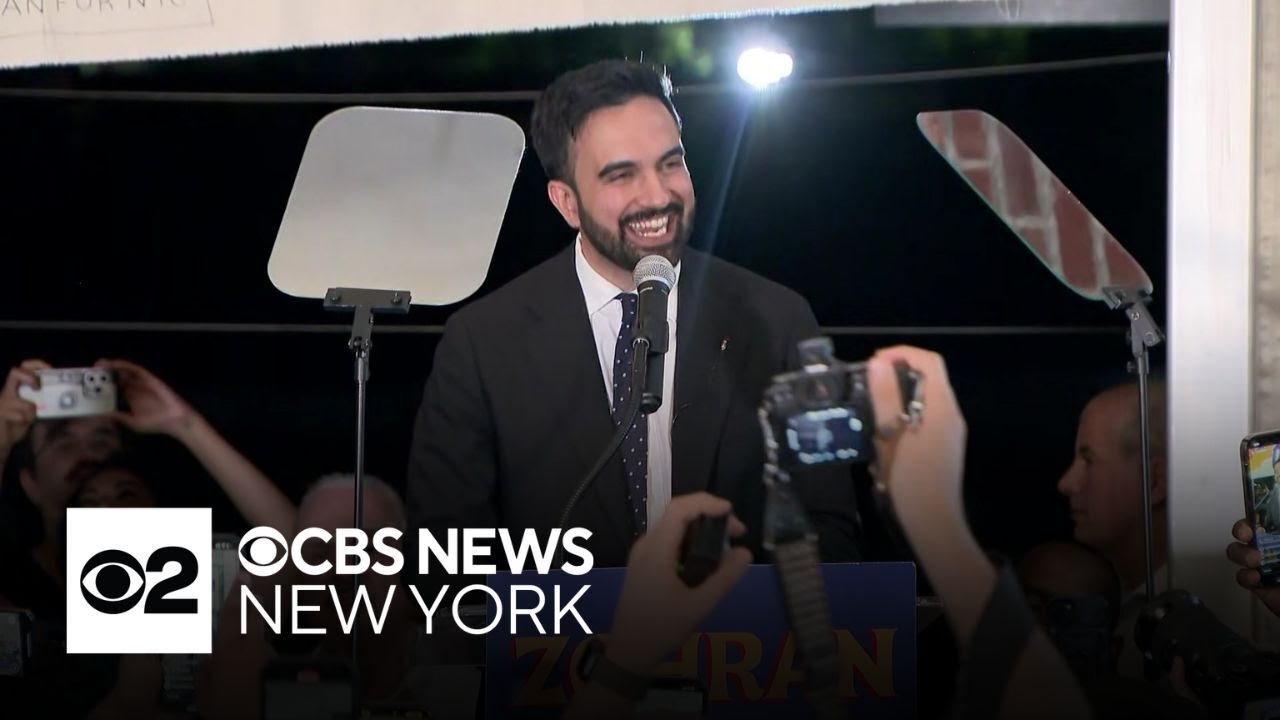 Zohran Mamdani Wins NYC Democratic Mayoral Primary

