
IslamiCity
Listen PodCasts, Live Quran, Watch Videos @VideoHub

For the first time in the history of the International Islamic University Malaysia (IIUM), both academicians and students had the privilege to witness and take part in a marathon-like intellectual discourse that spanned several days. The five-day congress, held from 8th to 12th September, was organized by AHAS KIRKHS and marked a significant milestone for the university.
The idea of bringing together all eleven departments of the Kulliyyah (Faculty) into one large congress was a major success, especially for the Dean, Prof. Dr. Hafiz Zakariya. The Chairperson, Dr. Rabiah Tul Adawiyah Mohamed Salleh, along with her dedicated team of academics, technicians, and students, did a fantastic job in ensuring the smooth running of the entire event.
The congress was officially opened by Prof. Emeritus Datuk Dr. Osman Bakar, the Rector of IIUM, who was given the honour to grace the inaugural session and deliver a keynote address titled "Tawhidic Epistemology as the Catalyst for the Integration of Knowledge in the 21st Century."
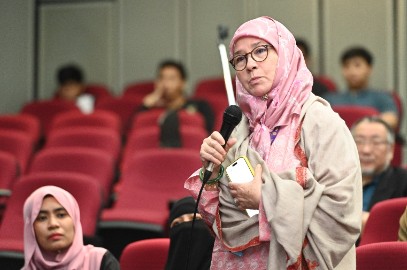
To everyone's surprise, the current Constitutional Head of IIUM, Her Royal Highness the Tengku Ampuan of Pahang, Tunku Azizah Aminah Maimunah Iskandariah binti Almarhum Sultan Iskandar Al-Haj, joined the afternoon session of the congress. Masha Allah, sitting among the audience, she actively took part in the discussion on two topics close to her heart: the issues of the Orang Asli/Orang Asal (Native People) of Malaysia and the importance of learning history. As a participant in that session, she requested to be treated just like everyone else. What touched everyone's heart was her friendliness, simplicity, and down-to-earth attitude.
The presentations, delivered by the chapter authors themselves, gave a chance to receive comments and feedback from fellow researchers. The Q'A sessions also allowed the audience to ask thoughtful and intellectual questions.
In addition, this part of all eight sessions of the congress included constructive criticism from the audience. In a way, the Q'A sessions became the highlight that kept both presenters and the audience engaged, lively, and in good spirits.
In the West, education was seen as a path to instill religious values based on the teachings of the Bible. The same was true in the Muslim world. Knowledge was never viewed in a dichotomous way-separating worldly life from the hereafter. Instead, Muslims approached knowledge from an integrated perspective, recognizing that both revealed and worldly knowledge offer benefits for the betterment of the Ummah. This holistic view of knowledge was the driving force that propelled Islamic civilization to its peak during the Golden Era (750-1258).
During this period, the world witnessed the rise of great polymath scholars in the Muslim world-individuals who excelled in both religious and worldly sciences. Among them were Al-Kindi (c. 801-873), Al-Farabi (c. 872-950), Ibn Sina, also known as Avicenna (980-1037), Al-Ghazali (1058-1111), Ibn Rushd, also known as Averroes (1126-1198), Al-Khwarizmi (c. 780-850), and Ibn al-Haytham, also known as Alhazen (c. 965-1040). These brilliant minds made pioneering contributions in various fields such as philosophy, medicine, mathematics, astronomy, and theology, and they were deeply rooted in both the revealed knowledge of Islam and the human sciences.
The shift in the ideals and objectives of seeking knowledge in the West began with the European Renaissance and the rise of secularism, modernism, and other modern ideologies. This marked a turning point, where knowledge gradually became separated from religion, reflecting the West's growing rejection of God and scripture. Since then, the main purpose of seeking knowledge in the West has often been centered around worldly pursuits such as self-glorification, fame, power, and dominance-rather than the moral and spiritual development that once guided educational efforts.
In Muslim lands, colonial occupation and control damaged the Islamic goal of seeking knowledge and education. The colonizers brought in two types of schools-religious and secular-which caused confusion and a crisis in the Muslim mind. Simply put, colonialism gave people a slave mentality and a sense of inferiority. They began to see themselves as less advanced in terms of civilization and progress. This mindset led many to copy European culture and lifestyle, thinking it was better than their own.
In the later development of the Muslim world, we witnessed the rise of great intellectual figures such as Syed Muhammad Naquib al-Attas (b. 1931), Ismail Raji al-Faruqi (1921-1986), Taha Jabir Al-Alwani (1935-2016), Fazlur Rahman (1919-1988), AbdulHamid AbuSulayman (1936-2021), and Mohd Kamal Hassan (1942-2023). These scholars made a strong impact in academic circles around the world by promoting the Islamization and integration of knowledge.
As a continuation of the legacy left by earlier scholars, philosophers, and thinkers, Prof. Osman Bakar (born 1946) has made great contributions in the fields of Islamic philosophy, science, and education. He has written around forty books.
Through his writings, he calls on the Muslim Ummah to integrate modern sciences with Islamic heritage and spirituality. In his academic work, he supports the idea of Tawhidic Epistemology and stresses the importance of combining human reason with divine revelation.
Through the lens of Tawhidic epistemology, reality is interpreted as something created, sustained, and willed by God Almighty. In this framework, man is seen as the best of God's creation, entrusted with the Amanah (trust) to administer the earth with justice, avoiding all forms of wrongdoing and injustice. Man is obligated to maintain a good relationship with himself, with God, with nature-including flora and fauna-and with the whole of humanity.
Unlike Western secular views, Tawhidic epistemology rejects the dichotomous way of viewing human life, such as the separation between religious and secular knowledge, religion and state, faith and reason, science and religion, mind and body, individual and society, knowledge and values, and material and spiritual life, as well as the divide between man and nature.
Tawhidic epistemology calls for all disciplines of knowledge-spiritual, natural, and social-to be linked to the concept of the Oneness of Allah. That said, it acknowledges that the sources of knowledge include al-waḥy (Revelation), ʿaql (human intellect), al-ḥawās al-khams (the five senses), aṭ-ṭabīʿah (nature), and scientific investigation, which is a valid human endeavor. In Islam, knowledge acquired by man is not value-free but value-laden.
To recap, Tawhidic epistemology believes that knowledge should lead to truth, justice, mercy, moral integrity, respect for the sanctity of life, and spiritual awakening.
The views expressed are those of Dr. Mohd Abbas Abdul Razak, Department of Fundamental and Interdisciplinary Studies, AHAS KIRKHS, IIUM, and do not necessarily reflect the views of IslamiCity.
 Hajj: The Battle Front at Mina


