
IslamiCity
Listen PodCasts, Live Quran, Watch Videos @VideoHub

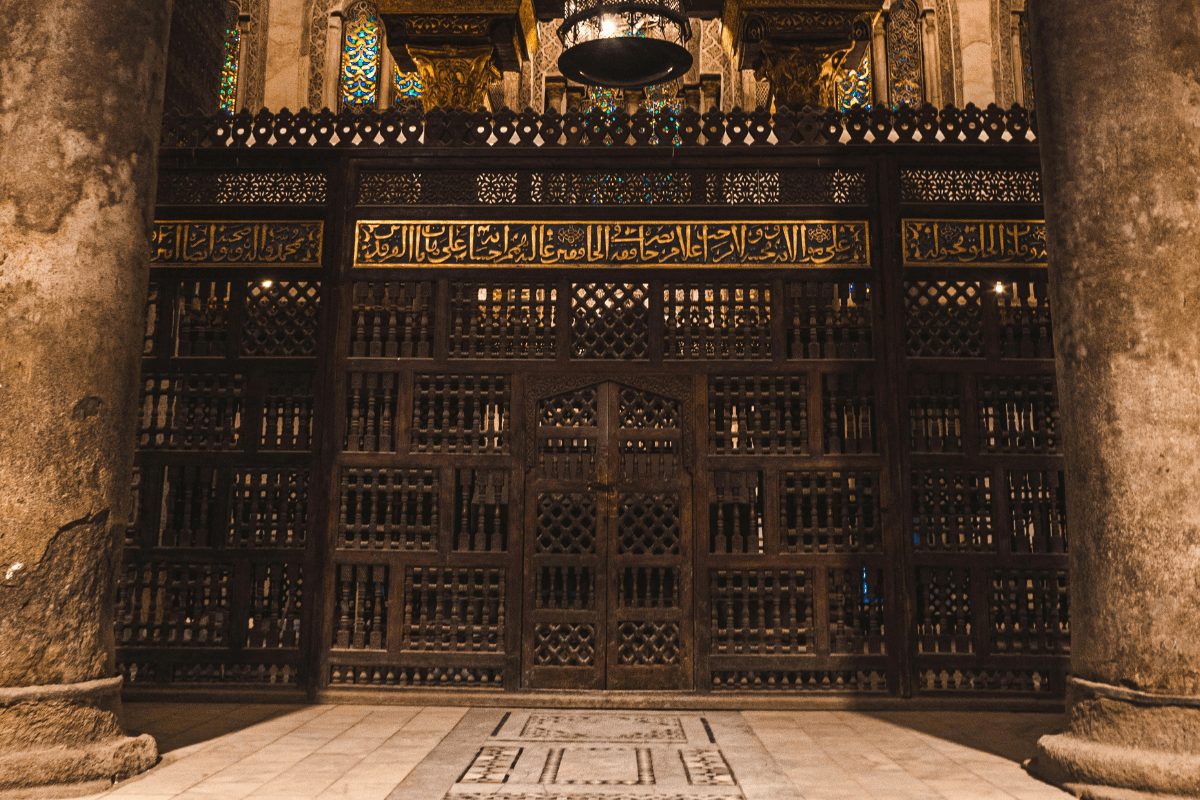
Today the parameters of the fence of the Prophet's burial chamber and its surrounding space encompass not only the house of A'ishah in which the Prophet was buried, but also the locations of some other houses that were located nearby. Of those houses was the house of the Prophet's wife Sawdah, which abutted the house of A'ishah on the latter's east side. A'ishah's house stood between the Prophet's mosque and Sawdah's house.
To the north of the houses of A'ishah and Sawdah there were two more houses: the house of Fatimah, the Prophet's daughter, and Ali bin Abi Talib her husband, which lay parallel to the house of A'ishah, and the house of the Prophet's wife Zaynab bint Khuzaymah, which was positioned parallel to the house of Sawdah. However, Zaynab bint Khuzaymah passed away shortly after her marriage to the Prophet. The Prophet then married Ummu Salamah, with whom he lived in the house where Zaynab bint Khuzaymah had previously lived. The locations of these two houses constitute the north section of the enclosed space associated with the Prophet's burial chamber.
Finally, to the south of A'ishah's and Sawdah's houses there was the house of the Prophet's wife Hafsah. A narrow pathway ran between the house of Hafsah on its south side and the houses of A'ishah and Sawdah on their north sides. The pathway is said to have been so narrow that even one person would struggle to traverse it with ease. A'ishah and Hafsah used to talk to each other while sitting in their respective houses. At present, a part of the location of Hafsah's house has been integrated into the south section of the enclosed space affiliated with the Prophet's burial chamber, and a part of it remained outside. Through the latter, visitors pass today in order to greet the Prophet, Abu Bakr and 'Umar bin al-Khattab.
The Prophet's houses were an example of simplicity. A partial description of their form is given by Ibn Sa'd in his "al-Tabaqat al-Kubra", due to a narrator named 'Abdullah b. Yazid, who saw them just before they were knocked down by the order of Caliph al-Walid bin Abd al-Malik to make way for the expansion of the Prophet's mosque: "There were four houses of mud brick, with apartments partitioned off by palm branches plastered with mud, and five houses made of palm branches plastered with mud and not divided into rooms. Over the doors were curtains of black hair-cloth. Each curtain measured 3 by 3 cubits (1.5 m). One could touch the roof with the hand." Several other eyewitnesses gave similar accounts on the matter, which are recorded elsewhere.
In other words, a visitor is in the area where the interactions between the physical and metaphysical worlds were not just most abundant, but also most dramatic. There are numerous verses of the Qur'an and as numerous, if not even more, traditions of the Prophet that were imparted within the sanctums of the Prophet's houses. Some verses and traditions yet targeted the houses with their inhabitants and the lives lived inside them.
It is normally said that everything about the Prophet is extraordinary and miraculous. However, while most of his "everything" is often dispersed throughout the changing landscape and unpredictable parameters of space and time, it is the realm of his houses and his family life inside them that the Prophet's "everything" congregated and generated a comprehensive individual and familial depiction. For that reason are the houses of the Prophet regarded as the vaults of religious knowledge and the sanctuaries of wisdom, and his wives as the conduits for preserving and transmitting those invaluable treasures.
The houses were institutions and family development centres on a par with the Prophet's mosque as a foremost institution and a community development centre. They were meant to complement each other in transforming the nascent Muslim community into a formidable civilizational force. To be sure, the successful cultivation of individuals and families is essential for the advancement of societies, in that a society is nothing more than a collective of individuals and family units.
Hence, the Qur'an informs the wives of the Prophet that they were special, enjoyed special privileges but with which came special responsibilities, and were entrusted with a special mission of guiding and educating the ummah (entire Muslim community). Concerning the propagation of the effects of the activities performed by the mosque institution, the Prophet had many aides, yet in relation to the propagation of the activities performed by the house institution, his only associates were his wives. Indeed, their load was colossal, rightfully granting them the designation of "mothers of believers" (ummahat al-mu'minin).
The Qur'an says about this: "O Prophet, say to your wives: 'If you should desire the worldly life and its adornment, then come, I will provide for you and give you a gracious release. But if you should desire Allah and His Messenger and the home of the Hereafter - then indeed, Allah has prepared for the doers of good among you a great reward.' O wives of the Prophet, whoever of you should commit a clear immorality - for her the punishment would be doubled two fold, and ever is that, for Allah , easy. And whoever of you devoutly obeys Allah and His Messenger and does righteousness - We will give her her reward twice; and We have prepared for her a noble provision. O wives of the Prophet, you are not like anyone among women. If you fear Allah , then do not be soft in speech (to men), lest he in whose heart is disease should covet, but speak with appropriate speech. And abide in your houses and do not display yourselves as (was) the display of the former times of ignorance. And establish prayer and give zakah and obey Allah and His Messenger. Allah intends only to remove from you the impurity (of sin), O people of the (Prophet's) household, and to purify you with (extensive) purification. And remember what is recited in your houses of the verses of Allah and wisdom. Indeed, Allah is ever Subtle and Acquainted (with all things)" (al-Ahzab, 28-34).
The Prophet's houses teach us what life truly is and how it is to be lived. To begin with, they teach us that life is to be lived not in order to die, but in order to live more and better. The perishable matter cannot make a person great or immortal; rather, it can only expedite his demise and extinction. If worshipped, matter can only destroy its devotees. Matter was never meant to be the end of one's cravings, the end of all ends. It does not have what it takes to satisfy the total yearnings of a person, hence, matter quickly morphs into a destructive force.
Matter is relative. As such, it is beneficial only when it is subjected to the benefits of the higher spiritual and moral spheres. It is useful as a means, not an objective. As a second choice, matter can be pacified and of service; conversely, if privileged, it turns out to be uncontrollably dangerous. Matter is either controlled, or it controls.
As the everlasting role model, the Prophet's way of life, which cantered on the energizing spirituality and morality, rather than the debilitating materialism and extravagance, is the only solution. The Prophet was guided by the heavenly light, whereas those who tend to offer substitutes to his example, do so misguided by their own worldly wants and by the burdens of the cluttering matter.
One of the criteria for determining the quality of each of the potential scenarios is to compare the enduring legacies of spiritual lives with the fleeting counterparts of those lives that are merely physical needs-oriented. The former endures because of the endurance of the spirit, whereas the latter dissolves because of the dissolution of the vicissitudes of matter and its needs.
Accordingly, a visitor to the Prophet's grave should try his best to visualise the minimalism of the Prophet's and his household's material lifestyle, and maximalism of their lives' substance, extracting thus some existential principles which would thereafter guide him throughout the vagaries of life. Against that background, a visitor should embark on assessing how deep, or otherwise, the substance of his own life and his household is.
The spot a visitor stands at while visiting the Prophet is the best opportunity to do so, for the spot always functioned as the antithesis of all sorts of inappropriateness. Right there, a person should declare a war against the impediments of matter and the venom of hedonistic lifestyles, and should vow that nothing will be placed between him and his rising towards the unbounded hights offered by the equally unbounded potentials of the spirit.
A person should become definitely clear with his self as to what exactly he wants to do in his life and how, plus whom exactly he wants to follow: the Prophet and the community of his followers as the best community ever evolved for mankind - based on the Qur'anic terminology (Alu 'Imran, 110) - or his personal whims, or the whims of some other deluded individuals.
If a person is yet to make his most consequential life decisions, he should not wait any longer; the clock is ticking. Visiting the Prophet's grave whose life legacy is the Criterion, is the most opportune time to do it. The setting is conducive to crushing egos and removing confusions. No normal person leaves the place unmoved and without a degree of introspection. Indeed, for each Muslim, visiting the Prophet is an occasion to draw a line in the sand.
There was no evil thenceforth, associated either with Satan or his cohorts from among the jinn and mankind, that was not correlated with this materialistic predisposition of Satan. They all exuded its spirit. Hence, when the Qur'an charged Satan with disobedience and haughtiness, the charges were replete with materialistic undertones. They governed the former's inception, expansion and continual existence.
Taking into consideration all this, the first thing that may assail a person's worldview is a form or a dimension of materialism, which then shapes a person's relationships with the Creator, people and the rest of creation. This is understandable on account of the power the way we perceive the nature of existence wields over human thoughts and actions. If a person gets trapped inside the fetters of matter, he becomes blind, deaf and dumb. He neither sees, nor hears, nor comprehends beyond the exigencies of the lowest plane of life and its simplest manifestations.
No wonder that people, submerged in the sea of matter-worship, easily become of those who place nothing but the prospects of pandering to their ego and fulfilling their carnal desires on the pedestal. Soon, those preferences turn into a person's deity - or deities - which he serves till the end. About this the Qur'an proclaims: "Have you seen he who has taken as his god his (own) desire, and Allah has sent him astray due to knowledge and has set a seal upon his hearing and his heart and put over his vision a veil? So who will guide him after Allah? Then will you not be reminded?" (al-Jathiyah, 23).
However, there is no escape. A person is trapped forever in the jaws of matter and a feeling of spiritual claustrophobia quickly starts haunting him. The more he tries to extricate himself from it, the deeper he sinks into it. The condition is akin to a vicious circle which does nothing but exacerbates the situation.
In the end, a person "assassinates" or stifles the potential spiritual aspect of his being, becoming nothing more than a piece of matter (body). He becomes as dead and non-functional as matter itself. As a materialist, such a person restricts his life to the domain of his physical body, existing purely as a piece of hardened and perhaps nicely shaped clay. This could be a reason why the Qur'an states that the fuel of the Hellfire "prepared for disbelievers" will be "people and stones" as two outwardly different but inwardly identical types of matter (al-Baqarah, 24). "(Hell-bound) people and stones" should be understood as "clay and stones."
Most of the above messages have been subtly captured in the following report narrated by 'Umar bin al-Khattab who, while once visiting the Prophet in one of his houses, gave the following account of the simplicity of the house and the Prophet's lifestyle, as well as of what the Prophet's attitude towards the subject was. 'Umar bin al-Khattab said: "I visited Allah's Messenger and he was lying on a mat. I sat down and he drew up his lower garment over him and he had nothing (else) over him, and that the mat had left its marks on his sides. I looked with my eyes in the store room of Allah's Messenger. I found only a handful of barley equal to one sa' and an equal quantity of the leaves of Mimosa Flava placed in the nook of the cell, and a semi-tanned leather bag hanging (in one side), and I was moved to tears (on seeing this extremely austere living of the Holy Prophet), and he said: 'Ibn al-Khattab, what makes you weep?' I said: 'Apostle of Allah, why should I not shed tears? This mat has left its marks on your sides and I do not see in your store room (except these few things) that I have seen. Persian and Byzantine sovereigns are leading their lives in plenty, whereas you are Allah's Messenger, His chosen one, and that is your store!' He said: 'Ibn al-Khattab, aren't you satisfied that for us (there should be the prosperity) of the Hereafter, and for them (there should be the prosperity of) this world?' I said: 'Yes'" (Sahih Muslim).
 The Rise, Fall, and Future of Muslim Political Power


