
IslamiCity
Listen PodCasts, Live Quran, Watch Videos @VideoHub

If one studies the geopolitics of the Arab Middle East from the dawn of the 20th century onwards, one can easily see that little positive or encouraging has emerged. This applies to the fate of the people in the region, as well as the Muslim Ummah in general.
Meanwhile, almost everything has been and continues to be positive and according to plan for the enemies who created and sustained the dynamics of the region.
This is despite the fact that most of the Arab Middle Eastern countries are among the richest in the world. However, due to ongoing geopolitical upheavals, a significant portion of this wealth goes to waste. It is spent on sponsoring or conducting proxy wars for Western powers, who are the architects and patrons of the region's troubles.
This wealth is also used to mislead the public and distract them from the true state of affairs both at home and abroad, as well as to support the crumbling corrupt pop culture of the tyrannical West to show unwavering loyalty.
In short, the apparent prosperity of the Arab countries in question is nothing but a mirage. They all ultimately suffer from what could be called a "resource bane" or a "paradox of plenty." Indeed, they have everything but own very little, and possess all the material prerequisites to rise to unprecedented heights but struggle with basic essentials such as genuine liberty, autonomy, self-esteem, and a sense of purpose.
There are several reasons that explain the sorry geopolitical situation in the Arab Middle East, including the issue of Palestine. They pertain to socio-politics, international relations, and the ever-changing global order. However, there is a factor that is often overlooked, which has a mix of spiritual and ethical elements and can be quite devastating.
This reason-known completely to Almighty Allah only-is a potential heavenly curse that manifests as a lack of divine providence and blessings (barakah). We all know that, from an Islamic perspective, if something, someone, or an event lacks Allah's barakah, nothing can ultimately go right. As a result, happy endings become difficult to achieve.
To begin with, it is a historical fact that the concept of the Middle East is a colonial-cum- Orientalist construct that serves Eurocentric imperialist interests. Such is part of a Western colonial narrative in which the geopolitical importance of the region has been acknowledged and contested.
Without a doubt - in passing - as a sign of their cultural, historical, and civilizational freedom, Arabs and Muslims should stop using the demeaning language of their colonial masters, who have Muslim blood on their hands, and instead work on creating their own terms that are more enlightening and dignified.
As the expansionist appetite of the West, led by Britain and France, grew uncontrollably, the main obstacle to penetrating and dominating the Arab Middle East was the Ottoman State (Devlet), which assumed and performed the role of Muslim leadership (khilafah islamiyyah) to the best of its ability.
Despite its increasing weaknesses on all fronts, it remained a force to be reckoned with until the end. Bringing it down, despite all its failings, was like "turning around an ocean liner." It takes a long time to change direction-or collapse.
Preceded by the incessant Western campaigns questioning the suitability and legitimacy of the Ottoman case and its significance for the future shaped by the emerging new world order, and fueled by the rapidly spreading nationalist movements worldwide, the West managed to convince the Arabs to engage in a revolt against the Ottomans.
The aim was for the Arabs, aided by the West, to defeat and expel the Ottomans from the Arab countries. The West promised military aid and recognition of Arab independence in exchange for Arab assistance against the Ottoman peril.
The created vacuum was to be filled with the establishment of a Unified Arab State. The vision was for a single Arab nation that would stretch from Syria to Yemen, integrating much of the Middle East.
The idea of Arab self-determination, driven by rising Arab nationalism, was also part of the agenda. The revolt aimed to assert Arab nationalist identity and autonomy, which had been perceived as suppressed first by Ottoman centralization policies and later by its persistent pan-Islamism programs.
This exaggerated outlook was encapsulated in the words of Abu Khaldun Sati'al-Husri (d. 1968), a Syrian intellectual, who said that "we are Arabs before everything else. The Turks tried to impose their language and erase our identity. That is why the Arab revolt was a national necessity."
The results were scandalous for Arabs and Muslims, and both the Ottomans and the Arabs bear an equal share of responsibility. The Ottomans were defeated and expelled from Arab lands; the dream of Arab independence in a Unified Arab State never materialized.
Britain and France, supported by other major Western powers like Russia and Italy, broke their promises and ignored all agreements, secretly dividing the Middle East and defining their spheres of influence. The idea of Islamic caliphate (khilafah islamiyyah), which could have served as a foundation for Muslim resistance, unity, and future revival, was likewise abandoned. And finally, Palestine was colonized and later handed over on the platter to the Zionists and their illegitimate state, Israel, thus creating the most malign tumor in the heart of Islamdom.
Moreover, the Arab Middle Eastern countries, with their complex demographics, were organized in a way that set their mutual interests against each other, leading them towards inevitable conflicts. To put it differently, the entire region was designed to never achieve genuine peace, to avoid lasting progressive governance, and to prevent authentic democracy.
It was targeted to remain perpetually unstable, constantly requiring intervention from external masters to manage its challenges, often exploiting the region under the guise of providing "services".
Perhaps the first to pave the way for the Arab revolt, acting as a standard-setter, was Ali Bey el Abbasi (d. 1818), a disguised Spanish explorer and Napoleon's spy in the Muslim world. He eloquently theorized that the Ottomans were barbarians whose actions were anti-civilizational, while the Wahhabis of Arabia showed better signs of eventually aligning with the principles of civilization.
Towards the same end were the views of Eldon Ruther (d. after 1956), a British explorer and writer, and John Philby (d. 1960), a British explorer and colonial intelligence officer. They both agreed that the founder and first king of Saudi Arabia, Abdulaziz b. Al Saud (d. 1953), was likely the best ruler that Arabia has known since the days of the first four rightly-guided caliphs. That was quite a commendation.
However, their words were misleading, acting as a decoy that obscured the truth for both historians and ordinary people, attempting to justify one of the most unambiguous outcomes of the Arab revolt.
Lastly, the words of Lawrence of Arabia (d. 1935), a British army officer, diplomat, and writer, say it all: "The Arab revolt had a limited aim - freedom from the Turks - and not from foreign control generally. We knew that freedom would be a façade." The man was clear about how he misled the Arabs to rebel against the Turks and side with the West (Britain), fully aware of Britain's position and that of the rest of the Western world. The dagger for stabbing the Arabs in the back was ready, which apparently caused some psychological discomfort for Lawrence, leading to an internal conflict of sorts.
He admitted: "I risked the fraud on my conviction that Arab help was necessary to our success in the East, and that better we win and break our word than lose. I had to decide, and I decided."
It goes without saying that the concept of the Middle East, along with its non-natural states and borders, is artificial. The situation denotes a perfect storm for all sorts of misperceptions,
regional uncertainties, and conflicts on which the historiography of the 20th and the beginning of the 21st centuries feeds. One gets the impression that the Middle East is always full of surprises and scandals, whether it's a conflict, an unconventional leader, unusual politics, the FIFA World Cup, mega concerts, or extravagant spending on celebrity performances and appearances. Without the Middle East, it can be further argued, the world would lack much excitement, astonishment, and hilarity; without it, the world would be "boring."
Of the things that have persisted and refuse to fade even in modern times is the anti-Ottoman sentiment. The modern Middle East is much the same as it was a century ago in terms of its socio-political raison d'etre. A clear example is the systematic destruction of centuries-old Ottoman heritage, particularly in the Kingdom of Saudi Arabia, in its two holy cities: Makkah and Madinah (excluding what is Islamically unacceptable, like tombs and other funerary memorials). One of the latest acts was the demolition of an Ottoman-era portico inside the Masjid al-Haram in Makkah, due to the mosque's ongoing grand expansions, an act that generated angry responses from Istanbul.
Moreover, most Arab Middle Eastern countries celebrate their national and independence days to commemorate their freedom from either Britain or France. But we must remember that the two became the colonizers of the Middle East only after betraying the Arabs, having previously deceived them into rebelling against and liberating themselves from the Ottoman yoke.
If nonetheless the Arab revolt had succeeded, as the gullible Arabs had been tricked into believing it would, their national and independence days would be remembered and celebrated for the expulsion of the "despotic" Ottomans, who were viewed as the conquerors and colonizers of the Arabs.
Since the Kingdom of Saudi Arabia was not colonized by either Britain or France, its national day is on 23 September, commemorating the unification of the country under Abdulaziz b. Al Saud, which was officially completed on 23 September 1932. During the unification process, the last Ottomans were expelled from Najd, Hijaz, and other Arabian territories. Thus, the Saudi national day indirectly celebrates independence from and the expulsion of the Ottomans.
In the same vein, the Arab revolt against the Ottomans adopted a flag that was infused with dishonorable symbolism. It was first introduced in 1916, serving as a powerful emblem of Arab nationalism during the uprising. It was designed by Sir Mark Sykes, a British diplomat, to unify Arab forces under a shared identity.
What is paradoxical, though, is that the flag designer was the same person who, as a British representative, was behind the secret Sykes-Picot agreement aimed at betraying the Arabs, undermining their revolutionary efforts, and dividing the Middle East according to the preconceived wishes of Britain's and France's sinister plans.
One can imagine what was racing through this man's mind when he, on one hand, was urging and facilitating the Arab uprising and, on the other, was finalizing a pact to seize Arab lands.
The flag features three horizontal stripes: black on top, representing the (Arab) Abbasid Caliphate and the Caliphate of the rightly-guided caliphs (al-Rashidun); green in the middle, representing the (Arab) Fatimid Caliphate or pure Islam in general; and white at the bottom, recalling the (Arab) Umayyad Caliphate. There is also a red triangle at the hoist, representing the Hashemite dynasty, which led the anti-Ottoman revolt.
These colors became known as the Pan-Arab colors. They were intended to completely exclude the Ottomans from the socio-political landscape of the region and from both the historical and civilizational leadership of Islam. The colors signified an effort to foster a sense of Arab identity.
Additionally, it is astonishing that these colors, with slightly varying designs, still appear in many modern Arab flags, including those of Jordan, Palestine, Syria, Kuwait, Iraq, Egypt, Yemen, Sudan, and the United Arab Emirates.
Today in Aqaba, a coastal city in Jordan, there is a plaza called the Great Arab Revolt Plaza. It is the city's most prominent area and its biggest tourist attraction. Among its highlights is a giant Arab revolt flag. Standing at 130 meters, the Aqaba flagpole proudly displays the flag to commemorate the Arab uprising against the Ottoman menace.
The flagpole is the sixth tallest unsupported flagpole in the world and can be seen from far and wide. The plaza, with its giant and soaring flag, radiates the message to the Arab consciousness: "Lest we forget." The contemporary interpretation of the flag's colors mirrors the meaning and motivation behind the anti-Ottoman revolution, with red symbolizing the blood of the martyrs, green representing peace and sustainability, black signifying oppression, and white representing a bright future.
The presence of what could be categorized as the Arab Middle East curse is due to the following. First, the geopolitical denominators of the region are not desired by its people but are instead planned and enforced by the enemies of the region, along with everything associated with it, including the religion of Islam and its history, identity, culture, and civilization.
Needless to say, once a desirable level of freedom, intellectual renewal, and religious awareness has been restored, the paralyzing geopolitical structure and (mal)functioning of the Middle East should be revisited and recalibrated. Continuing it only means continuing the predicaments and, with them, the curse.
Second, the geopolitics of the Middle East has emerged amid severe violations of key Islamic principles and values: brotherhood, unity, and cooperation. In this process, the most sacred aspects of Islam have been compromised, involving the dignity, honor, property, blood, and life of a Muslim believer. Regardless of social differences, ideological disagreements, or political disputes, Muslims are closest to one another. They must find common ground and unite against their true and mutual enemies.
A Muslim with weak faith is still a brother to another Muslim. Instead of abandoning, humiliating, or fighting him, fellow Muslims should strive to help him and raise him to a higher level of faith and practice. This is matched up with a great many messages enshrined in the Qur'an and the Prophet's Sunnah, which emphasize that believers form a single brotherhood and that peace and reconciliation between conflicting brothers should always be pursued. A Muslim should neither oppress nor humiliate another Muslim or look down upon him.
All aspects of a Muslim's life-his blood, wealth, and honor-are sacred to his fellow believers. The bond among believers is like that of a single body; when one part suffers, the entire body feels the pain because of sleeplessness and fever (Sahih Muslim).
Third, complementing the above points, the Prophet also said that a believer should never wrong another believer or hand him over to harm (Sahih Muslim). This demonstrates that a true believer would never betray or abandon another believer to danger or oppression, especially not to the proven enemies of Islam, empowering them thereby to harm Muslims.
A strong ethical principle is established here: believers-regardless of their misunderstandings and differences-are meant to protect one another, stand against injustice, and never betray each other, even under pressure. The worst Muslim is still better than the "best" enemy of Islam.
In other words, whoever the Ottomans were, they were still better than the British, French, and the other members of the Western imperial club, whose animosity towards Islam and Muslims was both undeniable and absolute. If the Ottomans were not angels, neither were the Arabs. In equal measure, neither of them were debased to such a level that they could be equated with the character and domains of the devil and his devilish army among humanity and the jinn.
If a Muslim party or community persists in wrongdoing, it is the responsibility of the rest of the Muslims-not non-Muslims, especially those with a proven anti-Muslim record-to use all possible means to turn them back to the right path, the path of Allah's guiding commandments. It is the inextinguishable inviolability of a Muslim, irrespective of its extent and intensity, that warrants this approach.
When will Muslims, led by the Arabs, fully understand and have complete faith in the words of Allah that neither Jews nor Christians will ever be satisfied with Muslims unless they abandon their faith and accept the religions and ideologies of Jews and Christians (al-Baqarah 120)?
When will Muslims not only believe in Allah but also trust Him? For a Muslim, the best protector and guardian is Almighty Allah, followed by fellow Muslims. If this is not the case, it means that Islam is absent and other alternatives have been embraced. Do people know better than Allah?
Fourth, the history of the Middle East-marked by the blood of Muslims shed by fellow Muslims, often instigated by and in cooperation with outsiders-is a testimony of a collective failure among Muslims. There is little honorable in this history to be proud of or to treasure as part of a unified vision for the future. The region's dynamics reveal some Muslims' betrayal of others, aligning with their most bitter and shared enemies.
If mistakes have been made, there should be serious efforts to correct them, and once absolved, one should confidently move forward. Mistakes are permissible and forgivable, as long as they are accompanied by genuine realizations and atonements. Boasting about past wrongs and taking pleasure in them shows a lack of insight, awareness, and humility. It is like walking in quicksand. A claimed progress often signifies further wandering and alienation, standing for a deliberate descent deeper into the mire.
Fifth, the geopolitics of the Arab Middle East is shaped by extreme nationalism and blatant historical revisionism, which openly challenges the essence of Islam and its role in building society and civilization. There is nothing in Islam that can compare to or condone prejudiced nationalism rooted in intellectual ignominy and spiritual regression.
Why don't we listen to the advice of the Prophet (peace and blessings be upon him and his family) that promoting, fighting for, and dying upon 'asabiyyah (nationalism, tribalism, racism, ethnocentrism, etc.) is not part of Islam, but rather jahiliyyah (ignorance) (Sahih Muslim; Sunan Abi Dawud)? Both life and death within the context of 'asabiyyah are wasted, something that every Muslim ought to dread.
Based on the above, the path forward is clear: Muslims must unite under the tawhidic idea of the Ummah and start taking action. They must stop being gullible and treat others as they should be treated against the backdrop of the Muslim existential purpose and life mission. They furthermore should integrate their Islamic worldview and values into all their religious and worldly initiatives. They need to reinterpret historical narratives to challenge the Western perspectives imposed on them.
Additionally, they must revive and cherish not only the mere concept but as well the comprehensive system of jihad, which encompasses the self, domestic life, education, human capital development, socio-economic progress, and, of course, defense. All things considered, people must live and die for Islam, not for some worthless ideologies and devious agendas.
Nobody can wish a Muslim better than a fellow Muslim, especially if their lives unfold under the aegis of their Islam and shared Islamic struggle. The ongoing genocide in Gaza is a slap in the face of the Arab Middle East first and the rest of the Muslim world second. Isn't it high time to see the true nature of things, to realize who the true friends and foes are?
The curse must be broken. It is never too late to embark on a personal and collective reformative journey. Let the Gaza tragedy serve as a wake-up call for a Muslim awakening and subsequent renaissance that will close the eyes to the artificial standards of (post)modernism, including nationalism, agnosticism, and relativism. Islam must be the alpha and omega for Muslims. It must be the beginning and end of everything that is theirs.
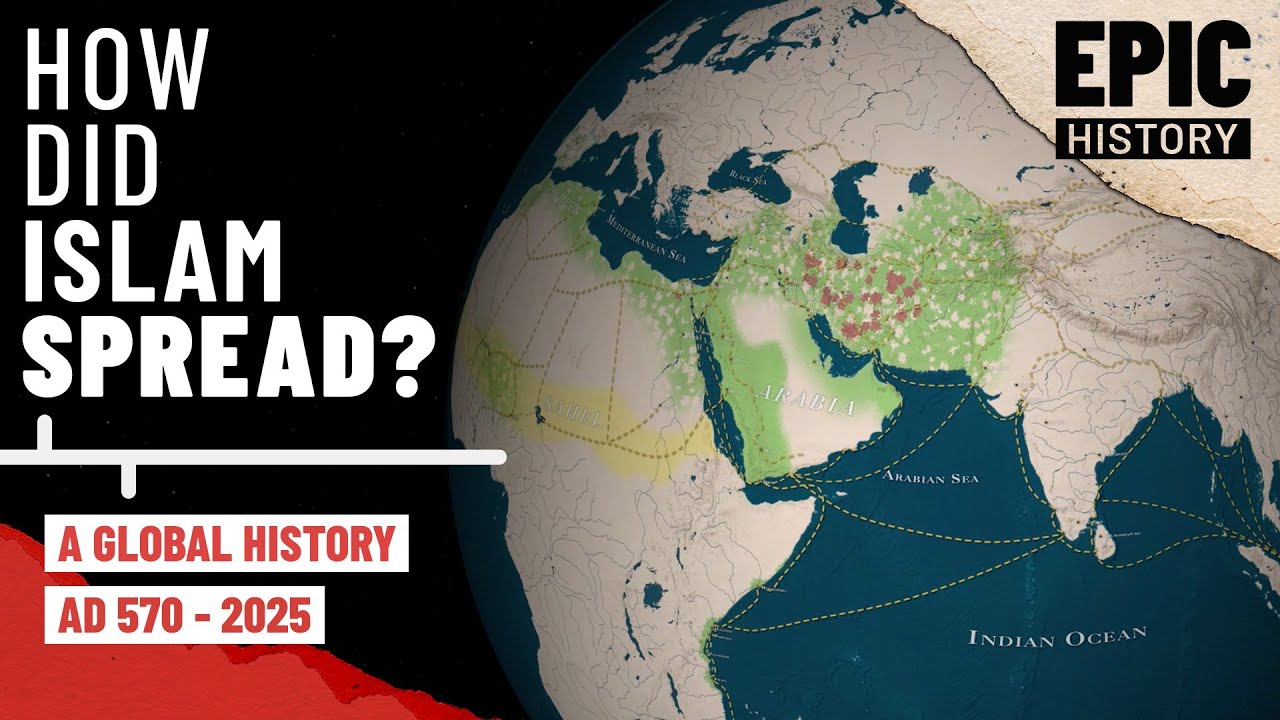 How Did Islam Become A Global Religion?


