
IslamiCity
Listen PodCasts, Live Quran, Watch Videos @VideoHub

Sudan's ruinous civil war is approaching its third year, leaving a legacy of malnutrition, massive population displacement and chronic insecurity.
As the UN system prepares to launch a call for record funding of $4.2 billion to support aid operations in the country, here are some of the main things to know about what has been described as the largest and most devasting displacement, humanitarian and protection crisis in the world today.
"A final political agreement should pave the way towards building a democratic State", saidformer UN Special Representative for Sudan, Volker Perthes, in December 2022. Ominously, however, he warned that "critical contentious issues" remained, not least a merger of the Sudanese Armed Forces (SAF) and the Rapid Support Forces (RSF), separate military groups which had teamed up to depose al-Bashir.
Tensions between the two sides grew in early 2023, marked by intermittent clashes, but the start of the current civil war came with the RSF attack on the capital Khartoum on 15 April. The fighting, which then spread to other parts of the country, forced the UN to evacuate Khartoum, and base operations in the relatively stable city of Port Sudan, on the Red Sea.
On Friday, the Secretary-General, described the situation in Sudan as a catastrophe of "staggering scale and brutality" at the AU's high stakes annual meeting in Addis Ababa, the capital of Ethiopia, and warned that it is increasingly spilling into the wider region. The UN has strongly condemned the fighting, and the Secretary-General's Personal Envoy to Sudan, Ramtane Lamamra, continues to support peace efforts, in close collaboration with regional organizations, including the African Union (AU).
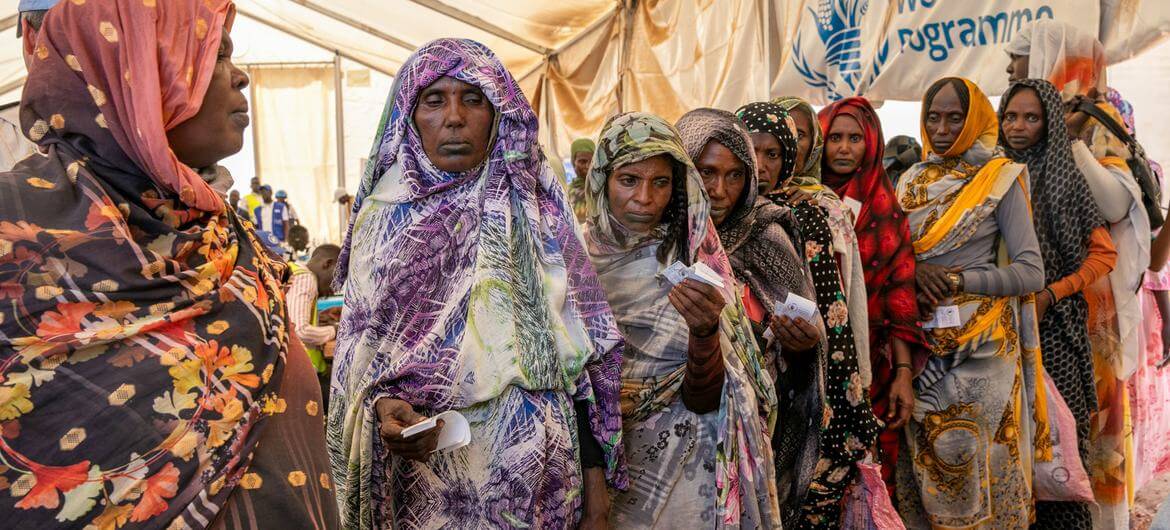
Acute hunger is a growing problem. Over half the population faces high levels of acute food insecurity, and famine conditions have been confirmed in five locations in North Darfur and the eastern Nuba mountains. Famine is expected to spread to five more areas by May of this year.
"This is a critical moment, as the consequences of food insecurity are already being felt in parts of South Kordofan, where families are surviving on dangerously limited food supplies, and malnutrition rates are rising sharply," warned Clementine Nkweta-Salami, the UN Humanitarian Coordinator in Sudan.
Humanitarian efforts are severely hampered by the lack of security, which is putting severe constraints on humanitarian access, complicating the movement of supplies and endangering aid workers.
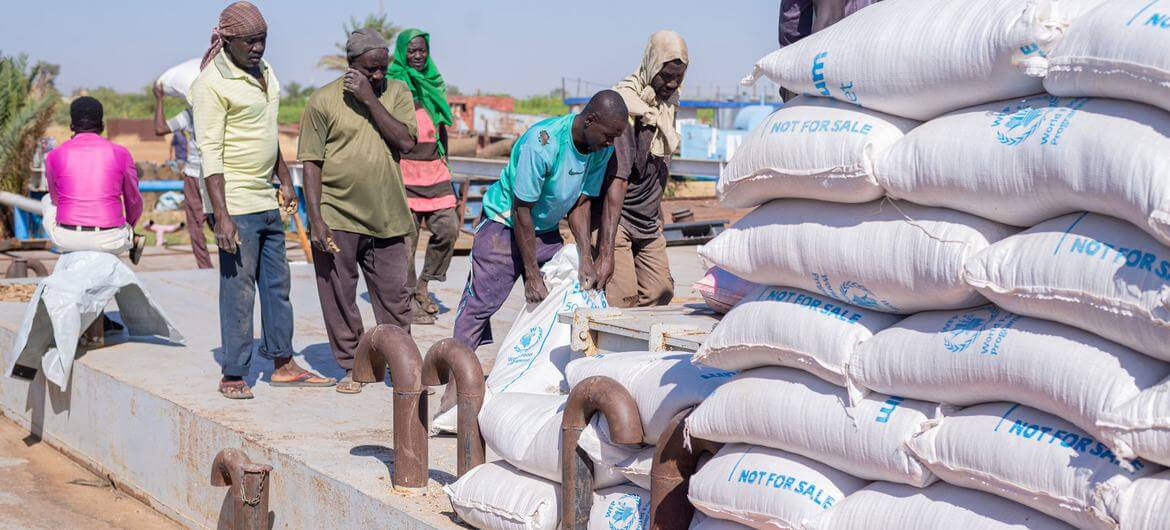
Despite the dangers, the UN and its humanitarian partners continue to reach vulnerable populations. The World Food Programme - the UN's emergency food aid agency - is saving thousands of lives every day and the Food and Agriculture Organisation (FAO) successfully distributed seeds to over half a million households during the planting season. In all, some 15.6 million people received at least one form of aid from the UN in 2024.
The country's health system is on its knees, with health facilities attacked and many health workers forced to flee. The World Health Organization and UN Children's Fund (UNICEF) are still operational, supporting immunization for cholera and malaria, and deploying mobile medical teams.
Because of the shifting frontlines, there have been successive waves of displacement, making the task of reaching those in need increasingly complicated. The UN refugee agency, UNHCR, has described the situation in Sudan as "the largest as well as the fastest growing displacement crisis globally."
The displaced population, whether they remain in Sudan or have moved abroad, face reduced access to food, scarce natural resources and limited access to essential services. In addition, outbreaks of diseases such as cholera and measles are rampant in camps for refugees and internally displaced people.
Many of the surrounding nations have their own economic and security problems, and some are among the poorest in the world, with limited and overstretched services. Where possible, the UN migration agency (IOM) and UNHCR are protecting lives, supporting states hosting refugees, and ensuring that the needs of those fleeing are met with dignity.
Civilians are being hit by artillery shelling, airstrikes and aerial drone attacks: the worst affected regions are South Kordofan and Blue Nile states. As well as the general population, aid workers have been targets of intimidation and violence, with reports that some have been falsely accused of collaborating with the RSF.
A UN fact-finding mission has documented a range of harrowing human rights violations committed by both the SAF and RSF, and called for investigations into the violations, and for the perpetrators to be brought to justice.
In an interview with UN News, Edmore Tondhlana, the deputy head of the UN humanitarian office (OCHA), explained that women and girls are the most severely impacted by the conflict, with reports of rape, forced marriage and abductions. "If you look at the recent attack in South Kordofan, in which about 79 people were killed, the majority of victims were women and girls."
However, teenage boys are also at high risk. "They cannot easily travel between frontlines. They will be suspected of spying," added Mr. Tondhlana. Large numbers of children have been recruited into armed groups, forced to fight or spy against the other side.
On Monday, OCHA and UNHCR will launch an appeal for funding, based on their respective response plans to the crisis. Humanitarian needs have been estimated at a record (for Sudan) $4.2 billion, with an additional $1.8 billion needed to support those hosting refugees in neighbouring countries.
Whilst the amount needed might seem large, Mr. Tondhlana emphasizes that, given the numbers in dire need, it barely scratches the surface. "We're trying to reach 21 million people, so this essentially $200 per person over the whole year. If we break it down even further, this is around $.0.50 per day.
The article was originally published at UN News. It can be accessed here.


 Sudan’s Army Chief Rejects US-Led Ceasefire Proposal, Calling it “Worst...