
IslamiCity
Listen PodCasts, Live Quran, Watch Videos @VideoHub

Part 1 - Mexican Women Converting to Islam in a Christian-Majority Society
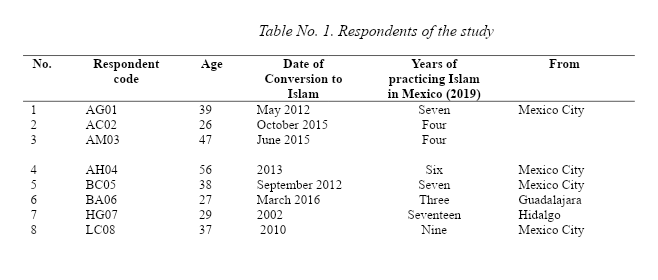
She embraced Islam in October 2013, changed all her lifestyle from Christian beliefs and secular practices to Islam. Bachelor on Communication, Master in Education and second Master on Human Science graduated from the International Islamic University of Malaysia (IIUM) in 2020. Currently, she is an independent researcher.The sample population in this study resulted in 14 respondents (see Table No. 1). The research criteria to participate were: "to be Mexican, a convert, and a practicing Muslim for more than three years, and living in Mexico during the period when the study was conducted."
A disclaimer needs to be made: conversion to Islam is different from practicing the religion. Conversion to Islam involves announcing the testimony of the Islamic faith, what Muslims call the *shahada*, while practicing the religion involves following the religion and making some lifestyle changes according to the requirements of Islam.
For practical purposes in this study, "practicing Muslim" is understood as a person who has announced the Islamic testimony of faith, performs prayers, and fasts during the month of Ramadan. However, this is a practical definition that needs to be discussed and defined in future research papers.
The narrative interview was the most suitable research instrument for this study because it allows for engaging the respondents using narrative and storytelling as sense-making tools (Riessman, 2008). The interview was divided into four parts:
After the respondents submitted their answers, the raw data were gathered in the ATLAS.ti software for analysis. After reading and listening to the interviews several times to familiarize themselves with the raw data, precoding, coding, and subcoding were conducted as a starting point for the three main concepts of the Sense-Making Theory (Dervin, 1983) and ISB:


 Understanding of Islam by the Contemporary Western Intellectuals and organi...